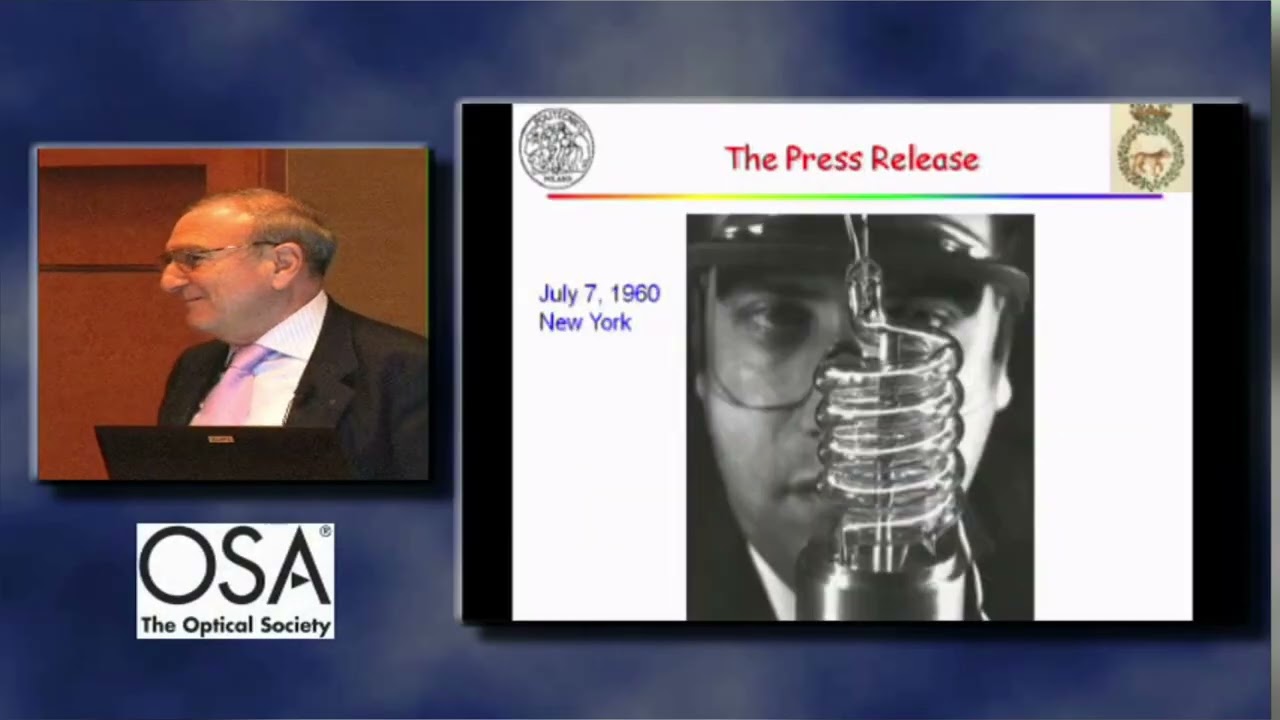
Lecture by Orazio Svelto Honoring the 50th Anniversary of the Laser at ASSP 2010 in San Diego, CA, U
Title history
- Lecture by Orazio Svelto Honoring the 50th Anniversary of the Laser at ASSP 2010 in San Diego, CA, U — observed on 20261025-1506 UTC (YouTube)
Keywords
Summary
149 words
Critical Evaluation
Value of the Information & Strength of the Argument
The talk’s value lies in its historical perspective from a key contributor. Svelto provides concrete examples of early errors and successes, such as the misidentified photo in Hughes’ press release leading to inefficient flash lamps, and the accidental discovery of stimulated Raman scattering in Q-switching experiments. His argumentation is supported by his own work (e.g., his 1962 paper on lamp coupling efficiency) and by well-known publications. He effectively illustrates how scientific progress is nonlinear, with deadends and false starts, leading to eventual breakthroughs. The narrative arc from early confusion to a turning point in 1970 is convincing, based on documented developments. While the talk is not a systematic review, its strength lies in authentic anecdotal evidence and the speaker’s authority.
Scientific Rigor, Source Quality, Title Accuracy
The scientific rigor is high: Svelto cites specific papers, dates, and researchers (e.g., Franken, Giordmaine, Hellwarth, Mocker, DeMaria, Sorokin, Schawlow). He also references his own textbook, ‘Principles of Lasers’, and its editions. The title accurately reflects the content, which is a historical lecture. No commercial or non-scientific sources are referenced. The oral account aligns with established history, and the speaker’s personal involvement adds credibility. The video’s low viewership does not affect the intrinsic quality. Overall, the content is reliable and well-grounded.
216 words
Title / Content Match
The title accurately describes the content: a lecture honoring the 50th anniversary of the laser, with a focus on early developments.
Quality & Reliability
9/10
Orazio Svelto, a pioneer of laser physics, provides a first-hand historical account loaded with accurate technical details and personal anecdotes, making this a highly reliable source.
Key Moments
Markers derived by PSI from the transcript: the creator did not define chapters.
- Jim Kafka introduces Orazio Svelto, highlighting his contributions and the upcoming talk.
- Svelto discusses Maiman's ruby laser and the immediate replication efforts, including Sorokin's second and third lasers.
- Q-switching invention by Hellwarth and McClung, and the accidental discovery of stimulated Raman scattering.
- Mode-locking discovery, initially considered a nuisance for optical communications, leading to ultrashort pulses.
- Dye lasers and their role as tunable lasers, including anecdotes about their colorful nature and Peter Sorokin's intervention.
- Frustrating early applications in medicine and optical communications fail due to wrong wavelengths and high fiber losses.
- The 'magic turning point' around 1970: argon lasers, pulsed dye lasers, double-heterostructure lasers, and low-loss fibers.
- Conclusion: the laser becomes a bright solution for many problems, and the century of the photon.
Cited Sources
- Principles of Lasers (book) — Authored by Orazio Svelto, important reference and frequently mentioned.
- Applied Optics, Vol. 1, No. 1 (1962) — Svelto's first paper on pump coupling efficiency.
- Franken et al., Physical Review Letters (1961) — First demonstration of second harmonic generation.
- Giordmaine, Maker & Terhune (1962) — Phase-matching techniques for SHG.
- Hellwarth and McClung (1962) — First Q-switched laser.
- Hargrove et al., Bell Labs (1964) — Mode-locking in helium-neon laser for pulse code modulation.
- Mocker & Collins, DeMaria (1966) — Passive mode-locking with saturable absorbers, beginning of ultrashort pulses.
- Sorokin and Schafer (1966) — Independent discovery of dye lasers.
- Moulton (1982) — Introduction of titanium-sapphire laser.
Concurring Sources
- History of the Laser — Corroborates the general timeline and key figures mentioned by Svelto.
Contribution & Novelties
This talk provides a rare personal account of laser history, including humorous and insightful anecdotes not typically found in textbooks. Svelto’s insider views on early failures and accidental discoveries (e.g., the incorrect press release photo leading to inefficient lamp designs, the accidental discovery of stimulated Raman scattering, and the initial dismissal of mode-locking as a nuisance) offer a unique historical depth. His analysis of the ‘magic turning point’ in 1970 synthesizes how multiple technologies converged to make the laser practical. The talk also traces the evolution of ultrafast science, from early mode-locking to femtosecond pulses, linking his own contributions.
Pour aller plus loin :
- Laser — Wikipedia overview of laser physics and history.
- Mode-locking — Details on techniques for generating ultrashort pulses.
- Nonlinear optics — Covers second harmonic generation and phase matching.
- Dye laser — Historical and technical aspects of tunable dye lasers.
- Q-switching — Explanation of the Q-switching technique and its role in high-peak-power pulses.
156 words
Radar Profile
The radar profile shows very high scores in quality and reliability, with moderate technical depth and information quantity, reflecting a dense but limited-scope historical lecture. The high reliability and quality are due to the speaker's authority and accurate historical references.