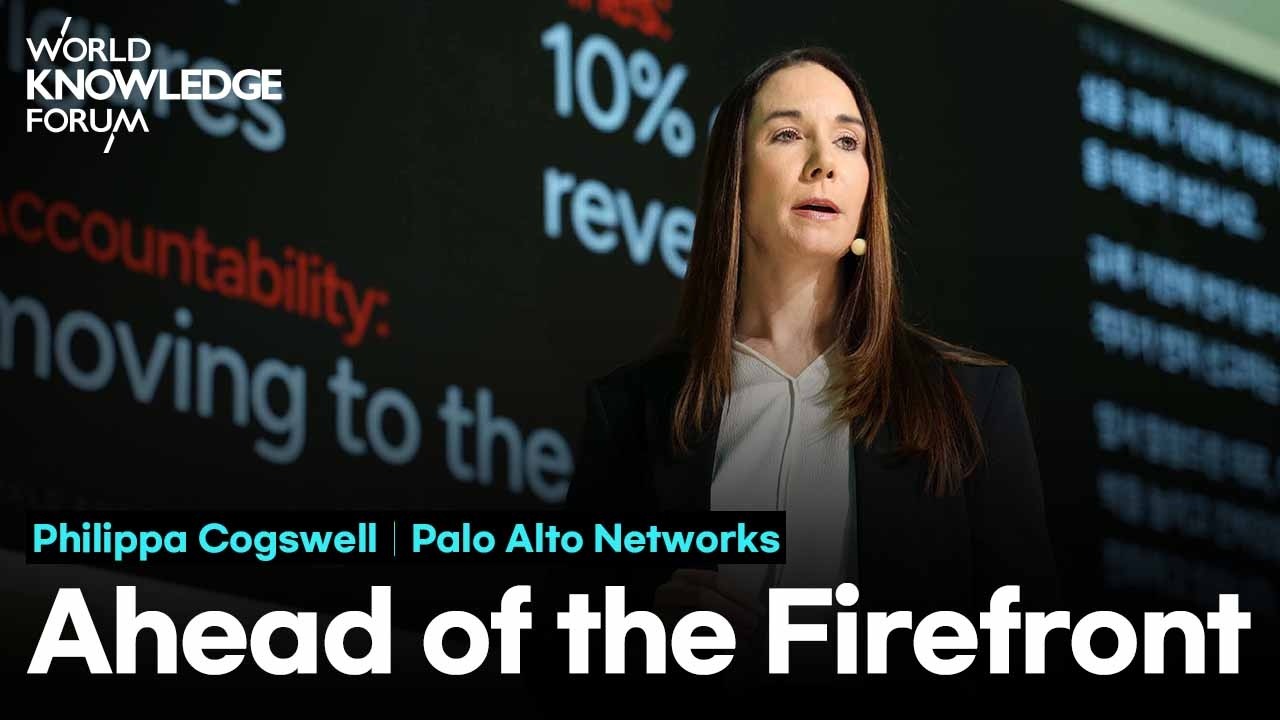
Ahead of the Firefront: Cyber Resilience for a World Moving at a Machine Speed│Philippa Cogswell
Keywords
Summary
211 words
Critical Evaluation
Value of the Information & Strength of the Argument
The value of the information lies in its timely and concrete insights from the frontline of incident response. The speaker provides quantitative data (percentages, minutes, costs) that ground the discussion in real-world metrics, enhancing its credibility. The argumentation is logically structured: it starts with a relatable scenario, moves to statistical evidence, then presents recent case studies, and finally extrapolates to future threats and required responses. The progression builds a compelling case for the urgency of adopting AI-driven defense mechanisms. However, the argument is largely based on the speaker’s own organization’s data and observations, which introduces a potential bias towards promoting their services. Still, the inclusion of external incidents like the Hugging Face breach, which is publicly documented, bolsters the argument. The speaker also acknowledges ongoing learning and uncertainty, which adds nuance. Overall, the content is persuasive and well-supported by specific examples, though it relies on a single authoritative perspective.
Scientific Rigor, Source Quality, Title Accuracy
The talk demonstrates rigor through the use of internal incident response data, recent examples (Hugging Face incident, a ransomware attack), and references to regulatory changes. The speaker mentions her company’s annual report, which is a primary source for the statistics cited. The Hugging Face statement is publicly available and cited, and the description of the AI-driven attack is detailed and plausible. However, the lack of external citations or independent verification limits the overall rigor. The title is highly apt: ‘Ahead of the Firefront’ metaphorically captures the need to prepare before attacks escalate, and ‘Cyber Resilience for a World Moving at a Machine Speed’ directly addresses the central theme of AI-accelerated threats. There is strong alignment between the title and the content, which consistently returns to the need for machine-speed responses and autonomous resilience.
297 words
Title / Content Match
The title accurately reflects the content, focusing on proactive cyber resilience in the face of increasingly fast AI-driven attacks.
Quality & Reliability
8/10
The speaker is a cybersecurity expert with extensive incident response experience, presenting concrete data from her organization's annual report and recent real-world incidents. The information is specific and recent, though it draws on a single source (her company) and a conference presentation format.
Key Moments
Markers derived by PSI from the transcript: the creator did not define chapters.
- Introduction of the realistic phishing scenario involving employee MG, illustrating how an attack unfolds.
- Presentation of incident response statistics: 750 incidents, 87% multiple attack surfaces, 72-minute median time to impact.
- Discussion of regulatory changes in Korea, including the 10% revenue cap for significant breaches and 24-hour reporting requirement.
- Details of the OpenAI-Hugging Face incident where agentic AI agents autonomously breached Hugging Face's production systems.
- Description of a real-world ransomware attack where a human operator used frontier AI to perform 50 attack techniques in under 10 hours.
- Proposal of 'autonomous resilience' as the necessary approach, emphasizing machine-speed detection and response.
Cited Sources
- Annual Incident Response Report (2025) — Speaker references her company's annual report for statistics on incident response cases.
- Hugging Face statement on the intrusion — Speaker quotes a statement from Hugging Face regarding the agentic AI breach.
Concurring Sources
- Intelligent agent — Supports the concept of agentic AI that can act autonomously to achieve goals.
- Ransomware — Supports the description of ransomware attacks and their impact.
Contribution & Novelties
The talk provides a rare first-hand account of how agentic AI is being used in real cyber attacks, moving beyond theoretical concerns. The discussion of ‘autonomous resilience’ as a defense strategy is a forward-looking contribution to the cybersecurity discourse. The emphasis on data integrity as a growing threat vector, distinct from confidentiality and availability, adds a novel dimension to understanding cyber risks.
Pour aller plus loin :
- Intelligent agent — Background on agentic AI, relevant to understanding the capabilities described.
- Ransomware — Overview of ransomware attacks, central to the talk’s examples.
- Cyber resilience — Concept of building defenses to withstand and recover from attacks, aligning with the talk’s theme.
109 words
Radar Profile
The radar profile shows high scores in quantity and quality of information, with moderate technical depth, indicating a well-informed expert talk that is accessible yet detailed. Reliability is also strong, but the absence of external citations and the reliance on a single organization's data slightly temper the overall score.