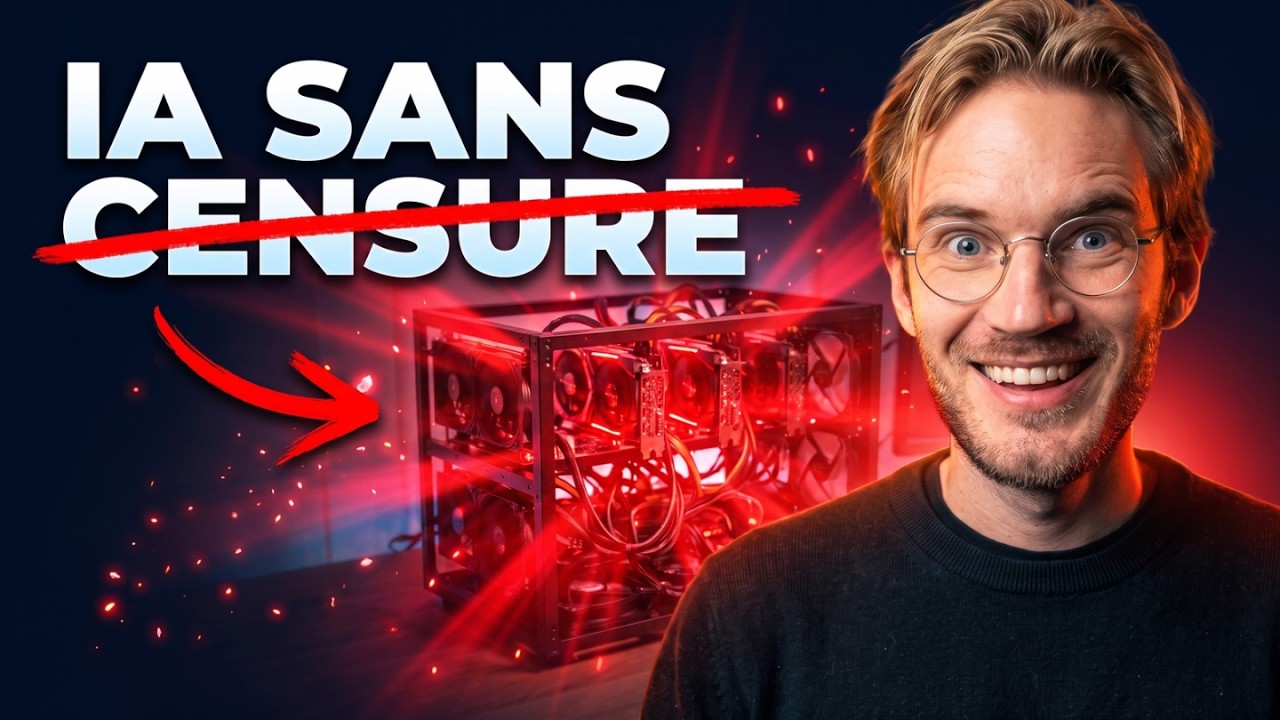
🤯 PewDiePie a fabriqué sa propre IA… et OpenAI l'a BANNI
🤯 PewDiePie built his own AI… and OpenAI BANNED him
Title history
- 🤯 PewDiePie a fabriqué sa propre IA… et OpenAI l'a BANNI — observed on 20261111-2052 UTC (YouTube)
Keywords
Summary
129 words
Critical Evaluation
Value of the Information & Strength of the Argument
The video provides valuable context on AI distillation and the accessibility of AI technology. It effectively argues that AI development is no longer restricted to large corporations, using PewDiePie’s example to illustrate how an enthusiast can train models at home. The argumentation is generally coherent: it presents the legal and ethical conflicts, weighs PewDiePie’s right to use AI outputs against OpenAI’s terms of service, and discusses the implications for data ownership. However, the narrative leans sympathetic to PewDiePie, framing OpenAI’s actions as an overreach, without deeply exploring counterarguments beyond mentioning the terms of use. The inclusion of specific dates, emails, and technical details strengthens the argument’s credibility.
Scientific Rigor, Source Quality, Title Accuracy
The video demonstrates solid rigor by citing a variety of sources, including PewDiePie’s videos, official communications from OpenAI, media outlets like Decrypt and the Financial Times, academic papers on distillation, and the arXiv preprint for recovering hidden reasoning. It distinguishes between verified facts and PewDiePie’s own claims, such as the second ban which is not evidenced by tangible proof. The title is well-aligned with the content, accurately summarizing the central conflict, though it slightly overstates the drama with the emojis. The overall sourcing is reliable, and the narrative does not invent information, instead guiding viewers to original sources when possible.
222 words
Title / Content Match
The title accurately highlights the core story: PewDiePie building an AI and facing a ban from OpenAI. It is engaging and covers the main narrative.
Quality & Reliability
8/10
The video relies on numerous cited sources, including official communications, media reports, and academic papers. It clearly distinguishes facts from speculation and presents both sides of the debate, though it leans toward PewDiePie's perspective.
Chapters
- Le mail d'OpenAI
- PewDiePie, du premier PC au supercalculateur Odysseus
- Comment on fabrique une IA (et le raccourci)
- La distillation expliquée simplement (DeepSeek, Anthropic)
- GPT 5.6 Sol, le mail, l'appel et les excuses d'OpenAI
- Ajax : une IA sans censure, sur votre ordinateur
- Attention aux faux téléchargements
- Faire tourner une IA gratuite chez soi (Qwen, Odysseus)
Cited Sources
- PewDiePie videos (dates: 21/08/2025, 31/10/2025, 27/02/2026, 31/05/2026, 01/10/2026) — PewDiePie's own videos documenting his AI projects, including the build of Odysseus and training his models.
- data.pewdiepie.com and Wayback Machine archives (01-02/10/2026) — Official website and archived pages showing the Ajax release countdown and subsequent delay notice.
- Decrypt — Report on the incident on 03/10/2026, likely covering the ban and Ajax release.
- Interesting Engineering — Article on the same date, possibly discussing the technical aspects.
- Unilad — News outlet coverting the story on 03/10/2026.
- Anthropic (statement on distillation) — Anthropic's accusation of large-scale distillation by three companies, mentioned on 23/02/2026.
- Financial Times (OpenAI and DeepSeek distillation) — Report on OpenAI's suspicions that DeepSeek used its models for distillation, dated 29/01/2025.
- Hinton, Vinyals, Dean, arXiv (2015) 'Distilling the Knowledge in a Neural Network' — Seminal paper that introduced knowledge distillation, cited as the origin of the technique.
- arXiv 2608.09867 (10/08/2026) — Study explaining how to recover hidden reasoning from AI models, referenced by PewDiePie.
- OpenAI Terms of Use — The rules prohibiting use of outputs to create competing models, cited as the basis for the ban.
- Hugging Face, Qwen3.5-9B — Open-source model from Alibaba used as the base for Ajax, available for download.
Concurring Sources
- Financial Times (29/01/2025) — Supports the claim that OpenAI had suspicions about DeepSeek using distillation, reinforcing that this practice is a major concern.
- Anthropic (23/02/2026) — Corroborates the scale of distillation incidents, aligning with the video's portrayal of the issue.
Dissenting Sources
- OpenAI Terms of Use — Contradicts PewDiePie's justification by showing that users explicitly agree not to use outputs to build competing models, making the ban arguably justified.
Contribution & Novelties
The video offers a unique narrative that ties together a celebrity’s technical journey with the broader implications of AI democratization. It adds value by explaining complex concepts like distillation and local AI in accessible terms, and by highlighting the risks of fake downloads. The main novelty is the full story of PewDiePie’s ban, including the apology and alleged second ban, which is rarely fully reported. Overall, it contributes to public understanding of AI ownership and the tensions between corporate control and user-driven innovation.
Pour aller plus loin :
- Knowledge distillation — Broad overview of the technique and its applications.
- AI alignment — Discussion of how to ensure AI behaves as intended, relevant to the uncensored nature of Ajax.
- Open-source artificial intelligence — Context on the movement behind freely available models like Qwen.
132 words
Radar Profile
The radar shows a balanced profile with high scores in quantity of information and global reliability, while technical level is slightly lower. This suggests the video is informative and trustworthy but accessible to a general audience.