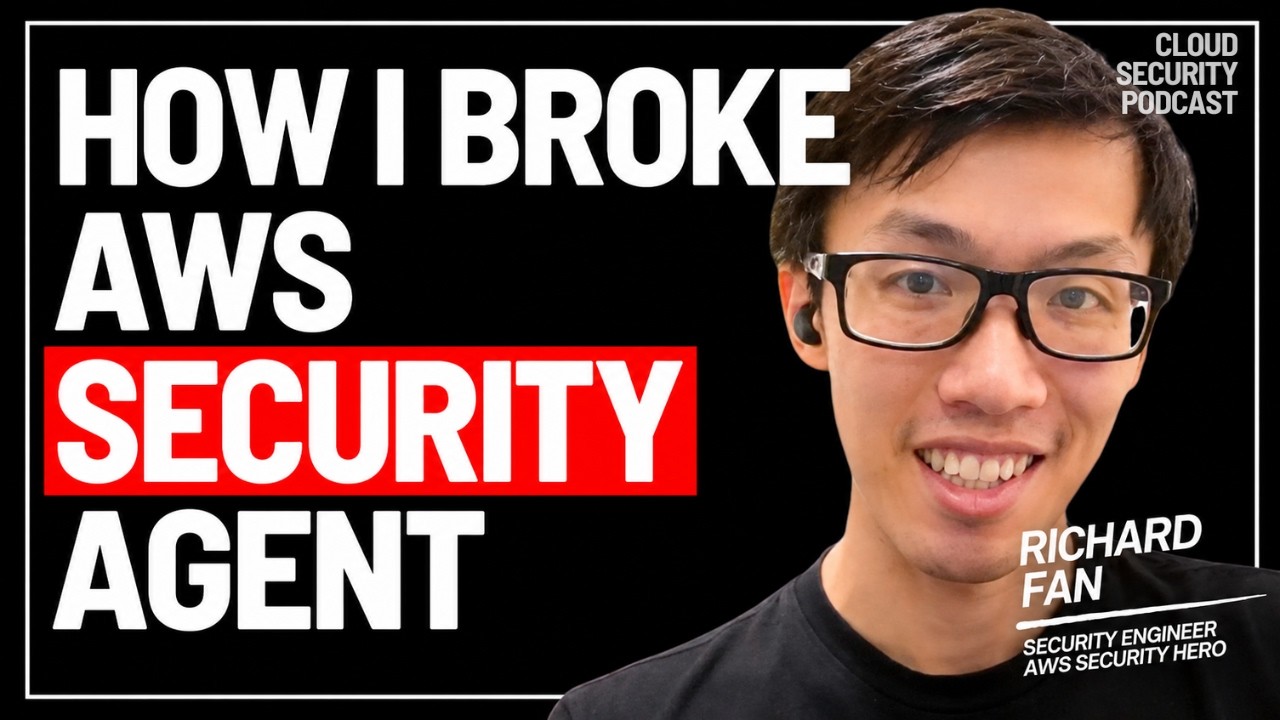
Pentesting AWS Security Agent | Richard Fan, AWS Security Hero
Title history
- Pentesting AWS Security Agent | Richard Fan, AWS Security Hero — observed on 20261106-0253 UTC (YouTube)
Keywords
Summary
191 words
Critical Evaluation
Value of the Information & Strength of the Argument
The value of the information is high for security professionals interested in AI agents, particularly the practical demonstrations of bypass techniques. Richard provides concrete examples from his research, explaining step-by-step how he circumvented domain verification, exploited redirects, and outsmarted prefix-matching allowlists. His argumentation is logically structured, contrasting human pentester intuition with AI context-switching flaws. He also highlights cost implications and the danger of overly permissive guardrails. The main limitation is that the findings are based on a single researcher’s experience, and the techniques may not generalize to all configurations. However, his explanations are clear and demonstrate a deep understanding of both AWS services and AI behavior.
Scientific Rigor, Source Quality, Title Accuracy
The discussion maintains a rigorous technical level, with Richard citing his own research and talks at security conferences. He references specific AWS features like Route 53 private hosted zones and the general architecture of the agent. The title accurately describes the content. The show notes mention links to resources, but the video itself does not cite external scientific sources. The account is anecdotal and not backed by formal security advisories or peer-reviewed publications, though it appears credible given the speaker’s expertise. The conversation is well-structured and addresses the claims without unsupported generalizations.
213 words
Title / Content Match
The title accurately reflects the content: a deep dive into security testing of the AWS Security Agent, with Richard Fan's specific findings highlighted. It is clear and descriptive.
Quality & Reliability
7/10
The conversation presents original security research findings by an AWS Security Hero on a managed service. The methods are described in detail but not independently verified in the video. Claims are plausible and align with known AI security challenges. The speaker demonstrates technical depth, but the discussion relies on personal experience rather than peer-reviewed evidence.
Chapters
- Introduction to AI Autonomous Pen Testing
- Richard Fan’s Background as an AWS Security Hero
- What is AWS Continuum (formerly AWS Security Agent)?
- Research Goal: Testing the Guardrails of an AI Pen Tester
- Bypassing Domain Verification using Internal VPC DNS
- The Flaw of AI Context Switching vs. Human Intuition
- Using HTTP Redirects to Force the Agent Out of Scope
- The Danger of Prefix-Matching URL Allowlists
- Redefining the Cloud Shared Responsibility Model for AI Agents
- Why You Should Never Run Autonomous Agents in Production
- The High Costs of Running AWS Continuum ($50/hour)
- How the AI Agent Wrote Custom Scripts to Bypass Tool Restrictions
Cited Sources
- Cloud Security Podcast Website — Official podcast site with episodes, show notes, and resources.
- Cloud Security Bootcamp — Training program mentioned as a resource for cloud security education.
- Cloud Security Newsletter — Newsletter for cloud security updates, associated with the podcast.
- Cloud Security Podcast LinkedIn — LinkedIn page for the podcast and community.
Concurring Sources
- AWS Security Agent - AWS official documentation — Official product page providing information on the agent's features and capabilities.
Dissenting Sources
- AWS Continuum - AWS announcement blog — Official AWS communications often highlight the security and reliability of their services, which may contrast with the vulnerability findings presented in this video.
Contribution & Novelties
The video provides original insights into the practical security flaws of a commercial AI agent for pentesting, specifically the AWS Security Agent. It demonstrates how simple techniques like DNS spoofing and HTTP redirects can bypass guardrails, highlighting the need for stronger verification and more robust allowlisting mechanisms. The discussion on shared responsibility in the context of AI agents is a novel contribution, as it questions the boundaries of accountability when AI makes unexpected decisions.
Pour aller plus loin :
- AI Red Teaming — Relevant to the concept of attacking AI systems to find vulnerabilities.
- Prompt Injection — A technique that could be used to manipulate AI agents, related to the discussed vulnerabilities.
- MITRE ATLAS — A framework for adversarial attacks on AI systems, providing context for the security challenges discussed.
- NIST AI Risk Management Framework — A framework relevant to the shared responsibility and guardrail considerations mentioned in the video.
150 words
Radar Profile
The radar profile shows relatively high scores in technical depth and information quality, with moderate scores in quantity and reliability. The discussion is detailed and expert-oriented, but the reliability is tempered by the anecdotal nature of the research and the lack of independent verification. Overall, the profile suggests a content piece that is informative for cybersecurity professionals but not a definitive reference.