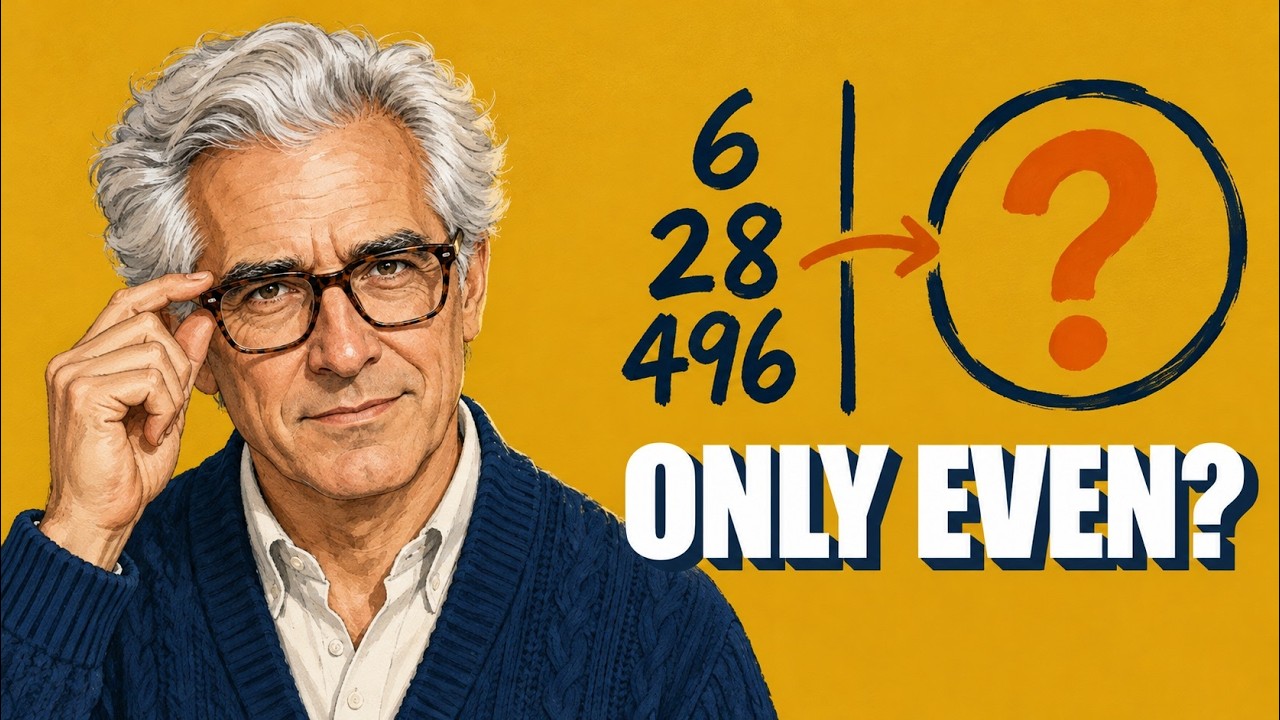
Why Every Perfect Number We Know Is Even
Title history
- Why Every Perfect Number We Know Is Even — observed on 20261031-2309 UTC (YouTube)
Keywords
Summary
207 words
Critical Evaluation
Value of the Information & Strength of the Argument
The video provides substantial value by demystifying a classical number theory problem using an intuitive scoring metaphor. The argumentation is sound: it starts with definitions, builds intuition with examples, presents Euclid’s construction, then Euler’s proof, and contrasts the even case with the odd case. The explanation of why powers of two are always deficient by exactly one and how Mersenne primes fill the gap is rigorous yet accessible. The use of historical context (Descartes’s spoof, Sylvester’s doubts) and modern computational bounds strengthens the narrative. The logical flow is coherent, and each step follows naturally from the previous, making the content both educational and intellectually satisfying.
Scientific Rigor, Source Quality, Title Accuracy
The scientific rigor is high: the video correctly states the Euclid-Euler theorem, accurately describes the necessity of Mersenne primes for even perfect numbers, and appropriately contrasts it with the unresolved odd case. Historical references are accurate (Euclid, Nicomachus, Augustine, Descartes, Sylvester), and modern bounds (Ochem & Rao, Nielsen) are correctly cited. The video carefully distinguishes proven facts from open questions, avoiding overclaiming. The quality of sources is excellent, as it relies on well-established mathematical knowledge. The title is fully appropriate, as the video addresses precisely why all known perfect numbers are even, and it also clarifies the scope of the open problem. No comment data was provided, so public reception is not analyzed.
233 words
Title / Content Match
The title accurately reflects the content: it explains why all known perfect numbers are even and addresses the open question about odd ones.
Quality & Reliability
8/10
The video presents accurate mathematical facts, correctly describes the Euclid-Euler theorem and the odd perfect number problem, mentions modern bounds with correct citations. It distinguishes clearly between proven results and open conjectures.
Chapters
- Perfect numbers 6 and 28, and why all 52 known are even
- Divisors, perfect numbers and the open question about odd ones
- Scoring numbers: deficient, abundant and the line at 2
- Euclid's recipe in the Elements and Nicomachus's broken patterns
- Powers of 2, the missing one and Mersenne primes
- Euler's proof and the Euclid Euler theorem
- Why odd numbers struggle to reach a score of 2
- Descartes's spoof perfect number and Sylvester's doubts
- Modern bounds on odd perfect numbers
- What the question really asks
Cited Sources
- Euclid's Elements, Book IX, Proposition 36 — Original recipe for generating perfect numbers from powers of two and primes.
- Euler's proof of the Euclid-Euler theorem — Published posthumously in 1849; shows every even perfect number is of the form 2^(p-1)(2^p - 1) with 2^p - 1 prime.
- Descartes's letter to Marin Mersenne (1638) — Descartes proposed an odd 'spoof' perfect number that fails because 22021 is composite.
- Sylvester's work on odd perfect numbers (1888) — Proved necessary conditions such as at least five distinct prime factors and not divisible by 105.
- Ochem & Rao (2012) — Proved that an odd perfect number must be greater than 10^1500 and have at least 101 prime factors counting multiplicities.
- Nielsen (2015) — Proved that an odd perfect number must have at least ten distinct prime factors.
Concurring Sources
- Wikipedia – Perfect number — Confirms the definition and the even perfect number characterization.
- Wikipedia – Mersenne prime — Supports the role of Mersenne primes in generating even perfect numbers.
- Wikipedia – Euclid–Euler theorem — Provides the theorem and proof details.
Contribution & Novelties
The video offers a fresh visual explanation using a ‘score’ (σ(n)/n) to unify the concepts of perfect, deficient, and abundant numbers, making the proof of the Euclid-Euler theorem more intuitive. It also highlights the historical missteps and the modern computational bounds, giving a comprehensive overview of the odd perfect number problem. The ‘Pour aller plus loin’ section suggests further exploration.
Pour aller plus loin :
- Perfect number — Overview and history.
- Mersenne prime — Related primes and their properties.
- Euclid–Euler theorem — Formal statement and proof.
- Odd perfect number — Current status and known constraints.
95 words
Radar Profile
The radar profile indicates high quality and reliability with moderate quantity and technical depth. The video excels in clarity and factual accuracy, while the technical level is accessible to a general audience but still substantial. The balance supports its purpose as an educational overview.