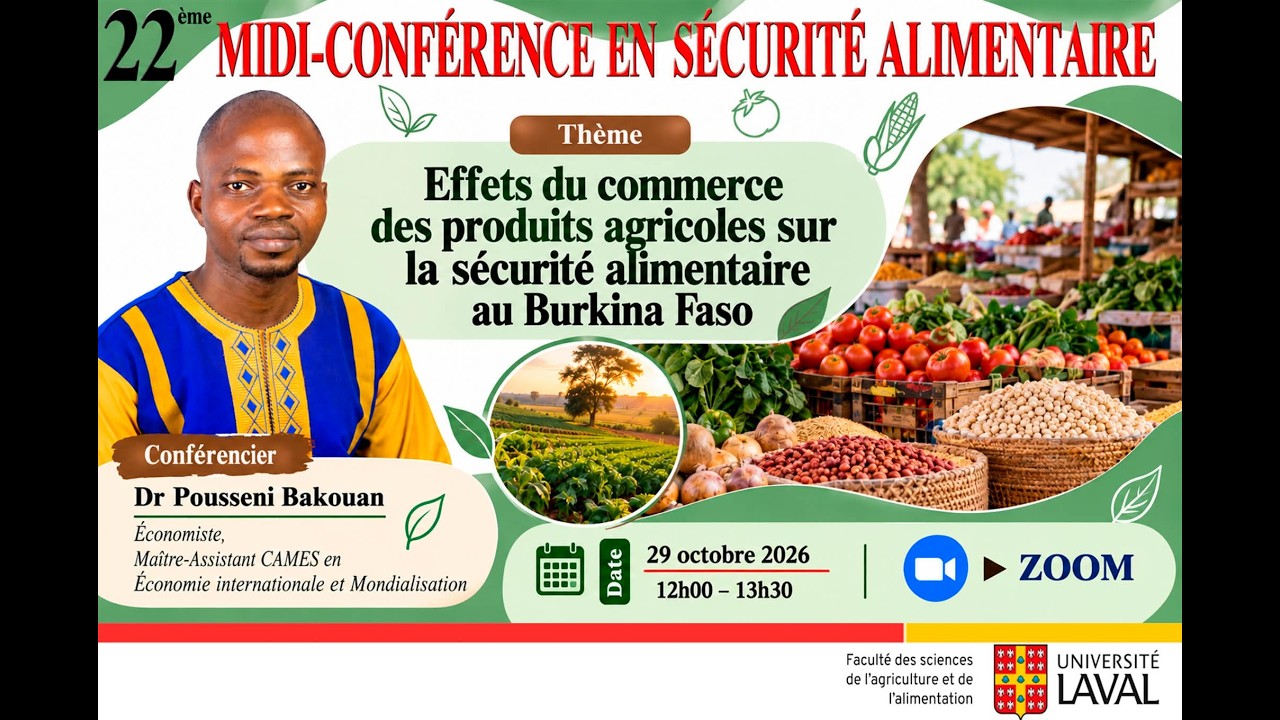
Agir pour la sécurité alimentaire | Midi-conférence Commerce des produits agricoles Burkina Faso
Acting for food security | Midday conference Agricultural products trade Burkina Faso
Title history
- Agir pour la sécurité alimentaire | Midi-conférence Commerce des produits agricoles Burkina Faso — observed on 20261105-2136 UTC (YouTube)
Keywords
Summary
129 words
Critical Evaluation
Value of the Information & Strength of the Argument
The information is highly valuable as it provides empirical evidence on the nuanced relationship between agricultural commercialization and food security at a disaggregated level. The argumentation is solid: the researcher justifies the topic with contextual facts (high food insecurity, low commercialization), builds a theoretical framework grounded on Sen’s entitlement theory, and employs robust econometric models (OLS, bootstrap, spatial autoregressive models). The results are presented with caveats and acknowledge the complexity of food security dimensions. The use of multiple indicators (consumption score, dietary diversity, meals per day, calorie availability) strengthens the analysis. However, the presentation is limited to the study’s own findings; no external validation or comparative discussion is provided during the main talk.
Scientific Rigor, Source Quality, Title Accuracy
The scientific rigor is high: the study uses official agricultural survey data and applies appropriate econometric techniques. The speaker cites theoretical references (e.g., Amartya Sen) and institutional sources (e.g., World Food Programme) but does not provide explicit URLs. The title accurately matches the content, which focuses on the effect of agricultural trade on food security in Burkina Faso. While the methodology is rigorous, the lack of peer-review status and limited external sourcing in the presentation are minor weaknesses.
206 words
Title / Content Match
The title accurately reflects the content: a conference on food security focusing on agricultural trade in Burkina Faso. The additional subtitle specifies the format and geographic scope.
Quality & Reliability
7/10
The presentation is based on rigorous empirical research using provincial panel data over 13 years, with clear methodology and spatial econometric techniques. The speaker is an academic expert, though the work is not yet peer-reviewed.
Key Moments
Markers derived by PSI from the transcript: the creator did not define chapters.
- Introduction of speaker and research topic: effects of agricultural trade on food security in Burkina Faso.
- Motivation: 2.5 million people in acute food insecurity, low cereal commercialization (10.8%).
- Theoretical framework: review of literature on trade and food security, Sen's entitlement approach.
- Data and methodology: provincial panel (2012–2024), variables, and spatial econometric design.
- Descriptive statistics: average commercialization 10.8%, consumption score 73.7%, diversity 23%, meals 2.6/day.
- Main results: commercialization improves consumption score and diversity, but reduces number of meals.
- Spatial analysis reveals spillover effects and policy implications for region-specific strategies.
Cited Sources
- Programme Alimentaire Mondial (PAM) — Cité pour les statistiques d'insécurité alimentaire aiguë au Burkina Faso.
- Amartya Sen (1981) — Référence théorique sur la définition de la sécurité alimentaire basée sur les capacités.
- Enquête Permanente Agricole du Burkina Faso — Source des données utilisées pour l'étude (2012–2024).
Contribution & Novelties
The study’s original contribution lies in its provincial-level analysis of cereal commercialization in Burkina Faso, using panel data across 45 provinces and 13 years. It goes beyond macro-level studies by examining multiple food security dimensions (consumption score, dietary diversity, number of meals) and by incorporating spatial econometrics to capture spillover effects. The finding that commercialization improves certain food security indicators but reduces others highlights the trade-offs and underscores the need for targeted policies.
Pour aller plus loin :
- African Continental Free Trade Area (AfCFTA) — Directly relevant to the context of regional trade integration discussed at the beginning of the talk.
- Food security — Provides a comprehensive definition and dimensions of food security, aligning with the study’s indicators.
- Spatial econometrics — Explains the methodological approach used to test spillover effects between provinces.
132 words
Radar Profile
The radar profile shows strong scores in information quantity and quality, reflecting a comprehensive and well-structured presentation. Technical level is moderately high, suitable for an academic audience. Overall reliability is solid, though the lack of peer-review and limited external sources slightly lowers the fiability score.