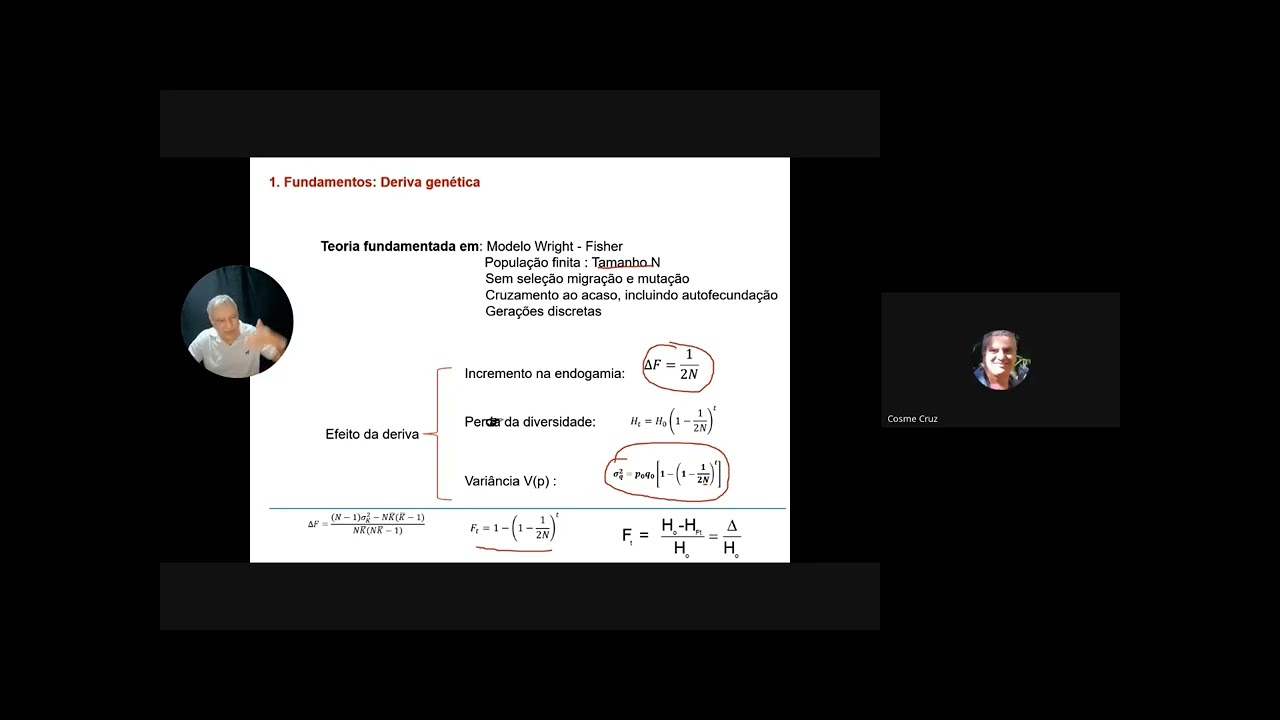
MGV3702 - Genética de Populações: Aula11
MGV3702 - Population Genetics: Class 11
Title history
- MGV3702 - Genética de Populações: Aula11 — observed on 20261106-1237 UTC (YouTube)
Keywords
Summary
177 words
Critical Evaluation
Value of the Information & Strength of the Argument
The lecture provides a solid conceptual foundation for understanding effective population size, clearly explaining its importance in population genetics and conservation. The argumentation is well-structured, starting from the ideal population model and then showing how real populations deviate, leading to the need for Ne. The use of Buri’s experiment is effective in empirically illustrating the concept. The instructor emphasizes the practical implications for breeding programs and conservation. The reasoning is deductive, with frequent recalls of previous lessons to anchor new concepts.
Scientific Rigor, Source Quality, Title Accuracy
The lecture references classic studies (Buri 1956, Wright 1931) and presents theoretical derivations (e.g., ΔF = 1/2N, variance of allele frequencies). However, it does not provide specific references or URLs in the description, so the sources are limited to those mentioned verbally. The title accurately reflects the content. No comments are provided.
148 words
Title / Content Match
The title accurately reflects the content: a population genetics lecture focusing on effective population size.
Quality & Reliability
7/10
The lecture is structured, pedagogical, and based on foundational genetic concepts (Wright-Fisher model, effective population size). It references classic works (Buri 1956, Wright 1931). However, it lacks direct citations to specific equations in a written form, and the presentation is verbal with slides, limiting verifiability of the derived expressions.
Key Moments
Markers derived by PSI from the transcript: the creator did not define chapters.
- Introduction to the lecture and recap of previous topics: genetic drift and inbreeding.
- Introduction to effective population size and its importance.
- Review of the ideal population model (Wright-Fisher) and its assumptions.
- Derivation of ΔF = 1/2N and explanation of its meaning.
- Discussion on the consequences of genetic drift: loss of heterozygosity and variance in allele frequencies.
- Presentation of Buri's 1956 experiment on Drosophila, showing effective size vs. census size.
- Explanation of why effective size is often smaller than census size.
- Discussion on the impact of sex ratio and variation in offspring number on Ne.
- Use of historical population size to account for bottlenecks and past events.
- Practical examples from agriculture (coffee, eucalyptus) and discussion on maintaining genetic variability.
Cited Sources
- Buri, P. (1956). Gene frequency in small populations of mutant Drosophila. — Experimental demonstration of effective population size using Drosophila, referenced in the lecture.
- Wright, S. (1931). Evolution in Mendelian populations. — Theoretical development of effective population size concept.
Concurring Sources
- Effective population size and genetic drift — Supports the concept that Ne is often lower than census size.
Contribution & Novelties
This lecture provides a comprehensive introduction to effective population size, connecting theoretical models with empirical evidence. It emphasizes the practical implications for breeding and conservation. The pedagogical approach of reinforcing concepts through questions and examples is valuable.
Pour aller plus loin :
- Effective population size - Wikipedia — General overview and formulas.
- Wright-Fisher model - Wikipedia — Background on the model used in the lecture.
- Genetic drift - Wikipedia — Core concept related to effective size.
- Buri’s experiment on genetic drift - ScienceDirect — Discussion on Buri’s experiment and effective size.
91 words
Radar Profile
The radar profile shows high scores in information quantity, quality, and technical level, indicating a dense and informative lecture. The reliability is moderate, as it relies on verbal presentation without cited references.