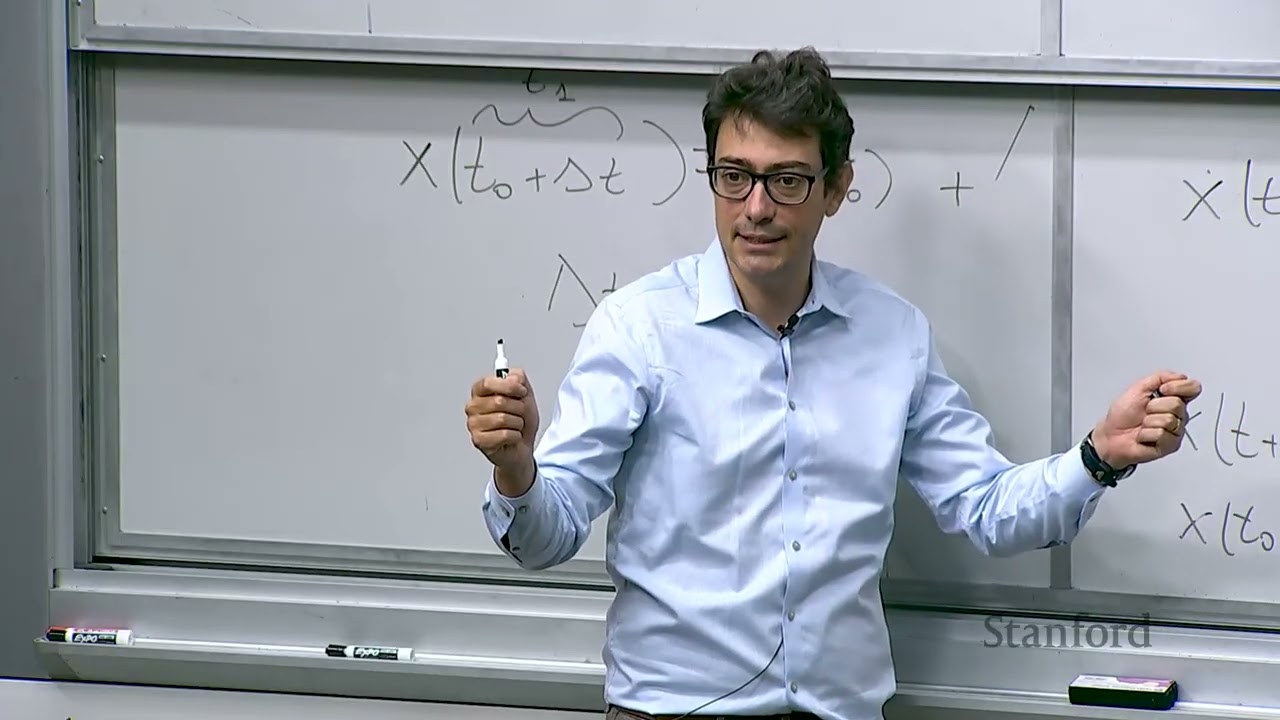
Stanford AA274A Principles of Robotic Autonomy | Autumn 2019 | Trajectory Optimization
Keywords
Summary
159 words
Critical Evaluation
Value of the Information & Strength of the Argument
The lecture delivers valuable academic content, providing a comprehensive overview of trajectory optimization methods and their theoretical underpinnings. The argumentation is systematic, starting from fundamental differential equations and building up to advanced concepts like differential flatness. The professor effectively bridges theory and practice, explaining why certain approaches are computationally feasible and why the two-step control design is advantageous. The inclusion of historical context enriches the presentation. The reasoning is clear and well-supported, though some parts rely on verbal explanations without visual aids, which may require extra attention.
Scientific Rigor, Source Quality, Title Accuracy
The scientific rigor is high, as the lecture is part of a Stanford graduate course taught by an expert with extensive research experience. The sources are credible, including the companion textbook ‘Principles of Robot Autonomy’ (available freely online), the course syllabus, and standard references like Siciliano et al. The title aligns perfectly with the content. The lecture does not cite specific research papers within the video, but the provided links offer further reading. The audience questions indicate engagement and clarification, suggesting the content is well-received.
187 words
Title / Content Match
The title accurately reflects the content, which focuses on trajectory optimization within the context of robotic autonomy.
Quality & Reliability
8/10
High-quality academic lecture from a recognized expert in the field, part of Stanford's graduate curriculum. The content is technically rigorous and well-structured, though it is an educational presentation rather than peer-reviewed research.
Key Moments
Markers derived by PSI from the transcript: the creator did not define chapters.
- Introduction to trajectory optimization problem: given initial and final states, find trajectory satisfying constraints.
- Discussion on cost function: running cost and terminal cost, examples and interpretation.
- Distinction between open-loop and closed-loop control, and the two-step design approach.
- Introduction to differential flatness as a method for trajectory optimization, applicable to quadrotors.
- Connection to historical optimal control methods: Pontryagin's principle and dynamic programming.
- Detailed explanation of differential flatness and its advantages for computing open-loop trajectories.
Cited Sources
- Stanford Online Graduate Education — General information about Stanford graduate programs, mentioned in video description.
- Principles of Robot Autonomy (Companion Textbook) — Free online textbook referenced as companion reading for the course.
- PoRA-I Course Schedule and Syllabus — Course schedule and syllabus; links to latest edition may differ from video content.
- AA274A Full Playlist — Full course playlist for the robotics autonomy course.
Concurring Sources
- Principles of Robot Autonomy — Companion textbook that aligns with the course content, providing further detail on trajectory optimization.
- Siciliano, Villani, Oriolo - Robotics: Modelling, Planning and Control — Recommended textbook for deeper understanding; chapter 11 is cited as reference for trajectory optimization.
Contribution & Novelties
This lecture provides a concrete, pedagogically structured introduction to trajectory optimization, emphasizing differential flatness as a practical tool. The novelty lies in the clear exposition of the two-step control design and the mathematical foundation for computing open-loop trajectories. The lecturer connects theory to historical developments, offering a nuanced perspective on optimal control methodologies.
Pour aller plus loin :
- Differential flatness (Wikipedia) — Core concept covered in the lecture; extends beyond simple examples.
- Penalty method for constraints (Wikipedia) — Useful for handling state constraints in trajectory optimization.
- Euler method (Wikipedia) — Numerical integration method used throughout the course.
- Pontryagin’s maximum principle (Wikipedia) — Historical and analytical approach to optimal control.
- Dynamic programming (Wikipedia) — Alternative solution approach referenced in the lecture.
120 words
Radar Profile
The radar shows a balanced profile with high scores in quantity and quality of information, moderate to high technical level, and strong reliability. The lecture is dense but well-explained, making it valuable for both beginners and practitioners.