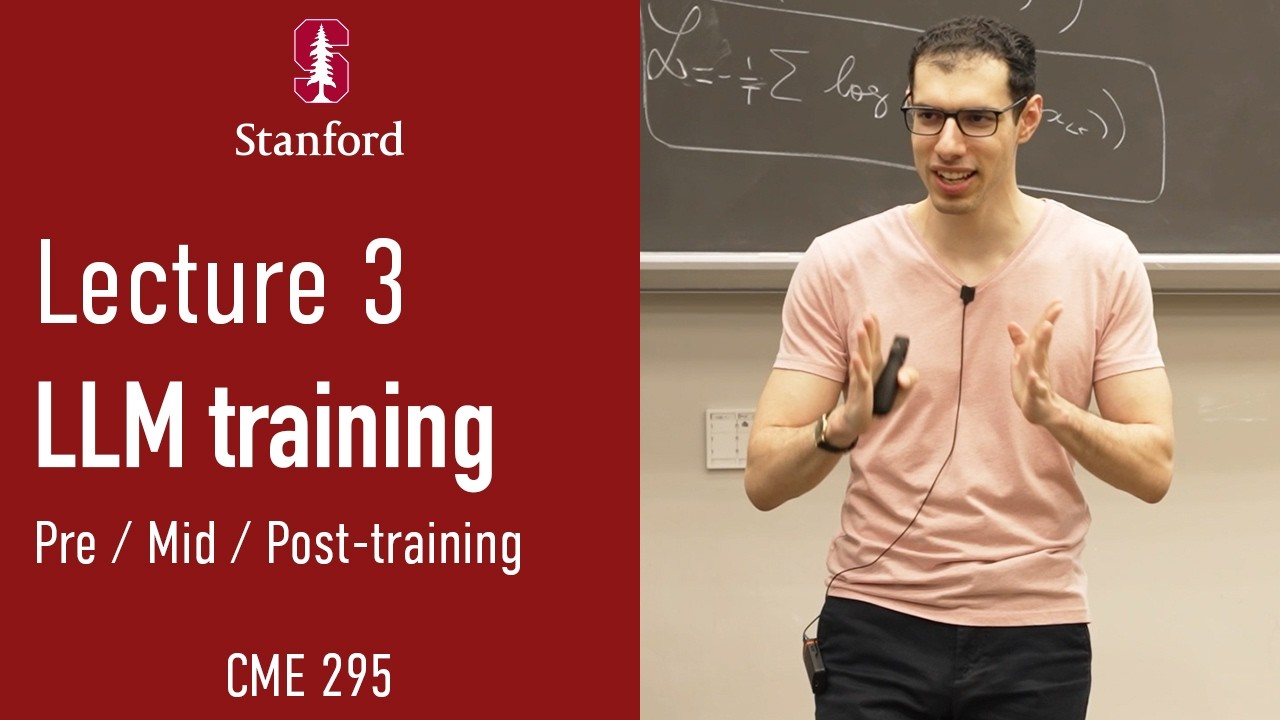
Stanford CME 295 Transformers & LLMs | Fall 2026 | Lecture 3 - LLM training
Keywords
Summary
109 words
Critical Evaluation
Value of the Information & Strength of the Argument
The lecture provides a comprehensive and well-structured overview of LLM training. The value lies in its clear explanations of complex concepts, from cross-entropy loss to advanced alignment techniques. The argumentation is solid: each concept is motivated by practical problems and supported by references to recent papers. The instructors effectively use examples and answer student questions, reinforcing understanding. The logical flow from pretraining to fine-tuning to alignment makes the material accessible despite its technical depth.
Scientific Rigor, Source Quality, Title Accuracy
The lecture demonstrates high scientific rigor. The instructors, both adjunct professors at Stanford, present content that is aligned with current research, citing papers like Chinchilla, DataComp, and others. The sources are credible and the explanations are accurate. The title ‘LLM training’ accurately reflects the content, which focuses on the training procedures for large language models. The structure with clear chapters enhances the educational value. No discrepancies between title and content are observed.
161 words
Title / Content Match
The title accurately reflects the lecture content on training large language models, covering pretraining, fine-tuning, and alignment.
Quality & Reliability
9/10
Lecture given by Stanford adjunct professors on the official Stanford Online channel, with clear structure, references to recent research, and rigorous technical explanations.
Chapters
- Introduction
- Pretraining
- Cross-entropy loss
- Data mixtures
- Midtraining
- Long context training
- Supervised finetuning (SFT)
- Low-Rank Adaptation (LoRA)
- Preference tuning
- Bradley-Terry formulation
- Reinforcement Learning from Human Feedback (RLHF)
- Direct Preference Preference Optimization (DPO)
- Reasoning
- Group Relative Policy Optimization (GRPO)
- On-Policy Distillation (OPD)
- End-to-end example
Cited Sources
- CME 295 Syllabus — Course syllabus and schedule for following along.
- Stanford Online Graduate Education — Information about Stanford's graduate programs.
- Playlist: Transformers & LLMs — Full playlist for the course.
Contribution & Novelties
This lecture synthesizes the latest training techniques, providing a unified view of pretraining, fine-tuning, and alignment. It bridges theoretical foundations with practical methods, offering a roadmap for practitioners. The inclusion of recent advances like DPO, GRPO, and OPD demonstrates the fast-moving nature of the field.
Pour aller plus loin :
- LoRA: Low-Rank Adaptation of Large Language Models — Key method for efficient fine-tuning introduced in the lecture.
- Training Language Models to Follow Instructions with Human Feedback — Foundational RLHF paper discussed in the context of preference tuning.
- Direct Preference Optimization: Your Language Model is Secretly a Reward Model — Alternative to RLHF covered in the lecture.
- Training Compute-Optimal Large Language Models — Chinchilla scaling laws referenced for data and model size trade-offs.
122 words
Radar Profile
The radar profile shows consistently high scores across all dimensions, with the strongest scores in information quality and reliability, indicating a well-balanced and trustworthy lecture.