Session 7: Market Growth with Boom and Bust
Keywords
Summary
121 words
Critical Evaluation
Value of the Information & Strength of the Argument
The session offers practical heuristics for building complex system dynamics models, such as ‘chunking’ to isolate independent parts, verifying stock conservation, and precisely defining time constants. The argumentation is rigorous; the instructor justifies each recommendation with concrete examples from student submissions and clarifies common pitfalls, such as conflating production capacity with work-in-progress limits. The interactive format allows immediate feedback, enhancing the learning value and addressing specific student misconceptions.
Scientific Rigor, Source Quality, Title Accuracy
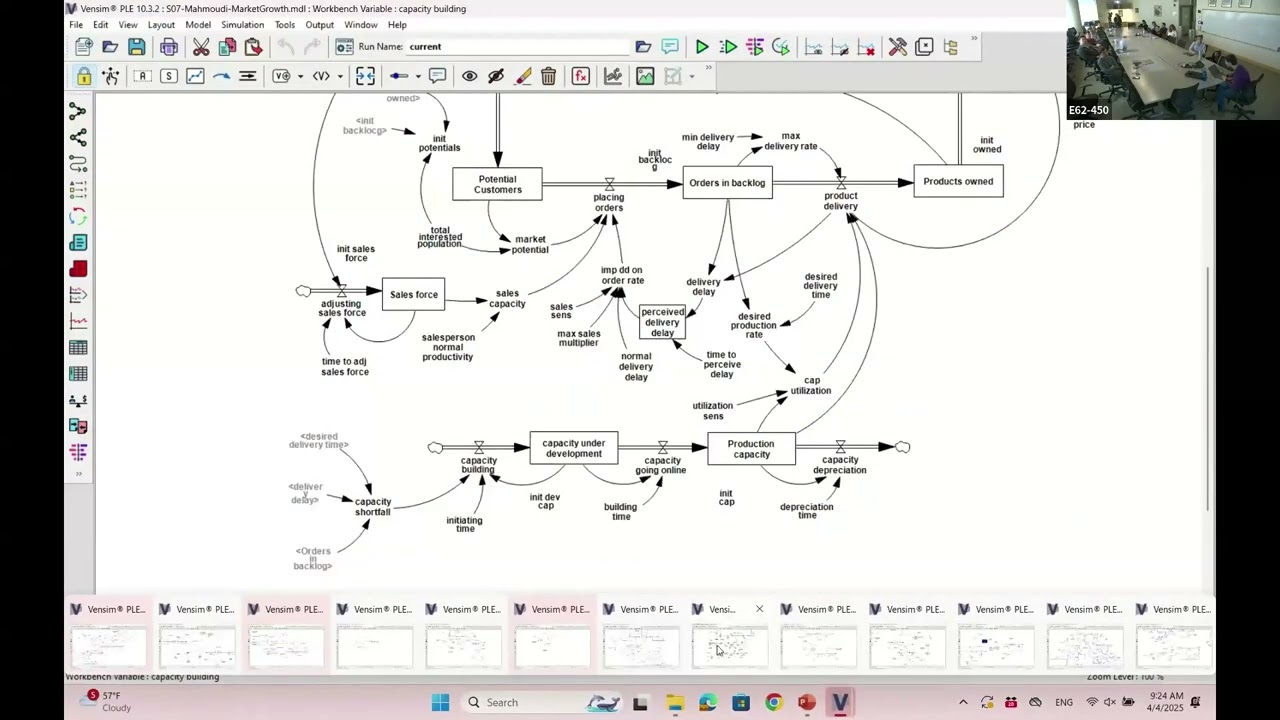
The content is methodologically rigorous, grounded in established system dynamics practice. No external citations are given, but the instructor’s expertise and the MIT OCW framework provide authority. The title is appropriate, explicitly mentioning market growth and boom-bust, which the session addresses through model behavior. The visual aids (student models) support the explanation, and the session’s critical review of formulations demonstrates a high standard of scientific rigor.
149 words
Title / Content Match
The title accurately reflects the session's focus on market growth models and the cyclical boom-bust dynamics arising from production and capacity delays.
Quality & Reliability
8/10
Hazhir Rahmandad, a professor at MIT, provides expert guidance on system dynamics modeling. The discussion is pedagogically sound, but it is a classroom session rather than peer-reviewed research.
Key Moments
Markers derived by PSI from the transcript: the creator did not define chapters.
- Introduction to the market growth model and objectives.
- Jake's difficulty in iterative modeling; instructor suggests a modular approach.
- Review of Ross's model: combining customer and demand sectors.
- Oriana's model segmentation: potential, interested, and current customers.
- Ann's model with cash reserve and work-in-process; discussion on necessity.
- Gerard's model incorporates repurchase decisions and potential adopters.
- Deep dive into Jake's capacity formulation; instructor points out unit inconsistencies.
- Discussion on perceived versus actual delivery delay and reputation adjustment.
Cited Sources
- MIT OpenCourseWare 15.879 Course — Course page for 15.879, including complete resources.
- YouTube Playlist — Playlist for the course sessions.
- OCW Terms — Terms of use for OCW materials.
- Support OCW — Donation link supporting OCW.
External References
Contribution & Novelties
The session offers a nuanced pedagogical perspective on system dynamics model building, emphasizing the importance of modularity and the correct interpretation of time constants. It goes beyond textbook examples by exploring real student formulations and their pitfalls.
Pour aller plus loin :
- System dynamics — foundational discipline for modeling complex systems.
- Stock and flow — key notation used throughout.
- Forrester’s Market Growth model — a classic reference for the dynamics of growth and capacity, though no direct URL is certain.
80 words
Radar Profile
The radar profile shows uniformly high scores across quantity, quality, technical level, and reliability, indicating a well-balanced and authoritative educational resource.