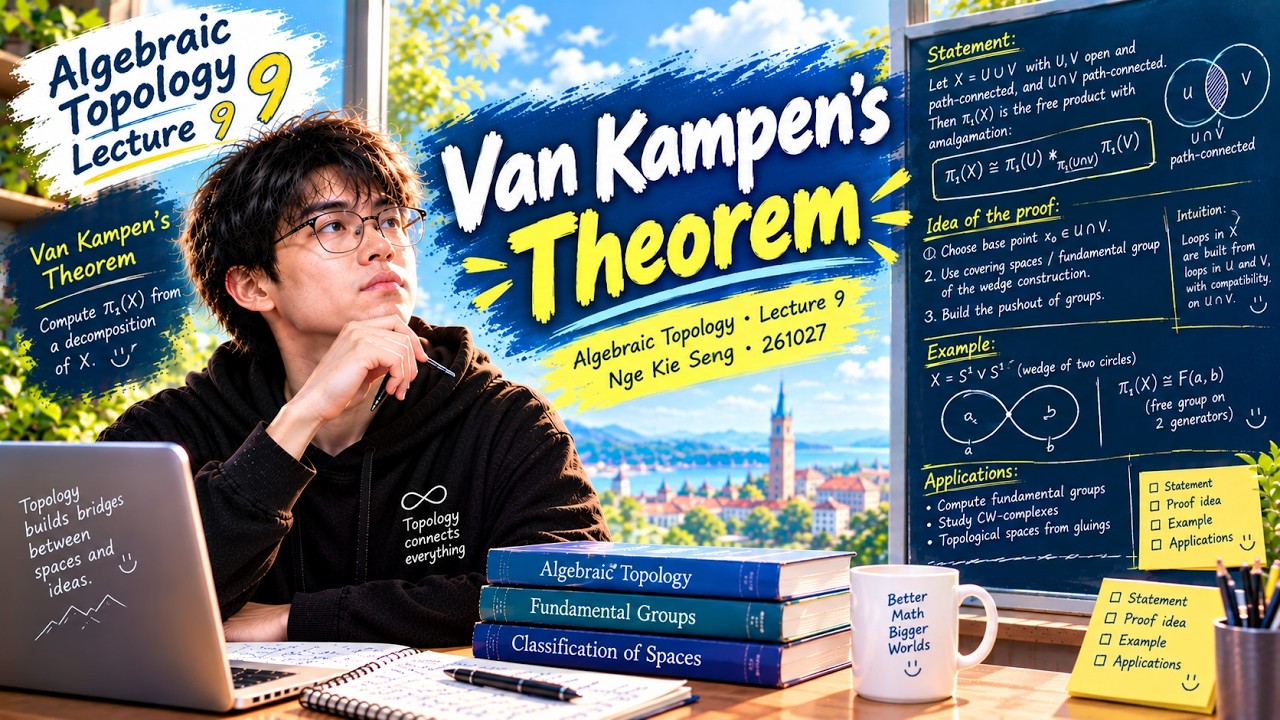
Van Kampen's Theorem | Algebraic Topology Lecture 9 | Nge Kie Seng 261027
Title history
- Van Kampen's Theorem | Algebraic Topology Lecture 9 | Nge Kie Seng 261027 — observed on 20261028-1235 UTC (YouTube)
Keywords
Summary
171 words
Critical Evaluation
Value of the Information & Strength of the Argument
The value of the lecture lies in its careful, step-by-step construction of the free product and its application to a central theorem in algebraic topology. The argumentation is methodical: the instructor defines objects precisely, checks well-definedness, and illustrates with concrete examples before stating the theorem. The use of commutative diagrams clarifies how induced homomorphisms on fundamental groups from different subspaces are compatible. The discussion of the kernel of the free-product-to-pi1 map is particularly instructive, as it reveals how the pairwise and triple intersection conditions control the amalgamation. The lecture successfully bridges algebra and topology, showing how group-theoretic constructions capture topological phenomena.
Scientific Rigor, Source Quality, Title Accuracy
The mathematical rigor is high: all definitions are formal, claims are proved or left as justified exercises, and the exposition follows the usual standard in algebraic topology. The instructor explicitly references ’the note’ for further details and earlier course material, but no URLs are provided in the description. The title accurately announces the topic, and the content matches the promised level for a graduate course. The lack of external citations is a minor weakness, but the self-contained nature of the lecture keeps the overall reliability solid.
202 words
Title / Content Match
The title accurately reflects the content: the lecture is entirely devoted to the setup and statement of Van Kampen's theorem within algebraic topology, after a thorough prerequisite discussion of free products.
Quality & Reliability
8/10
The lecture is a rigorous academic exposition of Van Kampen's theorem, presented at a graduate level. The instructor grounds each step in formal definitions and proofs, and though no external citations are provided, the mathematical arguments are coherent and follow standard textbook treatments. The absence of explicit references is offset by the depth and consistency of the presentation.
Key Moments
Markers derived by PSI from the transcript: the creator did not define chapters.
- Administrative announcements about submissions, attendance scheduling, and class logistics.
- Introduction of the free product of groups, definition of words and reduced forms.
- Examples: Z2 * Z and Z2 * Z2, leading to the infinite dihedral group and its geometric interpretation.
- Universal property of the free product, with discussion of unique extension of homomorphisms.
- Statement of Van Kampen's theorem, including conditions on intersections and the description of the kernel.
Contribution & Novelties
The lecture offers a clear pedagogical treatment of Van Kampen’s theorem, emphasizing the role of free products and their universal property. The continuous interplay between abstract algebra and concrete geometric examples (like the infinite dihedral group acting on the integer line) is a valuable contribution to understanding the material.
Pour aller plus loin :
- Van Kampen’s theorem — The theorem stated and proved in the lecture, also known as Seifert–van Kampen.
- Free product — The group-theoretic construction defined at length, including its universal property.
- Fundamental group — The invariant that Van Kampen’s theorem computes for a union of spaces.
- Infinite dihedral group — A concrete instance of Z2 * Z2 discussed in the lecture as a semidirect product with geometric meaning.
121 words
Radar Profile
The scores reflect a lecture that is quantitatively rich and qualitatively strong, with a high technical level. Reliability is slightly lower only because no external sources are cited, but the internal mathematical consistency supports the overall high rating. The profile is characteristic of a advanced university lecture built on established theory.