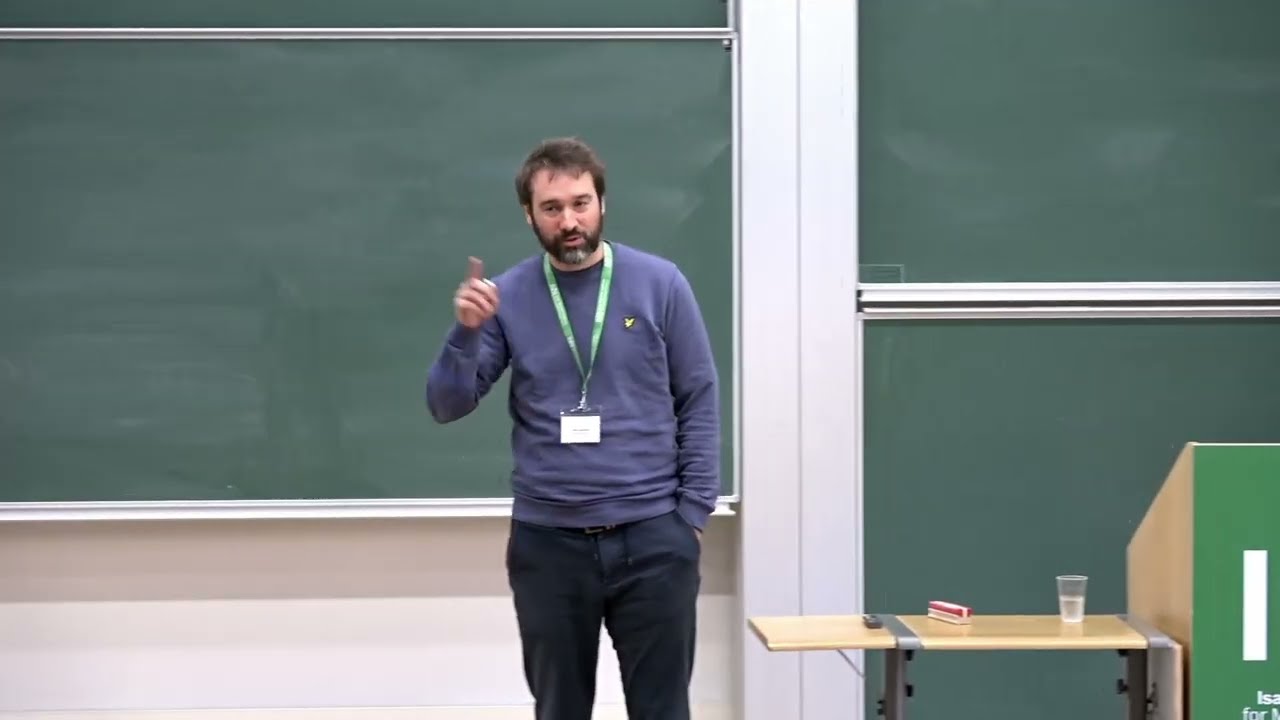
Prof. Nick Bultinck | Fermionic tensor networks: formalism, symmetry-protected quantum phases and...
Title history
- Prof. Nick Bultinck | Fermionic tensor networks: formalism, symmetry-protected quantum phases and... — observed on 20261030-1054 UTC (YouTube)
Keywords
Summary
121 words
Critical Evaluation
Value of the Information & Strength of the Argument
The seminar delivers a valuable and pedagogically sound treatment of a complex topic. The speaker builds the formalism from first principles, clarifying each step and addressing potential ambiguities, such as the ordering of basis states and the parity of operators. The argumentation is rigorous, with explicit demonstrations of contraction rules and their consequences, including the super trace and the Z matrix in periodic boundary conditions. The discussion of invariant subspaces and normal MPS provides a solid foundation for the fermionic generalization. Overall, the information is accurate, well-structured, and effectively communicated.
Scientific Rigor, Source Quality, Title Accuracy
The scientific rigour is high: definitions are precise, proofs are sketch but coherent, and the presentation follows a logical development from formalism to applications. The talk does not rely on external citations, but it is grounded in established results in tensor networks and quantum many-body physics. The title faithfully reflects the content, covering formalism, symmetry-protected phases, and Lieb-Schultz-Mattis constraints. The seminar is part of a reputable institution’s school, adding to its credibility.
177 words
Title / Content Match
The title accurately reflects the content: the seminar develops the formalism of fermionic tensor networks and addresses symmetry-protected phases and Lieb-Schultz-Mattis constraints.
Quality & Reliability
8/10
Clear rigorous presentation by an expert, with well-defined formalism and proofs. Minor lack of external citations in the talk, but based on established results.
Key Moments
Markers derived by PSI from the transcript: the creator did not define chapters.
- Definition of super vector spaces and Z2-grading
- Fermionic reordering map and its sign factors
- Contraction rules and super trace
- Example of fermionic tensor contraction
- Review of normal MPS and invariant subspaces
- Construction of fermionic MPS and periodic boundary condition
- Translational invariance and the Z matrix
- Connection to symmetry-protected phases and Lieb-Schultz-Mattis constraints
Cited Sources
- Isaac Newton Institute — Institute website hosting the seminar
- Seminar event page — Detailed information about the seminar
Contribution & Novelties
The seminar provides a clear and self-contained introduction to fermionic tensor networks, emphasizing the role of super vector spaces and fermionic reordering. It bridges the formalism with concrete applications to symmetry-protected phases and Lieb-Schultz-Mattis constraints, offering a practical framework for researchers.
Pour aller plus loin :
- Tensor network — General overview of tensor networks.
- Matrix product state — Specific class of tensor networks discussed.
- Fermion — Particle statistics underlying the formalism.
- Lieb–Schultz–Mattis theorem — Constraints on gapped phases.
78 words
Radar Profile
The profile shows high consistency across all dimensions, with technical level and quality of information being the strongest, reflecting the expert nature of the seminar.