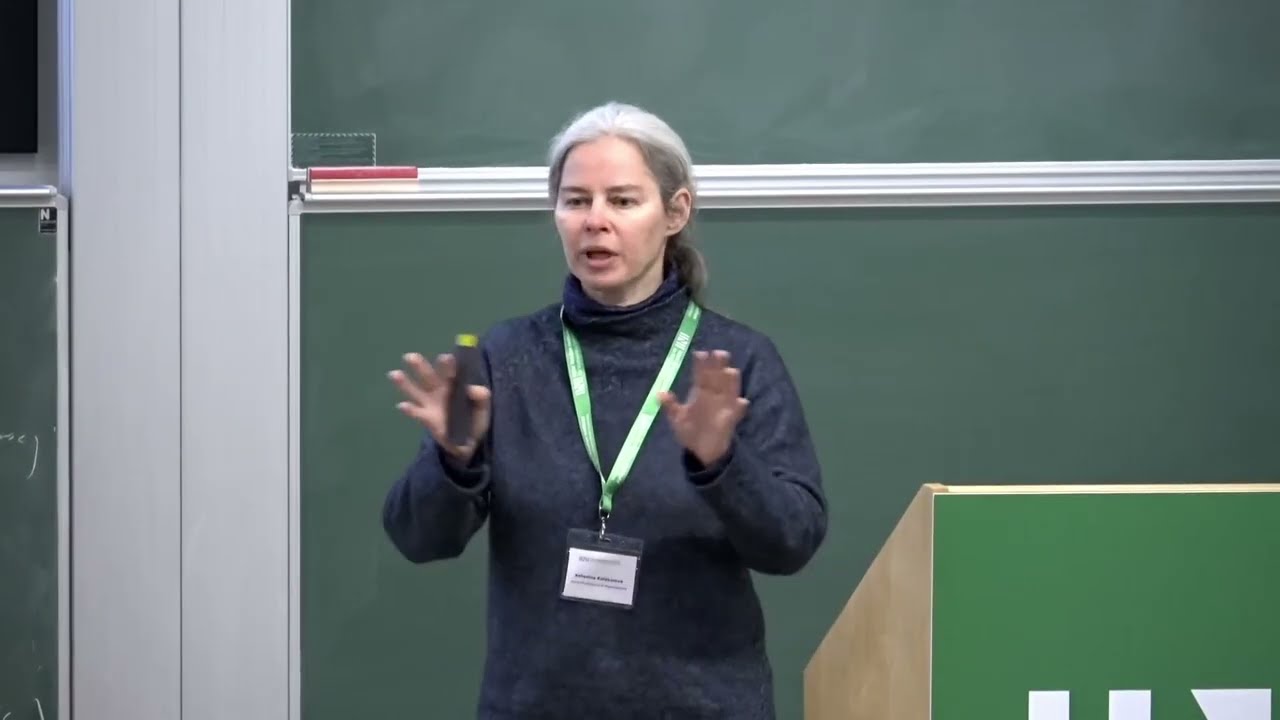
Prof. Antonina Kolokolova | Representation-independent lower bounds
Keywords
Summary
203 words
Critical Evaluation
Value of the Information & Strength of the Argument
The talk presents a clear conceptual contribution: formalizing the intuitive notion that the representation of a problem matters for proof complexity. The argumentation is solid, transitioning from motivating examples (pigeonhole principle, matching) to a rigorous definition and then to structural results. The speaker acknowledges prior work (knowledge compilation) and open questions. The logical flow is coherent, and the proposed framework has the potential to unify encoding-dependent lower bounds.
Scientific Rigor, Source Quality, Title Accuracy
The title accurately reflects the content: the talk focuses on lower bounds that are independent of representation for certain problems. The speaker cites specific works, including the knowledge compilation map by Darwiche and Marquis, and the work of Robert and others, though no explicit URLs are provided within the talk itself. The institutional source (Isaac Newton Institute) lends credibility. The presentation is rigorous, with definitions and proofs sketched, and no obvious unsupported claims. The content is highly specialized but coherent.
163 words
Title / Content Match
The title accurately represents the content: the talk focuses on lower bounds that are independent of how the problem is represented, a precise and appropriate description.
Quality & Reliability
8/10
The talk is a rigorous research presentation at a leading mathematics institute, with clear definitions and logical progression. The speaker is a recognized researcher in proof complexity, and the content is supported by examples and prior literature, though no detailed proof is given for all claims.
Key Moments
Markers derived by PSI from the transcript: the creator did not define chapters.
- Introduction: the problem of representation reformulation and its importance.
- Discussion of proof complexity techniques for making problems hard (randomization, lifting).
- Knowledge compilation and its relation to circuit representations and satisfiability.
- Pigeonhole principle under different encodings and the impact on proof complexity.
- Matching as a better representation; defining verifiers and solution sets.
- Formal definition of representation complexity and the measure combining size and proof length.
- Oracle separations and connections between representation complexity and standard complexity conjectures.
- Three-coloring: an example of a representation-independent lower bound derived from model-theoretic structure.
Cited Sources
- Isaac Newton Institute for Mathematical Sciences — Host institution for the seminar, providing venue and context.
- Seminar page for this talk — Official event page with details about the talk and the program.
Concurring Sources
- Proof complexity on Wikipedia — General background on the field of proof complexity, corroborating the talk's subject.
- Knowledge compilation on Wikipedia — Related area of research that studies how representation choices affect reasoning efficiency.
Contribution & Novelties
The main novelty is the introduction of a formal framework to study representation-dependent vs representation-independent lower bounds in proof complexity, and the demonstration that certain problems (three-coloring) have representation-independent lower bounds based on logical structure. This goes beyond typical knowledge compilation results by tying proof system parameters to the representation class. The talk also provides oracle separations highlighting the limits of such results.
Pour aller plus loin :
- Proof complexity — Foundational background on measuring the difficulty of proving tautologies.
- Knowledge compilation — Related field studying representation choices for efficient reasoning.
- Constraint satisfaction problem — The dichotomy results and links to model theory, relevant to the three-coloring lower bound.
- Pigeonhole principle — A central example in the talk, showing how different encodings affect proof complexity.
125 words
Radar Profile
The radar profile shows high technical depth and good reliability, with slightly lower quantity of information due to the focus on a specific research contribution rather than a broad survey.