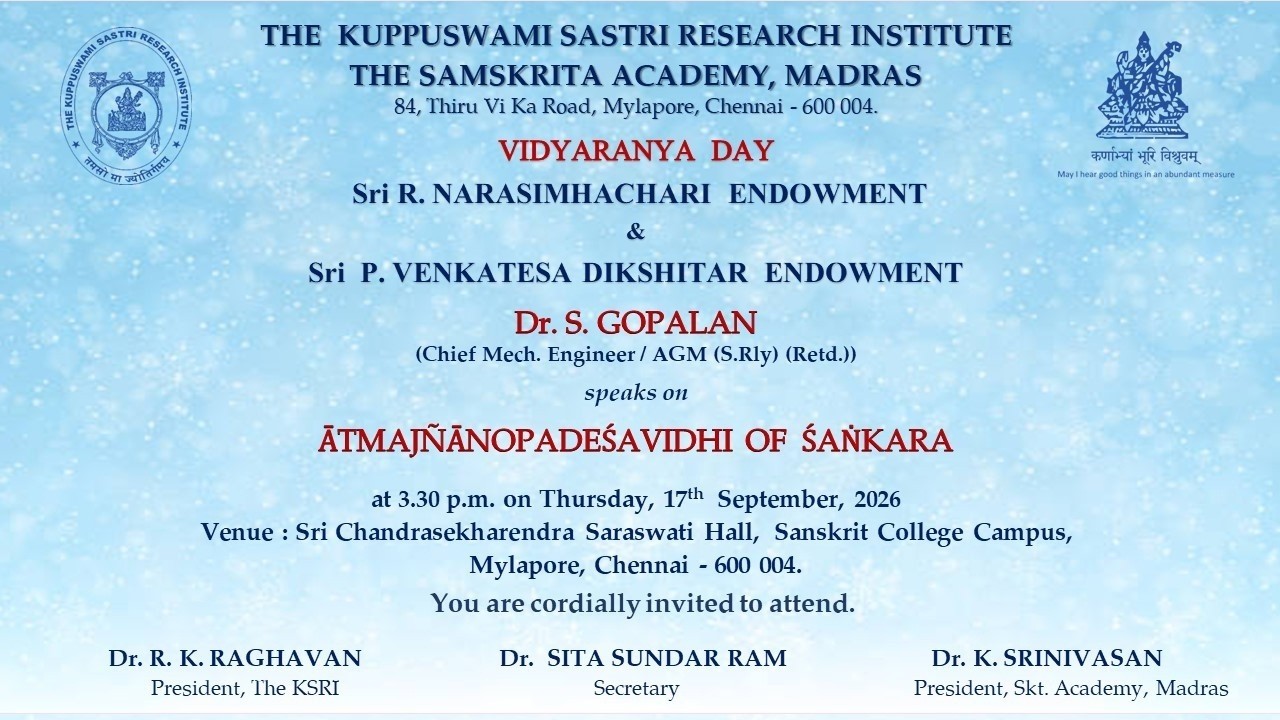
Dr. S. GOPALAN (Chief Mech. Engineer / AGM (S.Rly)(Retd.) speaks on ĀTMAJÑĀNOPADEŚA VIDHI OF ŚANKARA
Keywords
Summary
189 words
Critical Evaluation
Value of the Information & Strength of the Argument
The value of this lecture lies in its clear and systematic unpacking of a lesser-known Shankara text, making complex Advaitic doctrines accessible through careful analysis and concrete metaphors. Gopalan effectively argues for the self’s distinctness from the body-mind complex, establishing this through logical inference and scriptural citations. His argumentation is solid: he preempts common objections—such as how an actionless self can be an agent—and resolves them using analogies like the magnet and the iron, or the reflection of consciousness in the intellect. The distinction between the witness-consciousness and its superimpositions is explained with precision, and the lecturer stresses the practical goal of removing ignorance rather than acquiring new knowledge. The overall reasoning is coherent and faithful to the Advaita tradition, demonstrating both depth and pedagogical skill.
Scientific Rigor, Source Quality, Title Accuracy
The lecture shows a high degree of scholarly rigor, drawing directly from Shankara’s text and the commentary by Anandagiri, and situating the work within the broader context of Shankara’s corpus. The speaker, who completed a PhD on this exact text under Professor Vasudeva, demonstrates intimate familiarity with primary sources and pays careful attention to Sanskrit terminology and verse structure. The title faithfully reflects the content, which is entirely devoted to the Atmajnopadesha Vidhi. Though the speaker occasionally digresses into personal anecdotes or examples, these do not undermine the academic reliability of the presentation. The information is well-grounded in classical Advaita philosophy, and no factual errors or unsupported claims were detected.
251 words
Title / Content Match
The title accurately describes the content: a lecture on a specific text by Shankara, delivered by an engineer-turned-Sanskrit scholar.
Quality & Reliability
8/10
The lecture is a faithful and competent exposition of Shankara's Atmajnopadesha Vidhi, grounded in classical Advaita texts and the speaker's doctoral research. Despite occasional digressions, the philosophical reasoning is coherent and well-illustrated with examples.
Key Moments
Markers derived by PSI from the transcript: the creator did not define chapters.
- Introduction by the host, detailing the speaker's background and the two endowments.
- Dr. Gopalan begins his talk, outlining Shankara's text and its four chapters.
- Explanation of the self as distinct from the body, senses, and intellect, with the example of fire and wood.
- Discussion on the nature of the self as pure consciousness, using the analogy of the sun and the magnet.
- Detailing the three-fold condition of the intellect, and how the intellect transforms into seer and seen.
- Section four: the self as witness of the three states, and the elimination of superimposition for liberation.
- Concluding remarks on the possibility of liberation here and now, and the role of teacher's grace.
Contribution & Novelties
This lecture adds value by offering a concise yet thorough exposition of Atmajnopadesha Vidhi, a compact text by Shankara that is often overshadowed by his larger works. Gopalan’s engineering background brings a unique clarity to the logical structures, and his use of analogies such as electricity and film projection helps demystify abstract concepts. The emphasis on immediate liberation (‘moksha here and now’) and the role of the teacher provides practical guidance for seekers.
Pour aller plus loin :
- Advaita Vedanta — The philosophical school to which Shankara’s text belongs; essential for understanding the framework.
- Adi Shankara — The author of the text, whose life and works are crucial background.
- Panchadasi — A later work by Vidyaranya that elaborates on Advaita concepts; the lecture references Vidyaranya as a key commentator.
- Vidyaranya — The 14th-century philosopher and statesman whose day is celebrated; his works are closely linked to the tradition.
148 words
Radar Profile
The radar profile shows high scores for technical level and reliability, with slightly lower but still strong scores for information quantity and quality. This indicates a lecture that is advanced, accurate, and well-structured, but may assume significant prior knowledge of Advaita terminology, making it less accessible to absolute beginners.