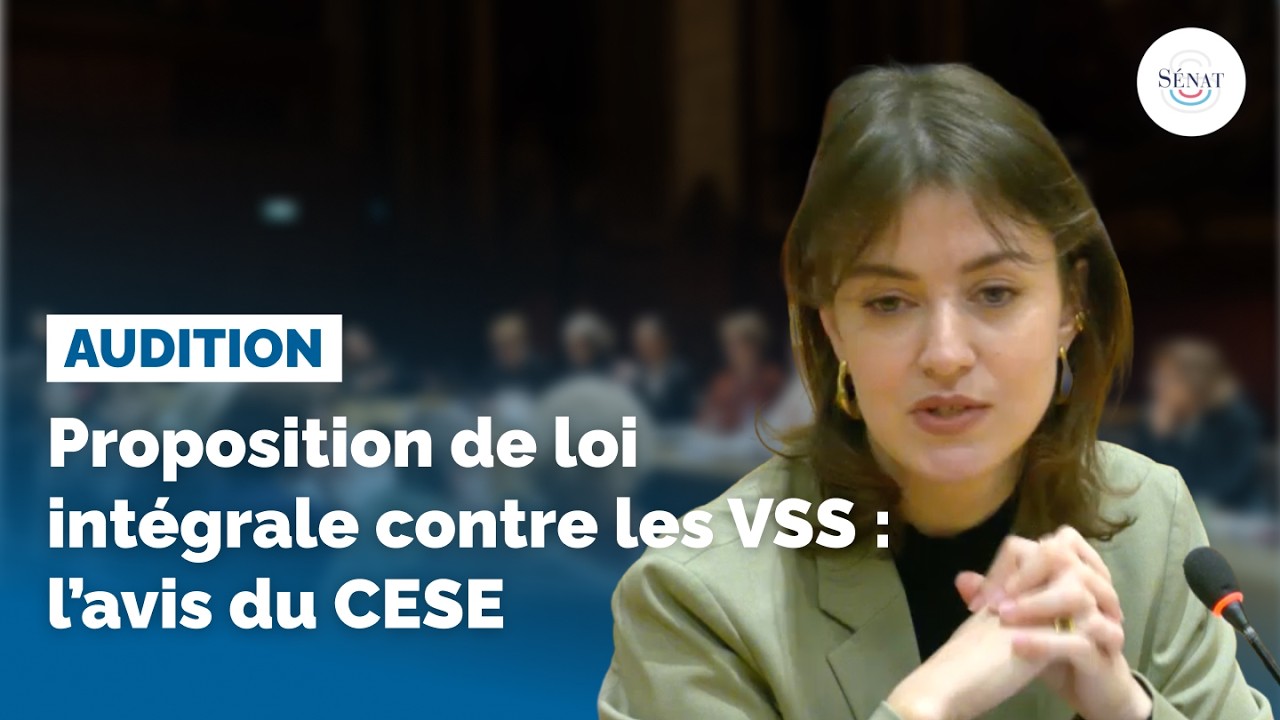
Proposition de loi intégrale contre les VSS : l’avis du CESE
Comprehensive bill against gender-based and sexual violence: The ESEC's opinion
Title history
- Proposition de loi intégrale contre les VSS : l’avis du CESE — observed on 20261106-0937 UTC (YouTube)
Keywords
Summary
251 words
Critical Evaluation
Value of the Information & Strength of the Argument
The value of the information is high, as it provides a detailed, institutional perspective on a major legislative project directly from a key civil society institution. The argumentation is well-structured and evidence-based: the CESE president explicitly anchors her recommendations in prior CESE reports (which were built over long months with extensive hearings), and she carefully distinguishes between supporting the repressive measures and insisting on the necessary complement of prevention and funding. The reasoning is logical, such as arguing that failing to let a victim take time off has higher economic costs for employers in the long run, which explains why even employers’ organisations supported the 10-day leave. The presentation effectively uses concrete examples, such as the issues in rural and offshore territories, to illustrate the need for more than just legal texts. The argumentation is solid, though it remains an institutional opinion rather than a critical scientific investigation, and self-criticism is limited to a respectful review of the legislative process.
Scientific Rigor, Source Quality, Title Accuracy
The scientific rigor is notable: the CESE president explicitly explains the methodology (working groups, reliance on prior detailed opinions), and grounds her views in the institutional framework of the CESE. While no external academic publications are cited, the debate references the CIVIISE report, the Conseil d’État’s scrutiny (which removed ‘cavaliers législatifs’), and the positions of various unions and feminist coalitions, giving a solid basis for the discussion. The reliability of the content is reinforced by the presence of comparative international law examples and a precise description of the bill’s own trajectory. The title adequately reflects the content, as the entire video is indeed the CESE’s opinion on the comprehensive VSS bill, despite a large portion being dedicated to procedural details and senatorial questions. The video presents an official opinion from the CESE, forming a useful expert reference point for parliamentary work.
316 words
Title / Content Match
The title accurately reflects the content: the video is a Senate commission hearing dedicated to the CESE's opinion on the comprehensive VSS bill, covering its main recommendations and their evolution through the legislative process.
Quality & Reliability
8/10
The content comes from an official parliamentary hearing involving the President of the CESE delegation on women's rights and the Senate delegation. It offers an institutional, first-hand assessment of a legislative opinion, based on prior CESE works and cross-referenced with the ongoing legislative process. The reliability is high due to the official nature of the speakers and the detailed procedural context, although it is primarily an opinion from a civil society body rather than an independent study.
Key Moments
Markers derived by PSI from the transcript: the creator did not define chapters.
- Introduction by Senator Dominique Vérien outlining the legislative context (from 69 to 134 articles) and the purpose of the hearing.
- Manon Rousselot-Pailley presents her personal background, her role at the CESE, and the composition of her delegation.
- Explanation of the CESE's working methodology: mobilising five work groups and relying on previous CESE opinions due to the tight schedule.
- Discussion on the importance of prevention and sex education (EVARS), with focus on the consequences of financing cuts for associations in rural areas and overseas territories.
- Debate on Article 46 concerning the 10-day leave for victims of violence (recently reduced to 3 days), citing international examples from Philippines, New Zealand, Canada, Ireland, Italy, and Slovenia.
- Exchange on the scope of the leave (including 'outrage sexiste' concern), the issue of excision as a French territory issue, and the debate on prudence regarding the enumeration in the penal code.
- Senator Adalsian raises three key questions: integration of CIVIISE recommendations, budgeting and financing of the measures, and concrete prevention actions.
Cited Sources
- CESE (Conseil économique, social et environnemental) — Institution authoring the opinion on the comprehensive VSS bill, represented by the speaker.
- Sénat (French Senate) — Hosting institution of the delegation dealing with women's rights, organising the hearing.
- Conseil d'État — Mentioned for its recommendation to remove or rewrite several provisions due to 'cavaliers législatifs'.
- Assemblée nationale (French National Assembly) — Site of the final adoption of the 134-article text and source of subsequent modifications.
Concurring Sources
- CESE opinion and National Assembly adoption — Both bodies agree on the ambition of the law and the need to move forward, though the CESE pushes for more prevention and funding.
Dissenting Sources
- Conseil d'État advice — The Conseil d'État recommended the deletion or rewrite of several provisions due to legal procedure (cavaliers), which contrasted with the initial broader scope of the text defended by various feminist coalitions.
Contribution & Novelties
The video provides an original institutional perspective, illustrating how a consultative body like the CESE positions itself in the legislative process on a major social issue. Its main contribution lies in explicitly linking the need for strict repression measures with the necessary funding and prevention mechanisms, offering concrete legislative feedback (e.g., the economic case for the leave, the specific needs of overseas territories) that enriches the parliamentary debate. It also highlights the interplay between CESE’s historical works and its rapid response to a current legislative deadline.
Pour aller plus loin :
- CESE (Conseil économique, social et environnemental) — Official body providing civil society opinions on legislative proposals, central to this discussion.
- CIIVISE (Commission indépendante sur l’inceste et les violences sexuelles faites aux enfants) — Key reference for child abuse and incest prevention recommendations, discussed in the hearing.
- Éducation à la vie affective, relationnelle et sexuelle (EVARS) — Central topic for prevention policies debated and emphasized in the video.
- Conseil d’État — Mentioned in the context of constitutionality review and legislative cavaliers, crucial for the procedural rigor of the bill.
179 words
Radar Profile
The radar profile shows a particularly high weight on reliability and quality of information, typical of an institutional, verifiable hearing. The levels of quantity and technicality are moderate, reflecting a rich but orally-delivered debate centred on legal and political concepts rather than quantitative data or scientific methodology.