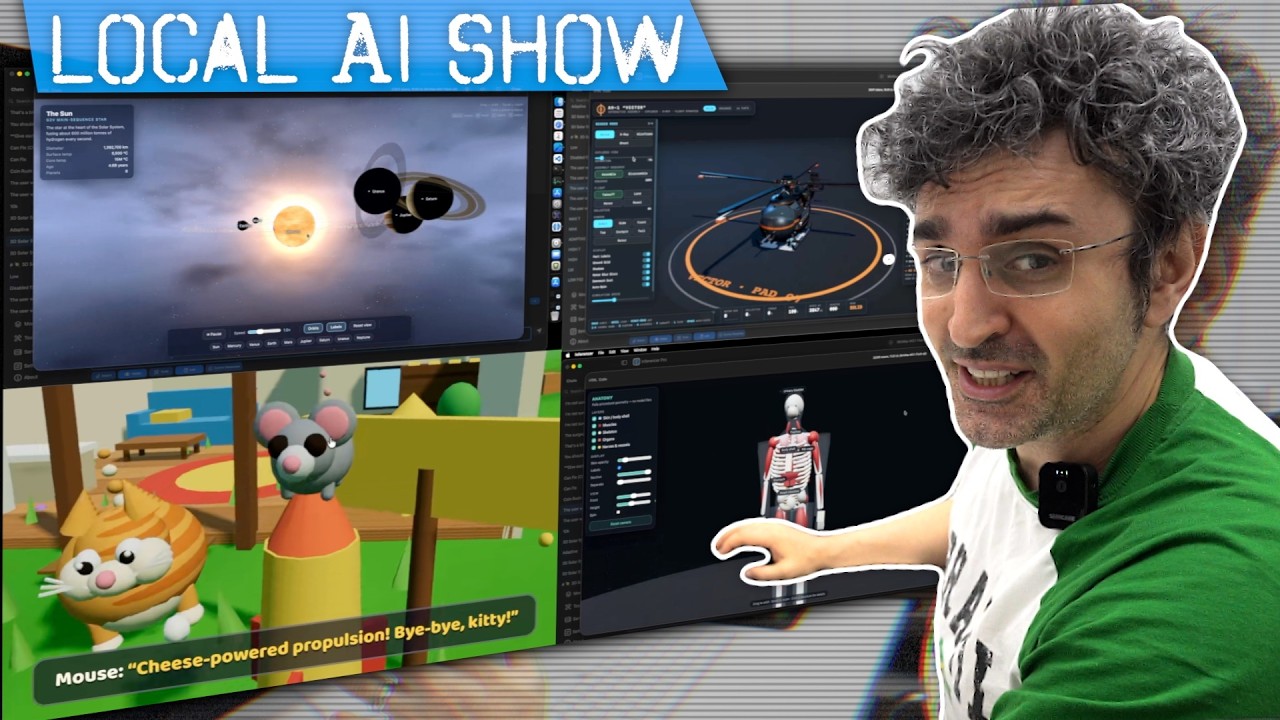
Let's Run MiniMax M3.1 Local AI - Better than DeepSeek & Opus? 🤔
Title history
- Let's Run MiniMax M3.1 Local AI - Better than DeepSeek & Opus? 🤔 — observed on 20261104-2152 UTC (YouTube)
Keywords
Summary
168 words
Critical Evaluation
Value of the Information & Strength of the Argument
The value of this video lies in its practical, real-world testing of a large open-weight model on consumer-grade hardware. The presenter provides concrete examples of token consumption across different reasoning efforts, which is valuable for users planning resource allocation. The explanation of temperature and top-p is pedagogical and helps understand how sampling parameters affect output. Argumentation is based on qualitative assessment of generated scenes and comparative benchmark numbers, but it is subjective and lacks rigorous statistical evaluation. The presenter acknowledges variability and potential errors, which adds honesty but weakens definitive claims. Overall, the practical insights and clear demonstrations outweigh the lack of formal analysis.
Scientific Rigor, Source Quality, Title Accuracy
The video cites benchmarks from the model card but does not independently verify them. The primary sources mentioned are the Hugging Face model page and the Inferencer tool used for testing. The title’s implication of superiority is addressed but not conclusively proven; the presenter notes that the model ties or beats others on certain benchmarks but also has quirks. The content is consistent with the title’s promise of a comparison, though the verdict is nuanced. The video does not reference academic papers or external validation, limiting its scientific rigor. However, the presenter transparently shows actual runs and errors, which adds credibility to the practical observations.
224 words
Title / Content Match
The title's comparative question is addressed through benchmarking numbers and side-by-side testing, but the verdict is nuanced and not a clear-cut 'better' — the content does, however, explore performance relative to DeepSeek and Opus.
Quality & Reliability
7/10
The video provides a hands-on, practical assessment of MiniMax M3.1-Flash with detailed commentary on generation quality, token usage, and parameter effects. However, it relies on personal impressions and unverified benchmarks, and the presenter does not perform systematic statistical evaluation.
Chapters
- Introduction & Benchmarks
- 3D Cat Game: Low Effort Mode
- 3D Cat Game: High Effort Mode
- How Temperature & Top-P Work
- Cat Game at Temperature 1.0
- Adaptive Thinking Mode Test
- Max Thinking Mode Tests
- 3D Volcano & Exploding Helicopter
- HTML5 Web Apps & Infographics
- Solar System: Disabled vs. Thinking Modes
- Helicopter with Token Limits
- 3D Human Anatomy Demo
- Recreating Mobile Games & Tomb Raider
- Logic, Coding & Math Benchmarks
- Final Verdict
Cited Sources
- MiniMax-M3.1-Flash-MLX on Hugging Face — Model card and weights for the local MLX version, used for benchmarking and testing.
- Inferencer — Inference tool/platform used to run the model locally.
External References
Contribution & Novelties
This video contributes hands-on performance data for a newly released open-weight model, specifically focusing on local execution feasibility. It highlights token consumption variability across reasoning modes and demonstrates practical impacts of sampling parameters. The ‘Pour aller plus loin’ section offers foundational concepts for deeper understanding.
Pour aller plus loin :
- Temperature (sampling) — Explains the core concept of temperature in LLM decoding, directly related to the video’s explanation.
- Top-p (nucleus) sampling — Details the method used alongside temperature to control randomness, as discussed in the video.
- Quantization (signal processing) — Relevant to the model’s pre-quantized NVFP4 format and its impact on performance.
102 words
Radar Profile
The radar profile shows high scores in technical level and quantity of information, indicating a rich, detailed tutorial. Qualitative and reliability scores are moderate, reflecting the subjective nature of the assessment. Global reliability is lower, consistent with the lack of independent verification.