MEMS Y NEMS - ESTUDIANTES ISC UNISON
MEMS AND NEMS - ISC UNISON STUDENTS
Title history
- MEMS Y NEMS - ESTUDIANTES ISC UNISON — observed on 20261030-1054 UTC (YouTube)
Keywords
Summary
157 words
Critical Evaluation
Value of the Information & Strength of the Argument
The video provides a hands-on, practical demonstration of building a MEMS-based compass, which is valuable for educational purposes. It clearly explains both hardware and software components, including the rationale for each code block. The argumentation is coherent but lacks critical analysis of design choices or alternative approaches. The presenters do not provide evidence or benchmarks to validate the compass’s accuracy beyond a simple demonstration. The explanation of the Kalman filter and sensor characteristics is informative, but the overall argumentation would be stronger with a more rigorous evaluation of the system’s performance.
Scientific Rigor, Source Quality, Title Accuracy
The video demonstrates moderate scientific rigor. It correctly states the HMC5883L sensor specifications and the principles of magnetoresistive sensing, but no external sources or datasheets are cited. The description provides no links or references, limiting the viewer’s ability to verify claims. The title ‘MEMS y NEMS’ is misleading as it suggests a broader coverage of MEMS and NEMS technologies, while the content is specifically about a single MEMS compass project. No comments are available to analyze public reception.
184 words
Title / Content Match
The title mentions MEMS and NEMS, but the content focuses exclusively on a MEMS-based compass with no discussion of NEMS, making the title only partially accurate.
Quality & Reliability
6/10
The video provides a fairly detailed technical overview of building a MEMS-based digital compass, including sensor specifications and code explanation. However, it contains some minor inaccuracies (e.g., 'SP32' instead of ESP32) and is presented as a student project with limited external validation.
Key Moments
Markers derived by PSI from the transcript: the creator did not define chapters.
- Introduction to the Mark 5 project and its purpose as a digital compass using MEMS.
- Hardware components: ESP32, ST7735 display, HMC5883L sensor, and 9V battery with switch.
- Discussion of the 3D-printed case and portability features.
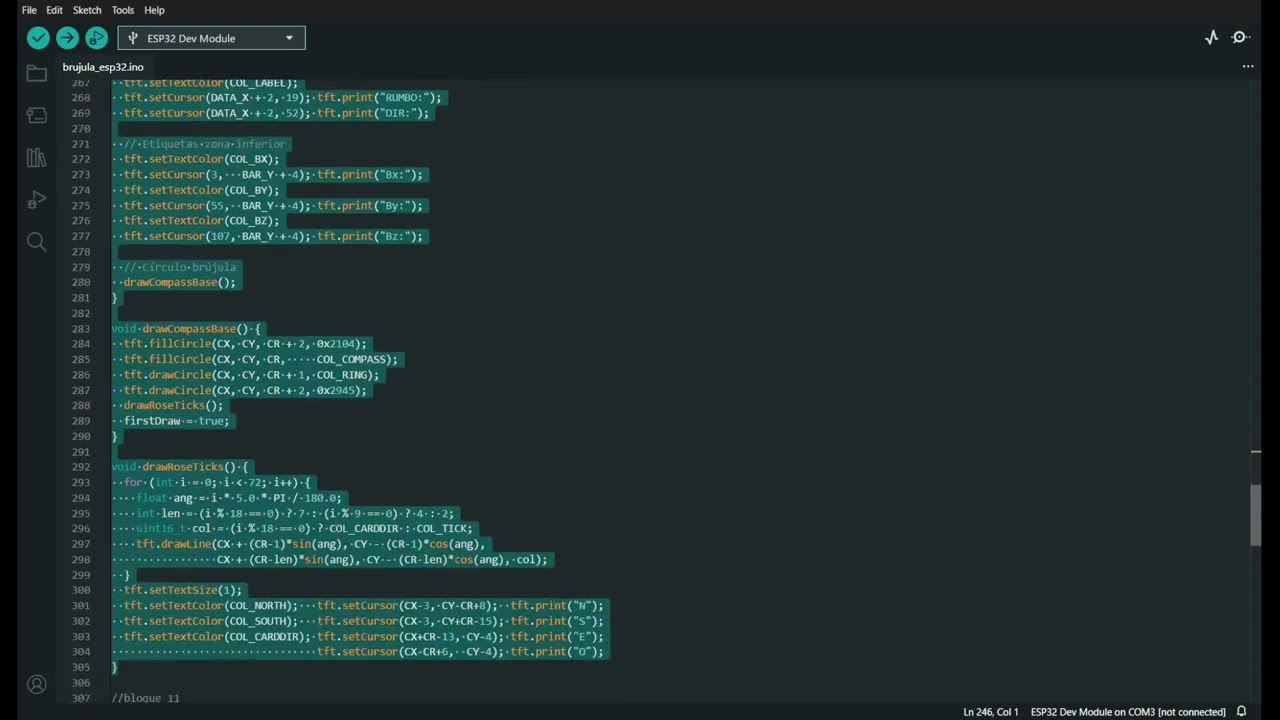
- Start of code explanation: block 1 (libraries and pin definitions) and block 2 (screen margin correction).
- Block 3: Magnetic declination configuration and block 4: Kalman filter.
- Block 5: Screen mapping and colors; block 6: Reading sensor and calculating heading angles.
- Blocks 7-9: North calibration button, setup, and main loop.
- Blocks 10-12: Drawing static compass face, needle animation, and updating text display.
- Sensor specifications of HMC5883L and explanation of magnetic field effects on compasses.
Contribution & Novelties
The video offers a practical, step-by-step tutorial on building a MEMS-based digital compass, integrating hardware selection, code explanation, and sensor physics. Its originality lies in the detailed walkthrough of the code structure and the use of a Kalman filter for smoothing. However, it is not a novel contribution but rather an educational demonstration.
Pour aller plus loin :
- Kalman filter — Relevant to the smoothing algorithm used in the compass.
- MEMS — Background on micro-electromechanical systems and their applications.
- Magnetometer — General principles of magnetic field sensing and techniques.
- ESP32 — Microcontroller platform used in the project, with references to its capabilities.
102 words
Radar Profile
The radar profile shows a moderate technical level with lower scores on information quality and reliability, indicating a practical tutorial that is informative but lacks external validation and critical depth. The high technical score reflects the hands-on nature, while the lower reliability score suggests the need for additional verification.