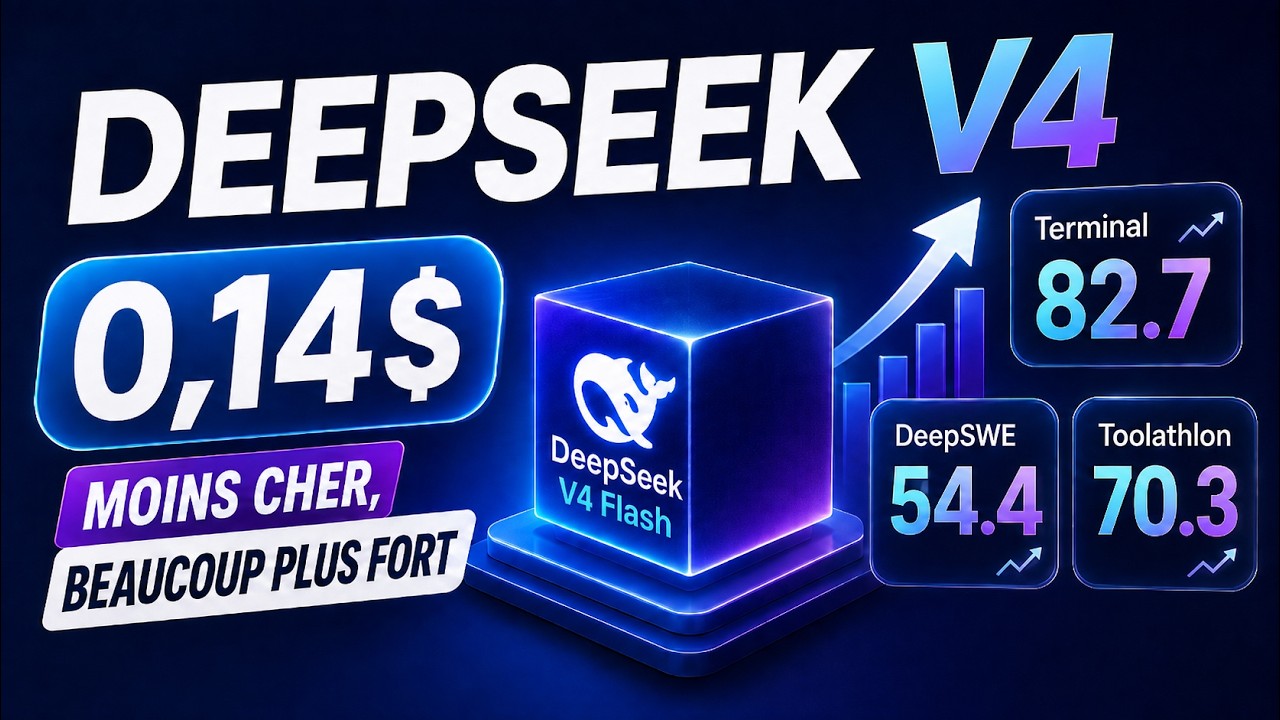
Pourquoi DeepSeek V4 Flash 0731 change ABSOLUMENT TOUT ?
Why DeepSeek V4 Flash 0731 changes ABSOLUTELY EVERYTHING
Title history
- Pourquoi DeepSeek V4 Flash 0731 change ABSOLUMENT TOUT ? — observed on 20261110-0253 UTC (YouTube)
Keywords
Summary
208 words
Critical Evaluation
Value of the Information & Strength of the Argument
The video provides concrete numerical comparisons and a hands-on demonstration, which adds practical value. The argumentation is clear: the improvements in agentic benchmarks and the ultra-low cost make this model a game-changer for developers. However, the presenter does not critically assess the source of the benchmark numbers (likely from DeepSeek’s own blog or official documentation) and does not compare with other models beyond a vague mention of Claude/Opus. The live test is illustrative but not rigorous (no error handling, missing features), yet it effectively shows the cost and capability trade-off. Overall, the reasoning is plausible and well-structured, but it could benefit from more independent verification and comparative analysis.
Scientific Rigor, Source Quality, Title Accuracy
The video does not cite specific external sources beyond mentioning benchmark names (DeepSWE, Terminal Bench, Toolathlon) and tools (OpenCode, OpenRouter, Ollama). No URLs are provided in the video itself. The description contains links to the presenter’s website, Twitter, and tutorial playlists, which are not directly relevant to the content. The title is somewhat sensationalist (‘changes absolutely everything’) but the content supports that the model significantly improves agentic performance at a low cost. No comments were available for analysis.
201 words
Title / Content Match
The title exaggerates the impact ('changes absolutely everything'), but the content does show significant improvements in agentic benchmarks and cost-effectiveness, so it's broadly aligned though somewhat sensationalist.
Quality & Reliability
6/10
The video provides specific benchmark numbers and a real-world test, but lacks direct references to the underlying sources. The claims are plausible and consistent with known AI trends, but independent verification is not provided.
Chapters
- DeepSeek V4 Flash : des performances qui explosent
- Pourquoi DeepSeek V4 Flash est beaucoup plus performant
- Les benchmarks agents IA : DeepSWE, Terminal Bench et Toolathlon
- Le vrai game changer : son prix
- Test réel avec OpenCode : création d’un clone de NotebookLM
- Premier résultat : une application pour seulement 10 centimes
- Amélioration de l’application avec DeepSeek V4 Flash
- Résultat final et bilan