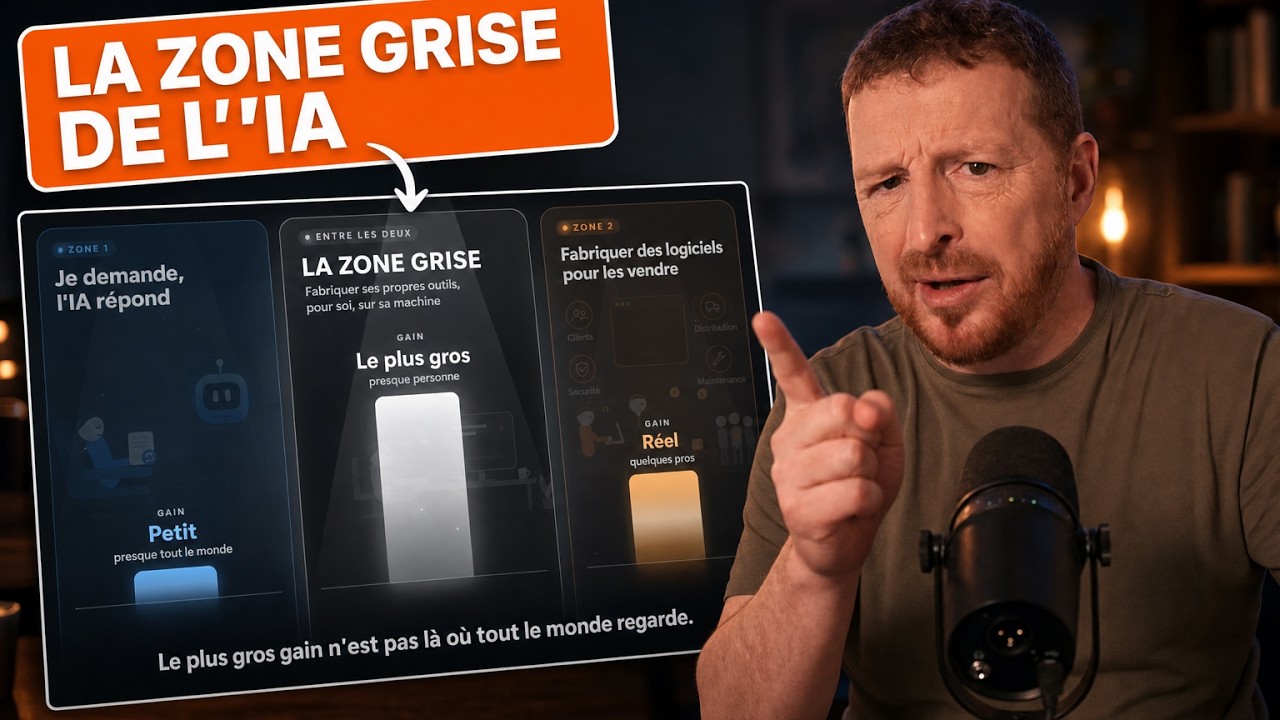
La zone grise de l'IA : ce que presque personne n'exploite
The AI Gray Area: What Almost No One Is Using
Keywords
Summary
178 words
Critical Evaluation
Value of the Information & Strength of the Argument
The video proposes an original and pragmatic approach to AI adoption, emphasizing personal agency and creativity. The author’s argument is coherent: he contrasts a passive use of AI (zone 1) with a developer-oriented path (zone 2), and positions the ‘grey zone’ as a space where non-experts can craft small programs to solve their own problems. He supports this with concrete examples from his daily routine, though they remain anecdotal. The reasoning lacks empirical data or external references, but it offers a compelling call for digital self-sufficiency. The argumentation is structured and persuasive, particularly in critiquing the over-reliance on opaque AI agents and the fear of cognitive decline. However, some claims (e.g., that this zone is ‘blocked from everywhere’) are stated without evidence.
Scientific Rigor, Source Quality, Title Accuracy
The video is largely based on the author’s personal experience and does not cite scientific literature or external studies. The only sources mentioned are his own website and club (renaud-dekode.fr and /abonnement-klub), which are promotional rather than informational. The title accurately encapsulates the core idea, but the content remains opinion-based rather than rigorously researched. No contradictions between sources are found because there are virtually no external sources. The video’s internal logic is consistent, though it sometimes takes a critical stance toward large tech companies without backing these claims with details.
227 words
Title / Content Match
The title accurately reflects the central concept of the video, which asserts that a productive 'grey zone' between basic chatbot use and full development is underutilized.
Quality & Reliability
6/10
The video offers a personal perspective on AI usage, grounded in practical examples but lacking empirical evidence or external references. The reasoning is coherent but relies on anecdotal experience.
Key Moments
Markers derived by PSI from the transcript: the creator did not define chapters.
- Introduction of the 'grey zone' concept and the two extremes of AI usage.
- Critique of the 'black box' nature of AI agents like Meta AI.
- Contrast between casual users and entrepreneurs/developers.
- Explanation of the 'grey zone' as a middle path of personal tool-making.
- Examples: timer for productivity, local transcription tool, biography assistant.
- More examples: surveillance camera project, robot companion 'Joshua'.
- Advice on mindset: seeing problems as opportunities and using AI as a creative partner.
- Criticism of media and school for ignoring the 'grey zone'.
- Call to action: invite viewers to join the community and share the video.
Cited Sources
- Site officiel Renaud Dékode — L'auteur y présente ses activités, ses lives et sa communauté.
- Abonnement Klub — L'auteur y propose des e-learning, ateliers et événements privés.
Concurring Sources
- Wikipedia sur le prompt engineering — En cohérence avec l'idée de bien réfléchir à ce qu'on demande à l'IA.
- Wikipedia sur les modèles de langage — Pour comprendre les bases technique des IA utilisées.
Contribution & Novelties
L’apport principal est la définition d’une ‘zone grise’ de l’IA, une voie intermédiaire entre la consommation passive de réponses et le développement full-stack. Cette approche valorise la création de micro-outils personnels pour améliorer la productivité et la créativité sans nécessiter de compétences avancées en programmation. L’auteur illustre ce concept avec des exemples concrets et reproductibles (timer, biographe, transcription locale, surveillance).
Pour aller plus loin :
- Prompt engineering — Décrit les techniques pour formuler des requêtes efficaces aux IA génératives.
- Local LLM — Permet de comprendre les modèles qui peuvent être exécutés localement, comme ceux utilisés pour la transcription.
- Vibe coding — Terme populaire pour décrire le développement itératif avec l’IA, pertinent pour la zone grise.
115 words
Radar Profile
Le profil est équilibré entre quantité et qualité d'information, avec un niveau technique modéré et une fiabilité moyenne. La vidéo est riche en idées mais manque de références externes, ce qui réduit sa fiabilité perçue.