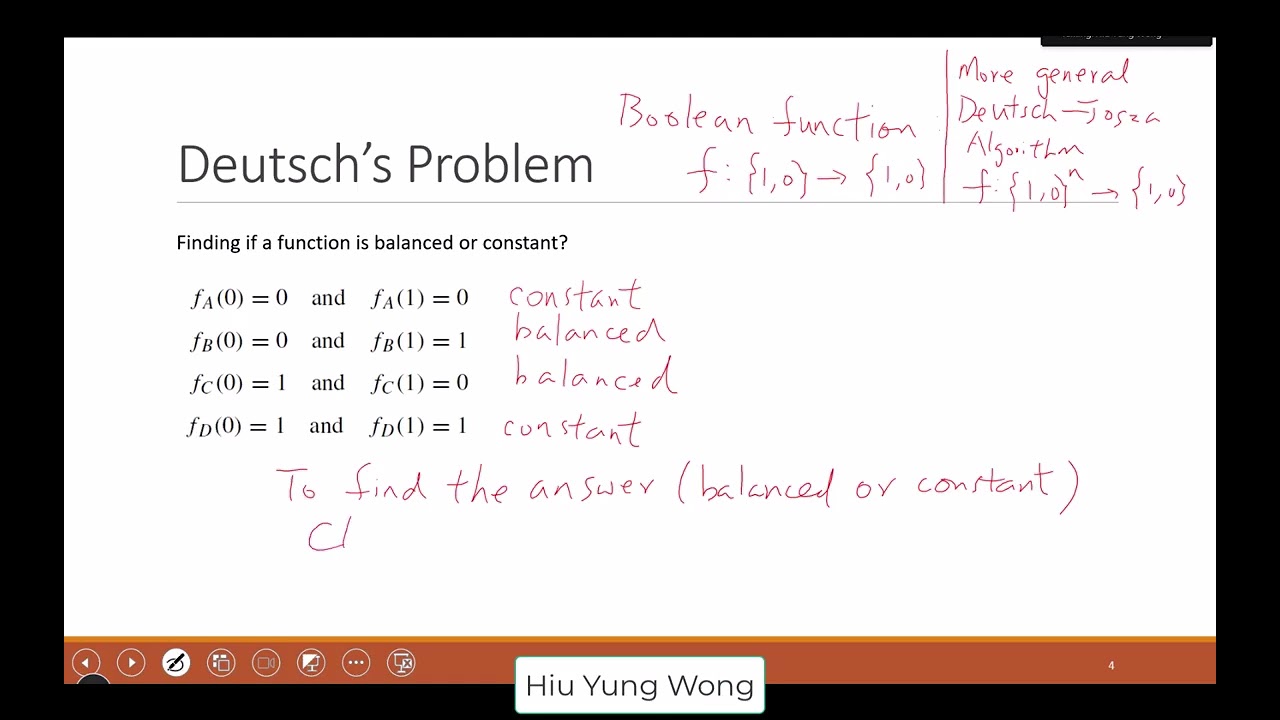
L16 Deutsch Algorithm and XOR Phase Oracle and Complexity
Keywords
Summary
183 words
Critical Evaluation
Value of the Information & Strength of the Argument
The video provides a clear and structured explanation of the Deutsch algorithm, breaking down each step from problem formulation to circuit implementation. The argumentation is logical and thorough, using algebra and state manipulation to show why the algorithm works. The instructor anticipates misunderstandings, such as the choice of superposition state, and explains the necessity of using |+>|-> rather than |+>|+>. The mountain analogy effectively conveys the idea of information trade-off in quantum computing. The value lies in making a potentially abstract algorithm accessible through step-by-step math and visual circuit diagrams, which benefits learners seeking a deeper understanding of quantum algorithms.
Scientific Rigor, Source Quality, Title Accuracy
The scientific rigor is high: the mathematics correctly derive the cancellation conditions for constant and balanced functions, and the circuit implementation aligns with standard quantum computing practices. However, the lecture relies primarily on the instructor’s expertise and does not cite external sources beyond the course playlist, limiting verifiability. The title accurately describes the content, focusing on the Deutsch algorithm, the XOR phase oracle, and complexity considerations. The presentation is consistent with the known literature on the Deutsch-Jozsa algorithm, though no specific references are given in the video description. The lack of discussion of limitations or alternative approaches is a minor weakness.
216 words
Title / Content Match
The title accurately reflects the content: it covers the Deutsch algorithm, the XOR phase oracle construction, and discusses computational complexity.
Quality & Reliability
8/10
The lecture is presented by an academic instructor, explaining the Deutsch algorithm with mathematical rigor and circuit diagrams. The content aligns with standard textbooks, but limited sources are cited directly.
Key Moments
Markers derived by PSI from the transcript: the creator did not define chapters.
- Definition of Boolean functions and the balanced vs constant problem
- Classical vs quantum computational complexity for the problem
- Overview of the Deutsch algorithm steps: oracle, superposition, parallel processing
- Detailed implementation of the quantum oracle UF and its truth table
- Preparation of the plus/minus superposition state and application to oracle
- Algebraic derivation: cancellation of terms based on constant vs balanced
- Circuit implementation with Hadamard gates and measurement in computational basis
- Simulation example showing the oracle behavior and final measurement
Cited Sources
- Quantum Computing Course Playlist — Playlist of lectures for the quantum computing course, containing the full series to which this video belongs.
Concurring Sources
- Deutsch-Jozsa algorithm - Wikipedia — Standard reference describing the Deutsch-Jozsa problem and solution, matching the concepts presented in the lecture.
Contribution & Novelties
The video offers a pedagogical walkthrough of the Deutsch algorithm, emphasizing the construction of the phase oracle and the role of superposition and interference. It clarifies common pitfalls, such as the selection of the minus state on the ancilla, and illustrates the information trade-off inherent in quantum speedup. The session is valuable for students aiming to grasp the mechanics of quantum parallel processing.
Pour aller plus loin :
- Deutsch-Jozsa algorithm — Generalization of the algorithm to multiple qubits.
- Hadamard gate — The single-qubit gate used to create superpositions and change basis.
- Quantum superposition — The fundamental principle enabling parallel computation in quantum algorithms.
103 words
Radar Profile
The scores reflect a balanced profile typical of an instructional lecture: good information quantity, high quality and reliability, and a moderate technical level suitable for learners with some quantum computing background. The relatively lower information quantity score is due to the focused scope on a single algorithm, while quality and reliability are strong.