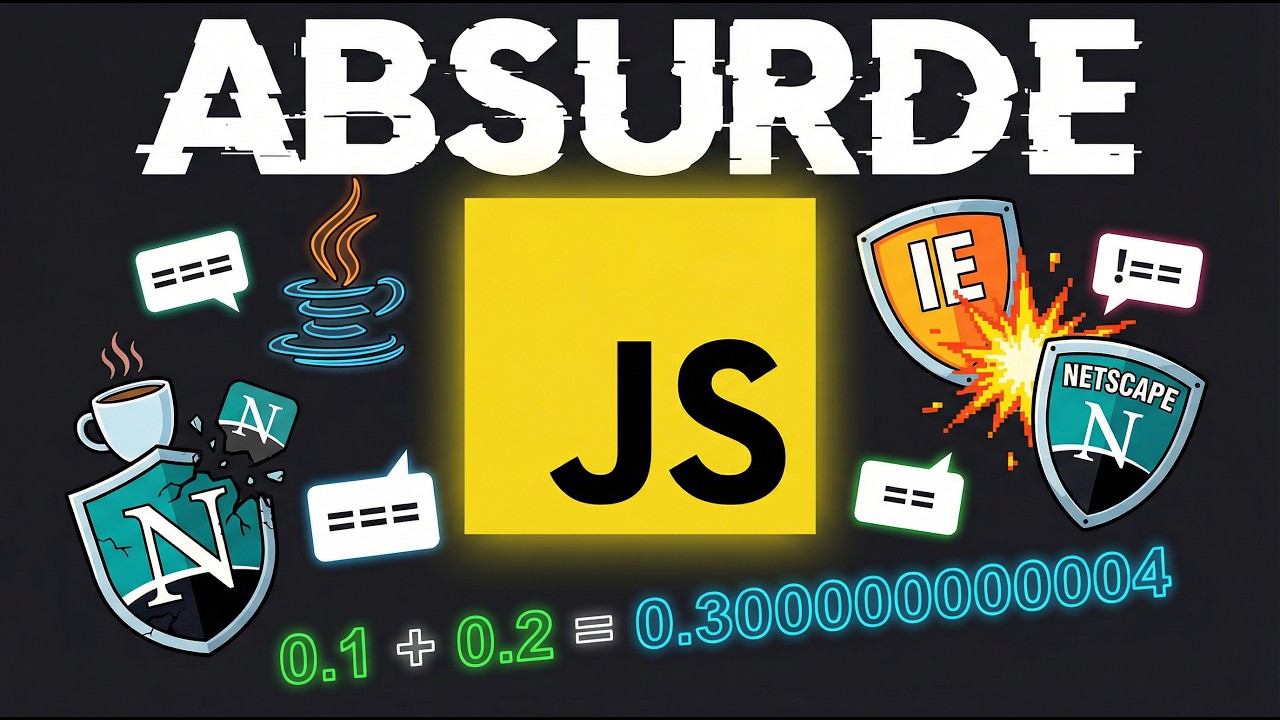
L'histoire absurde de JavaScript
The absurd history of JavaScript
Title history
- L'histoire absurde de JavaScript — observed on 20261110-0312 UTC (YouTube)
Keywords
Summary
typeof null returning ‘object’ due to tag-based memory representation. As the browser wars began, Microsoft copied the language as JScript, leading to a period of stagnation under the dominance of Internet Explorer 6. JavaScript’s revival began in 2004 with Gmail and the mainstreaming of Ajax, followed by jQuery in 2006 to smooth over browser inconsistencies. Google Chrome’s V8 engine in 2008 brought unprecedented performance, and Node.js in 2009 liberated it from the browser to the server. The 2010s saw the rise of npm and front-end frameworks like Angular, React, and Vue. With the ES6 update in 2015, the language was finally modernized. Today, JavaScript is the most widely used programming language globally, powering front-end, back-end, and mobile applications, demonstrating a paradox where a language birthed in haste and riddled with quirks became the dominant force of the web due to perfect timing and strategic positioning.214 words
Critical Evaluation
Value of the Information & Strength of the Argument
The video delivers high value by condensing 30 years of complex technical and business evolution into a coherent 14-minute narrative. It excels at explaining the underlying ‘why’ behind well-known quirks, linking business pressures (the Sun/Netscape deal) directly to technical outcomes (the Java-like syntax and naming). The explanation of the typeof null bug through the original 32-bit tagged-pointer implementation is remarkably precise and technically sound for a popular-science format. The argumentation is logically solid: it builds a clear causal chain—how a lack of competition led to IE6’s stagnation, which in turn made Ajax’s arrival a breakthrough, culminating in the V8 engine enabling Node.js. The central thesis that JavaScript triumphed not because it was the best language but because it was the only one available in the browser at the crucial moment is consistently and persuasively maintained. However, the video simplifies some nuances, such as the technical debates surrounding WebAssembly’s emergence as an alternative, but such simplifications are appropriate for the narrative scope.
Scientific Rigor, Source Quality, Title Accuracy
Scientifically, the video demonstrates a high degree of accuracy in its historical sequence. The dates for key events—Netscape’s dominance, the 1995 standardisation push, Gmail’s 2004 launch, Chrome’s 2008 debut, Node.js in 2009, and ES6 in 2015—are all correctly stated. The technical description of JavaScript’s internal value representation is accurate and correctly attributed to Eich’s original implementation. Regarding source quality, the video does not cite any primary, academic, or even notable secondary sources within the narration. The only references in the description are links to the creator’s own commercial product (a mini-comic) and two other videos from the same channel, so no external verifiable citations are offered to the viewer. The title perfectly matches the content; the ‘absurd’ framing is justified by the narrative of a language built in a rush, renamed for marketing purposes, and filled with bugs, yet which nonetheless became the backbone of the modern web.
324 words
Title / Content Match
The title is exceptionally accurate: the video narrates the chaotic, contradictory, and ironically successful history of JavaScript, perfectly capturing the 'absurd' journey from a 10-day rushed prototype to the most used language on Earth.
Quality & Reliability
7/10
The core historical timeline and key figures (Brendan Eich, Netscape, Sun Microsystems, Microsoft) are accurate and widely documented. However, the video relies on established tech folklore and anecdotal evidence, citing no primary sources or academic references in the narration itself. The only links provided are the creator's own commercial product and related videos.
Key Moments
Markers derived by PSI from the transcript: the creator did not define chapters.
- Introduces the central premise: a single developer is given 10 days in May 1995 to create a new programming language from scratch.
- Explains the political shift at Netscape from implementing Scheme to adopting a Java-like syntax to secure a deal with Sun Microsystems.
- Delves into the infamous `typeof null` bug, explaining its technical root cause in the original 32-bit tagged-pointer representation.
- Highlights Google Mail's launch on April 1st, 2004, and how Ajax redefined user expectations, sparking JavaScript's mainstream revival.
- Covers Ryan Dahl's creation of Node.js in 2009, which leveraged Chrome's V8 engine to take JavaScript beyond the browser and into server-side development.
- Discusses the massive ES6 (ECMAScript 2015) update that modernized the language, and the subsequent rise of TypeScript as a static-typed superset.
Cited Sources
- Mini BD: JavaScript - La naissance en 10 jours — A commercial mini-comic by the channel creator, presented as a visual companion to the video's narrative.
- L'histoire de Git (YouTube) — A related video by the same channel covering the history of Git, suggested as further viewing.
- L'histoire de Linux (YouTube) — A related video by the same channel about the history of Linux, linked as additional content.
Concurring Sources
- Brendan Eich - Wikipedia — Corroborates the biographical details of the creator of JavaScript and his role at Netscape during the 1995 timeline.
- ECMAScript - Wikipedia — Confirms the standardization process of JavaScript under ECMA International and the historical naming conventions.
Contribution & Novelties
The video provides a highly accessible and tightly structured synthesis of JavaScript’s history, skillfully weaving together technical details and corporate strategy. Its unique contribution lies in translating the classic ‘underdog’ narrative of a programming language into a compelling cause-and-effect chain, explaining how specific business decisions (like the Sun/Netscape alliance) directly created technical quirk and bugs that remain relevant today. It also effectively bridges the gap between the early browser wars and the modern ecosystem (Node.js, TypeScript), offering a coherent timeline that is both educational for newcomers and a satisfying recap for experienced developers.
Pour aller plus loin :
- ECMAScript on Wikipedia — Provides the official standardization history and detailed versioning (ES3, ES5, ES6) of the language.
- Brendan Eich on Wikipedia — Biographical details of the creator of JavaScript and his subsequent career.
- Ajax (programming) on Wikipedia — Explains the technical mechanism central to Gmail’s breakthrough, which the video identifies as the turning point for the web.
- Node.js on Wikipedia — Details the runtime environment built on Chrome’s V8 engine that enabled JavaScript’s move to the server side.
177 words
Radar Profile
The radar profile shows a video strong in information quantity and quality, reflecting its dense yet accurate historical narrative. Its technical level is moderate, which lowers the overall technical perception, while global reliability is solid but constrained by the lack of direct citations. This results in a well-balanced, popular-science documentary that excels in storytelling rather than in academic rigor.