From Foundation Models to Operational Weather Intelligence and Practice | Juepeng Zheng
Title history
- From Foundation Models to Operational Weather Intelligence and Practice | Juepeng Zheng — observed on 20261104-2218 UTC (YouTube)
Keywords
Summary
134 words
Critical Evaluation
Value of the Information & Strength of the Argument
The presentation provides substantial value by addressing concrete challenges in deploying AI weather models, backed by empirical results from multiple experiments. The argumentation is solid: each gap is identified, a corresponding method is proposed, and quantitative improvements are demonstrated (e.g., WeatherPEFT reduces trainable parameters from 1.2B to 52M while maintaining performance, diffusion framework improves precipitation accuracy, TianQuan-S2S outperforms baselines in long-lead forecasts). The reasoning is coherent and data-driven, though the speaker does not deeply discuss limitations or alternative approaches.
Scientific Rigor, Source Quality, Title Accuracy
The scientific rigor is acceptable for a conference talk: methods are clearly described, and evaluation metrics are provided. However, specific citations to external works are sparse, and no detailed references are given in the presentation. The only source provided in the description is the ADIA Lab symposium link. The title accurately matches the content, which systematically progresses from foundation models to operational intelligence. The talk is well-structured and stays on topic.
165 words
Title / Content Match
The title accurately reflects the content: the talk progresses from foundation models to operational weather intelligence and practical applications.
Quality & Reliability
8/10
Presentation of original research with detailed results and clear methodology, but limited external verification of claims and no direct cited publications.
Key Moments
Markers derived by PSI from the transcript: the creator did not define chapters.
- Introduction and motivation: why forecasting systems matter.
- Foundation models for weather and identification of three gaps (adaptation, knowledge, application).
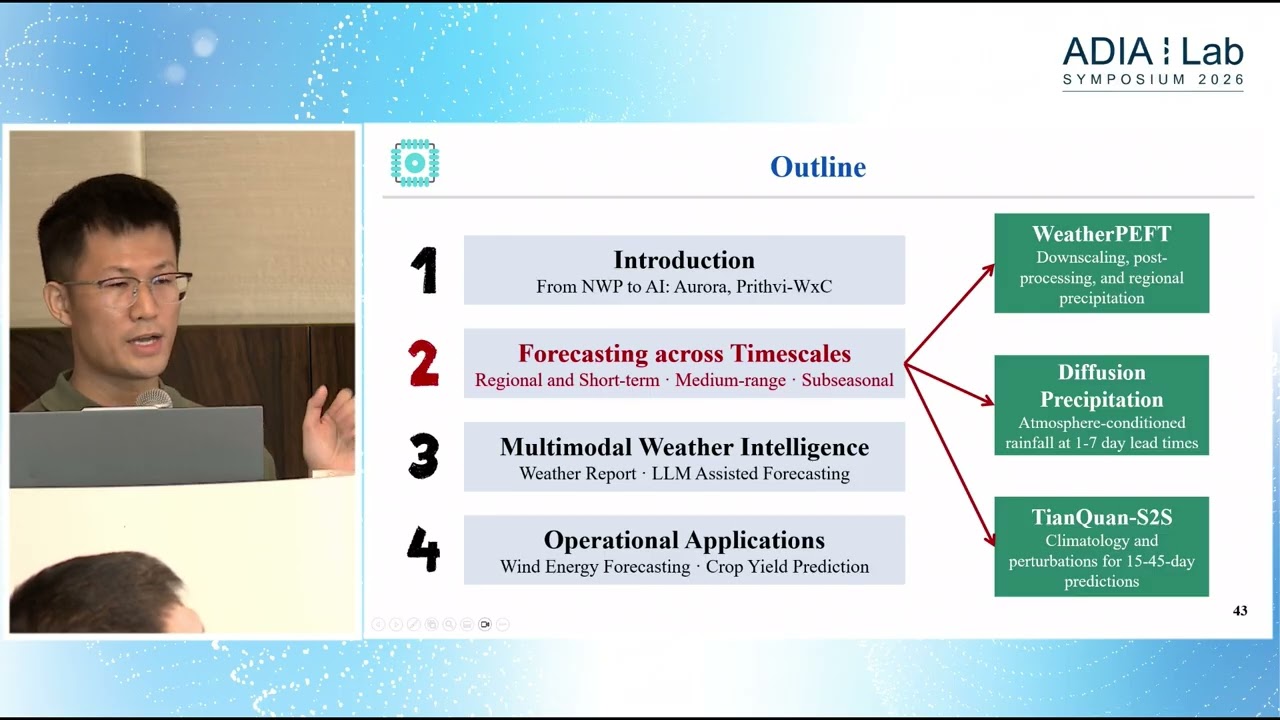
- WeatherPEFT: parameter-efficient adaptation for weather foundation models.
- Diffusion precipitation framework for daily rainfall generation up to 7 days.
- TianQuan-S2S: subseasonal-to-seasonal forecasting with climatological fusion.
- WeatherSim: language models for structured weather report generation.
- AGCD: agent-guided cross-model decoding for forecast refinement.
- Applications: turbine-level wind power forecasting and crop yield prediction.
- Future directions and conclusion: hybrid intelligence, HPC-AI co-design, and startup Scalling Science.
Cited Sources
- ADIA Lab Symposium 2026 — The talk was presented at this symposium; the link provides event information.
Contribution & Novelties
The talk presents several novel contributions: WeatherPEFT introduces a parameter-efficient fine-tuning method with dynamic prompting and stochastic selection for weather foundation models; the diffusion precipitation framework generates high-resolution daily rainfall without retraining the base weather model; TianQuan-S2S integrates climatological priors with transformer architecture to improve subseasonal forecasts; WeatherSim uses a three-stage training pipeline for controllable weather report generation; AGCD employs multi-agent language guidance to enhance forecast accuracy; and the applications to wind power and crop yield demonstrate practical value. The general contribution is a scalable HPC-AI pathway from reusable foundation models to decision-relevant services.
Pour aller plus loin :
- GraphCast — A widely known AI weather model that inspired part of the motivation; relevant for understanding the state of the art.
- WeatherPEFT and diffusion-based precipitation methods — These are original contributions; related concepts include parameter-efficient fine-tuning and conditional diffusion models, but no stable URL is identified.
- Subseasonal-to-seasonal forecasting (S2S) — A key research area; see the S2S prediction project by the World Weather Research Programme (no explicit URL available).
169 words
Radar Profile
The radar profile shows balanced scores across information quantity, quality, and technical level (all around 8), with a slightly lower reliability score (7) due to limited external citations. This indicates a technically detailed and informative talk with moderate external validation.