Benchmarking Machine Learning for Climate Science | Duncan Watson-Parris | ADIA Lab Symposium 2026
Title history
- Benchmarking Machine Learning for Climate Science | Duncan Watson-Parris | ADIA Lab Symposium 2026 — observed on 20261104-0952 UTC (YouTube)
Keywords
Summary
157 words
Critical Evaluation
Value of the Information & Strength of the Argument
The talk provides substantial value by introducing concrete benchmarks that address the critical need for evaluating ML models in climate science. It demonstrates that simply achieving high scores on in-distribution tasks does not guarantee ability to extrapolate to unseen climate scenarios. The argumentation is solid: each benchmark is described with its motivation, methodology, and key findings, and the speaker candidly notes limitations and saturation points. The design principles at the end synthesize lessons learned and provide actionable guidance for the community. The overall reasoning is coherent and evidence-based.
Scientific Rigor, Source Quality, Title Accuracy
The talk demonstrates scientific rigor through the description of benchmark construction processes, expert validation, and use of held-out data. However, explicit citations to published papers are not provided in the transcript, relying instead on the symposium context for credibility. The title matches the content well. No comments were provided for analysis, so no audience trends are considered.
160 words
Title / Content Match
The title accurately reflects the content, which centers on benchmarking ML in climate science via three specific benchmarks.
Quality & Reliability
8/10
The talk is presented by a recognized expert at an academic symposium, describing peer-reviewed benchmarks and results, with a rigorous methodology and balanced discussion of limitations.
Key Moments
Markers derived by PSI from the transcript: the creator did not define chapters.
- Introduction to ML in climate science and the need for benchmarks
- Description of ClimateBench for emulator evaluation and results
- Evolution to ClimateBench 2 with physical consistency and extrapolation tests
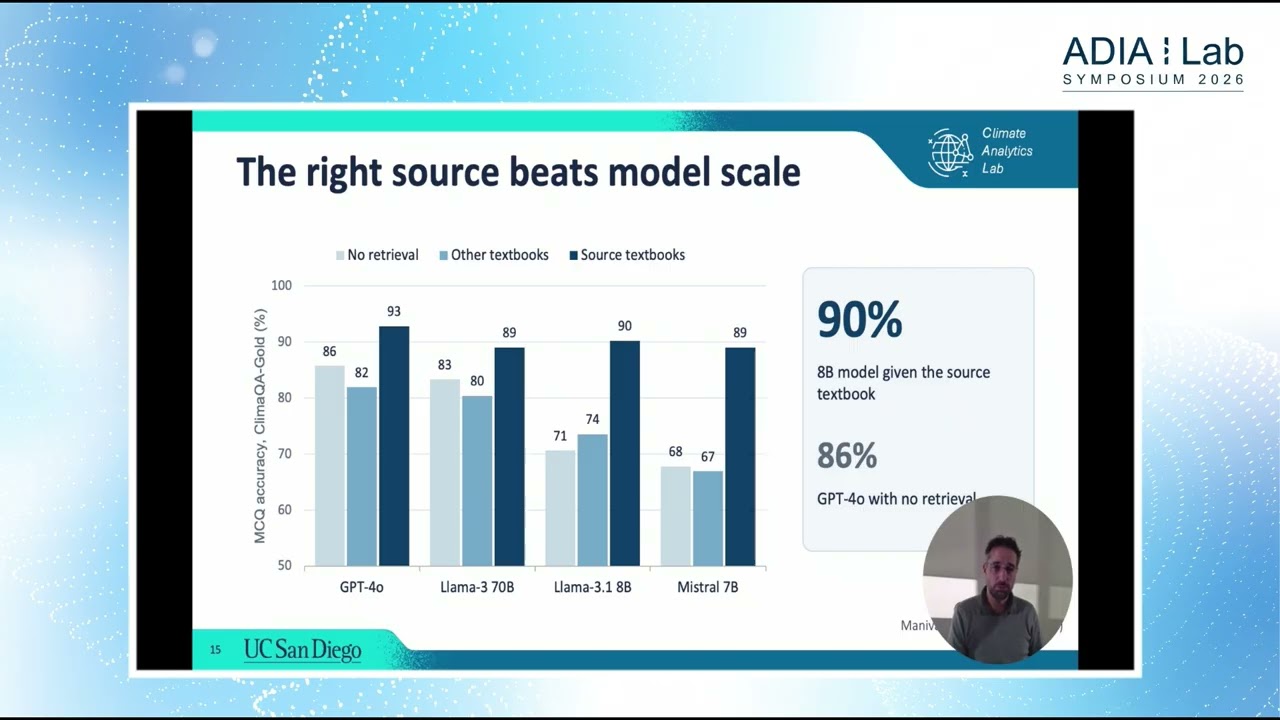
- ClimaQA benchmark for testing graduate-level climate knowledge in LLMs
- Zephyrus agent benchmark for weather and climate analysis tasks
- Lessons learned and six design principles for ML benchmarks
- Conclusion and analogy to ImageNet for benchmark evolution
Cited Sources
- ADIA Lab Symposium 2026 — Official page for the symposium where this talk was presented.
Contribution & Novelties
The talk contributes to the field by presenting three new benchmarks that assess different aspects of ML for climate science: emulation (ClimateBench), knowledge representation (ClimateQA), and agentic analysis (Zephyrus). It argues for a paradigm shift in evaluation toward testing physical consistency, calibrated uncertainty, and genuine extrapolation. The emphasis on benchmarks as living infrastructure is a forward-looking perspective that calls for continuous updates and maintenance.
Pour aller plus loin :
- Earth system model — relevant to the climate models being emulated in ClimateBench.
- Distribution shift — directly related to the out-of-distribution generalization challenge discussed.
- Probabilistic forecasting — underpins the call for calibrated uncertainty scores like CRPS.
105 words
Radar Profile
The radar profile shows high technical level (9) and strong information quantity and quality (8 each), with slightly lower reliability (8), indicating a highly specialized and detailed talk with a solid foundation.