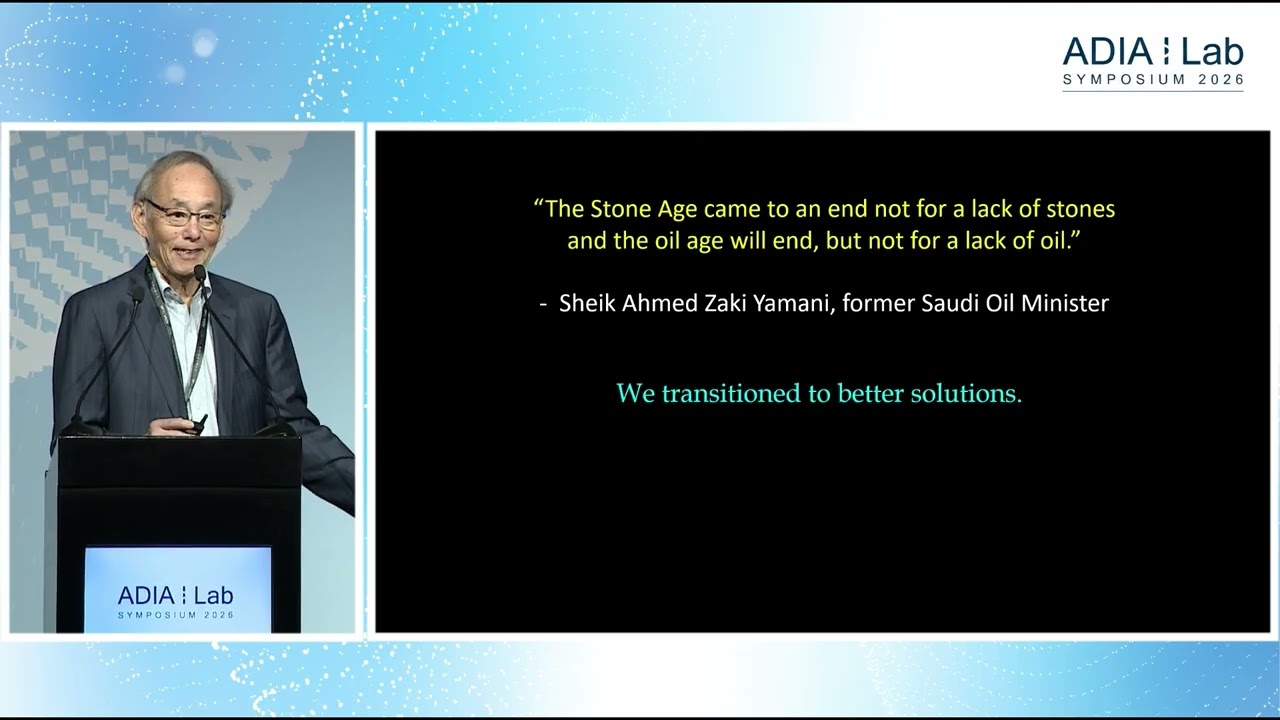
Technology Challenges in Getting to Net-Zero GHG Emissions | Steven Chu | ADIA Lab Symposium 2026
Title history
- Technology Challenges in Getting to Net-Zero GHG Emissions | Steven Chu | ADIA Lab Symposium 2026 — observed on 20261104-0952 UTC (YouTube)
Keywords
Summary
161 words
Critical Evaluation
Value of the Information & Strength of the Argument
The talk provides valuable insights into often-overlooked sectors like materials and agriculture, going beyond the typical focus on electricity and transport. The argumentation is solid, blending concrete examples (e.g., cost curves for batteries, historical analogies) with scientific projections. However, some claims are based on personal experience and optimistic assumptions about technological progress. The discussion of carbon capture costs is pragmatically grounded in current carbon prices. Overall, the value is high for a scientifically literate audience.
Scientific Rigor, Source Quality, Title Accuracy
The scientific rigor is strong, consistent with an expert’s overview of established research. Steven Chu does not cite specific studies, but relies on widely accepted climate science and technology cost data. The quality of sources is inferred from his expertise and the context of an academic symposium. The title and content align perfectly; the talk comprehensively covers technology challenges for net-zero. No comments were provided for analysis.
157 words
Title / Content Match
The title accurately reflects the content, focusing on technology challenges to achieve net-zero GHG emissions.
Quality & Reliability
8/10
The speaker, a Nobel laureate and former US Secretary of Energy, delivers an authoritative perspective with balanced use of data and personal insights. While some projections are subjective, the overall reliability is high.
Key Moments
Markers derived by PSI from the transcript: the creator did not define chapters.
- Introduction and overview of the talk's scope on climate risks and mitigation.
- Discussion on passing 1.5°C and the delayed impact of ocean heat uptake.
- Analysis of material extraction and carbon emissions from steel, cement, and plastics.
- Examples of electric vehicle advancements, including Xiaomi SU7 and fast-charging battery technologies.
- Agricultural emissions and the potential of synthetic biology to reduce fertilizer use.
- Emphasis on the need for direct air capture and cost constraints for deployment.
Cited Sources
- ADIA Lab Symposium 2026 — Event page where this keynote was presented, providing context for the talk.
Contribution & Novelties
The talk stands out for its comprehensive integration of technology challenges across energy, materials, and agriculture, often neglected in mainstream climate discussions. It offers a realistic assessment of direct air capture costs based on European carbon prices and highlights the rapid progress in battery storage and EV costs. The call for a fourth industrial revolution based on clean electricity is a compelling framing.
Pour aller plus loin :
- Direct air capture — Technology for removing CO2 from ambient air, central to the talk’s arguments on carbon removal.
- Synthetic biology — Engineering organisms to produce desired compounds, with potential to reduce agricultural emissions.
- Pumped-storage hydroelectricity — Dominant form of grid energy storage discussed in the context of renewable integration.
118 words
Radar Profile
The radar profile shows consistently high scores across all dimensions, with quantitative information and technical level slightly lower than qualitative and reliability metrics. This reflects an expert talk that is dense but accessible, with strong evidence but limited in-depth quantitative detail.