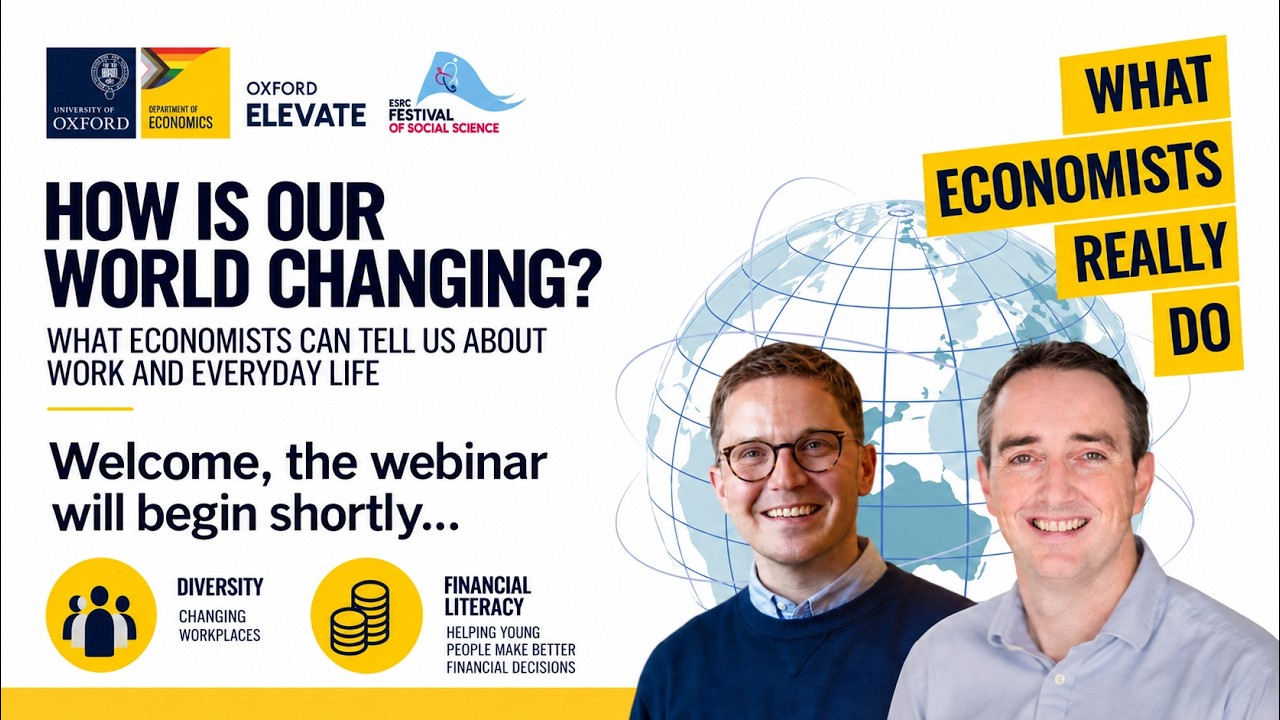
How Is Our World Changing? What Economists Can Tell Us About Work and Everyday Life
Title history
- How Is Our World Changing? What Economists Can Tell Us About Work and Everyday Life — observed on 20261030-1735 UTC (YouTube)
Keywords
Summary
172 words
Critical Evaluation
Value of the Information & Strength of the Argument
The video offers substantial value by combining two distinct economic perspectives on contemporary societal challenges. Michael McMahon’s argument for improving financial literacy is well-supported by concrete data from surveys and experimental evidence, showing that simple educational tools can significantly shift public understanding of complex economic mechanisms. He effectively uses relatable analogies (balloons, firefighting) to make abstract policy concepts accessible. Mathias Jensen’s presentation on NEET youth and mental health draws attention to a critical and often overlooked link between labor market participation and wellbeing, supported by statistics on disability claims and references to the Milbour Review. The argumentation is generally rigorous, though some claims rely on unpublished working research and oral summaries rather than fully cited publications. The panel discussion and audience interaction add depth, though the format limits the depth of analysis in some areas.
Scientific Rigor, Source Quality, Title Accuracy
The scientific rigor is moderate: the speakers are established academics with credible expertise, and they reference official sources like the Financial Conduct Authority survey and government reviews. However, the presentation is an expert-opinion format without formal citations or links to the mentioned studies. The title accurately matches the content, as the discussion directly addresses how economic changes affect work (labor market, NEET) and everyday life (financial decisions, mental health). The video is a high-level overview rather than detailed research, but it successfully conveys key insights from the presenters’ work. Audience comments were not provided, so no public reception analysis is possible.
251 words
Title / Content Match
The title accurately reflects the content: the discussion covers how economic changes affect work and everyday life, focusing on young people.
Quality & Reliability
8/10
Two Oxford economists present research-backed views on financial literacy and labor market inequality, citing specific surveys and studies, but the format is oral and lacks formal citations.
Key Moments
Markers derived by PSI from the transcript: the creator did not define chapters.
- Banu introduces the webinar and the two speakers, explaining the format: two presentations, a panel, and Q&A.
- Michael McMahon begins his talk on financial and economic literacy, highlighting the UK government's commitment to financial education and the low capability among young people.
- Michael discusses gender differences in financial risk-taking and the importance of understanding investments for retirement.
- Michael explains the research method: randomized controlled trials to test the effectiveness of financial education interventions.
- Michael talks about policy makers' communication challenges, introducing the three E's: Explanation, Engagement, Education.
- Michael presents a simple balloon analogy to explain monetary policy and shares results from an experiment showing improvement in understanding after a short educational video.
- Michael discusses the tax threshold experiment, showing how people's views on taxation change when informed about the actual top 10% income threshold.
- Mathias Jensen starts his presentation on young people not in employment, education, or training (NEET), and the rise in disability due to mental health.
Cited Sources
- Financial Conduct Authority Financial Lives Survey — Michael McMahon cited this survey to illustrate low financial capability among young people.
- Work with Andy Haldane on central bank communication — Michael mentioned a past collaboration with Andy Haldane on a 'manifesto' for policy makers to engage with the public.
- Work with Matthew Naylor on concept simplification — Michael referred to joint research with Matthew Naylor on making economic concepts more accessible in central bank communications.
- Milbour Review — Mathias Jensen cited the government-commissioned Milbour Review on the rise of NEET youth and mental health-related disability.
Contribution & Novelties
The video’s original contribution lies in the presenters’ firsthand account of their research and the practical implications for policy and public understanding. Michael McMahon’s experimental approach to financial education and his concept of the three E’s provide actionable insights for policymakers. Mathias Jensen’s focus on the link between mental health and NEET status highlights an urgent social issue with economic consequences. The discussion offers a bridge between academic economics and real-world applications.
Pour aller plus loin :
- Financial literacy — Provides a comprehensive overview of financial literacy and its importance, directly related to Michael’s talk.
- Randomized controlled trial — The methodology Michael described for testing educational interventions is a classic RCT approach.
- Monetary policy — Explains the central bank tools (interest rates, inflation targeting) that Michael’s balloon analogy simplified.
- NEET (Not in Education, Employment or Training) — Offers background on the NEET classification and its social and economic implications, relevant to Mathias’s presentation.
153 words
Radar Profile
The radar profile shows strong quantitative and qualitative information, with moderate technical level appropriate for a general audience. The reliability score is high due to credible speakers, but the oral format limits precision. The balance suggests a well-rounded educational talk that is both informative and accessible.