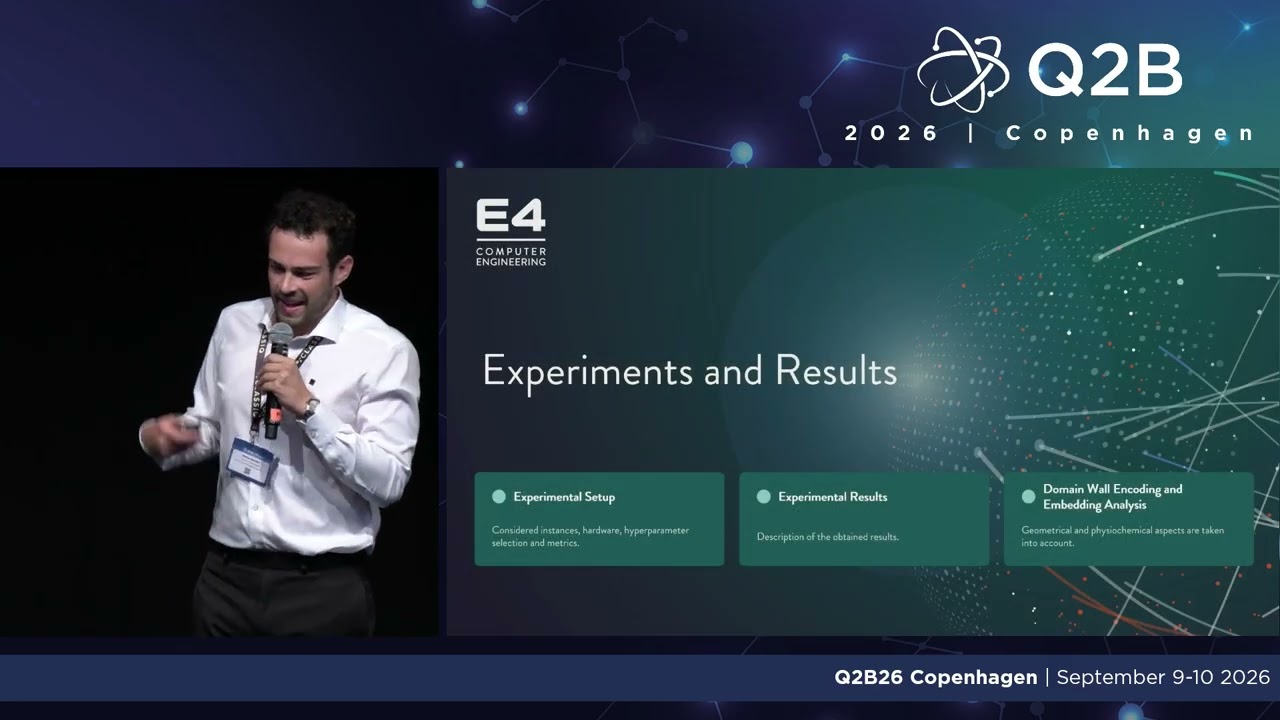
Q2B26 Copenhagen | Matteo Barberi, Quantum Developer, E4 Computer Engineering Spa
Keywords
Summary
199 words
Critical Evaluation
Value of the Information & Strength of the Argument
The talk provides valuable insights into the practical application of quantum annealing for a real-world chemistry problem. The speaker clearly describes the QUBO formulation, breaking down each term and how physicochemical data is integrated. The argumentation is logical: starting from a known geometric approach, they extend it with chemistry, then validate on a standard benchmark (PDBbind 2020). The comparison between classical and quantum results is honest, noting that better absolute RMSD for quantum annealing is due to smaller problem sizes, not intrinsic superiority. The discussion of encoding strategies is particularly valuable, showing that problem representation (one-hot vs. domain wall) significantly impacts hardware embedding and solution quality. However, the results are preliminary and limited to very small molecules, so the significance for practical drug discovery is not yet established. The speaker also transparently mentions the limitations of current hardware and the need for decomposition methods.
Scientific Rigor, Source Quality, Title Accuracy
The scientific rigor is moderate: the methodology is well-defined and reproducible, and they use a recognized benchmark (PDBbind). The speaker references a previous paper for the geometric approach and mentions a preprint for the extension, but provides no specific citations or URLs within the talk. The reliance on a single benchmark set and small molecule sizes limits generalizability. The title of the video is generic and does not convey the content, but the description clarifies the topic. No questions from the audience are shown in the transcript, so there is no additional context. Overall, the work appears methodologically sound but preliminary.
260 words
Title / Content Match
The title identifies the conference and speaker, but does not describe the content; the description clarifies the focus on quantum computing for molecular docking.
Quality & Reliability
7/10
The talk presents a clear methodology with preliminary results on small molecular systems, using standard benchmarks (PDBbind). The approach is sound but limited by hardware capabilities and small molecule sizes.
Key Moments
Markers derived by PSI from the transcript: the creator did not define chapters.
- Introduction to E4 Computer Engineering and its focus on HPC, AI, and quantum computing.
- Project Mosegat overview and partners.
- Definition of molecular docking and its two phases: posing and scoring.
- Geometric QUBO formulation with subgraph isomorphism approach.
- Incorporation of physicochemical information: Lennard-Jones, electrostatics, hydrogen bonds, hydrophobic interactions.
- Experimental setup: simulated annealing for hyperparameter tuning, quantum annealing on D-Wave Advantage 4.1.
- Results: 17.5% RMSD reduction with SA, 10% with QA compared to geometric baseline.
- Analysis of embedding: domain wall encoding reduces qubit count and chain length.
- Conclusion and future work: QUBO decomposition for larger ligands, and mention of extended results at Quantum Week.
Cited Sources
- Q2B Conference Website — Official website for the Q2B26 conference, where this talk was presented.
Contribution & Novelties
The main contribution is the extension of a purely geometric QUBO formulation for molecular docking by integrating physicochemical descriptors (Lennard-Jones, Coulomb, hydrogen bonding, hydrophobic) into a quantum annealing framework. The study demonstrates significant RMSD improvements on real quantum hardware and highlights the importance of encoding choice (domain wall vs. one-hot) for embedding efficiency. This work is among the early applications of quantum annealing to molecular docking with explicit chemistry-aware modeling.
Pour aller plus loin :
- Quantum annealing — Overview of the computational method used, relevant to understanding the hardware and optimization approach.
- Molecular docking — Background on the biological problem addressed and its classical computational challenges.
- Quadratic unconstrained binary optimization (QUBO) — The mathematical formulation central to the talk, with examples and applications.
123 words
Radar Profile
The radar profile shows high technical level and good information quantity, with moderate quality and reliability scores. This indicates a technically dense presentation that provides substantial detail but is limited by the preliminary nature of the results and small problem scales.