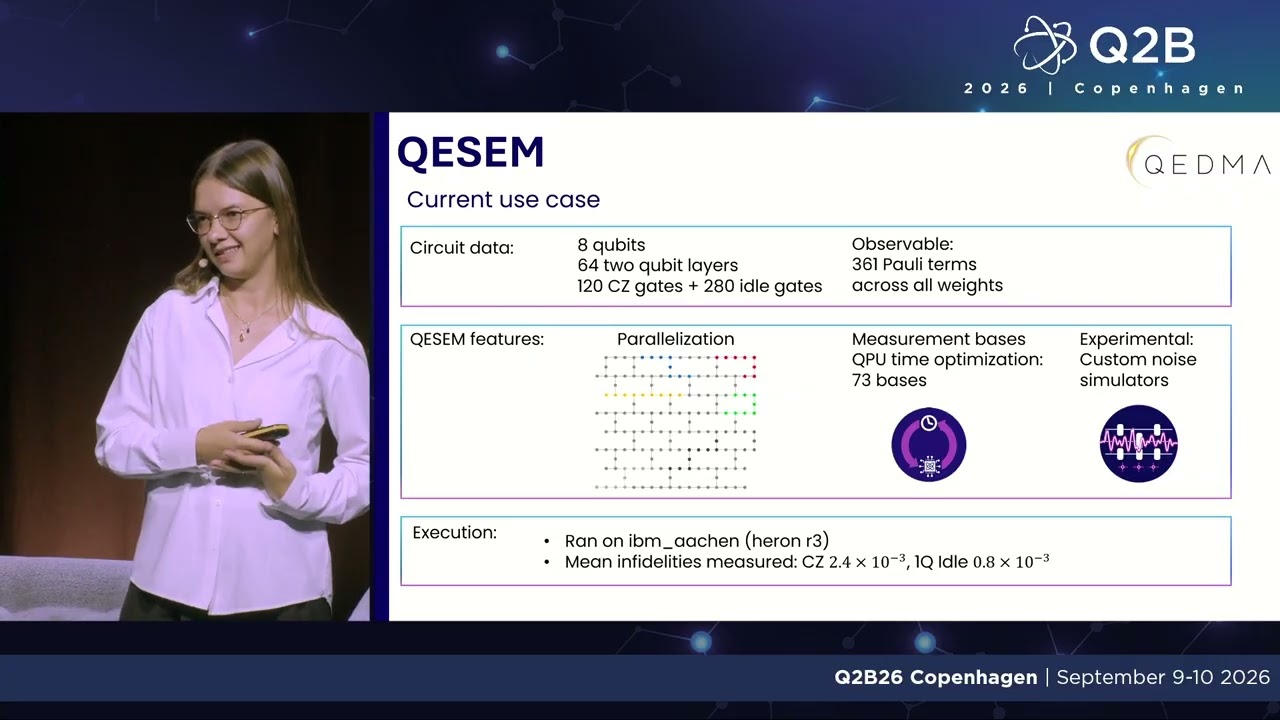
Q2B26 Copenhagen | Water Potential Energy Surface Study on quantum computer with QESEM
Keywords
Summary
182 words
Critical Evaluation
Value of the Information & Strength of the Argument
The value of this study lies in demonstrating a practical application of error mitigation to a chemically meaningful problem—calculating the PES of water—on real quantum hardware. The argumentation is structured clearly: they establish the need for sub-millihartree accuracy, show the raw errors, and then present the mitigated results with improvements of an order of magnitude. The use of orbital-optimized VQE and the PIPTOPS ansatz shows a thoughtful combination of classical and quantum resources. The statistical merging of runs is a rigorous approach to handle noise variability. However, the presentation lacks in-depth discussion of the error mitigation algorithm’s theoretical underpinnings and does not compare with other error mitigation techniques directly. The reliance on a single demonstration and the limited number of shots per point (though millions) without cross-validation on different hardware weakens the generalizability, but the observed consistent error reduction supports the method’s efficacy.
Scientific Rigor, Source Quality, Title Accuracy
The scientific rigor is moderate: the study is experimental and presented as a conference talk, with sufficient detail to replicate the general approach but not the exact parameters. Sources are not explicitly cited in the presentation, but the description links to the Q2B conference website, which likely hosts additional materials. The title is an accurate descriptor of the content, and the presentation aligns with the title. The lack of peer-reviewed publication or detailed reference to existing literature (e.g., the mentioned ‘Jones’ work) makes independent verification difficult. The talk does not provide a detailed error budget or statistical analysis beyond standard deviations. Adequacy of title is high; no mismatch is evident.
268 words
Title / Content Match
The title accurately reflects the content, presenting a specific quantum chemistry study (water PES) on quantum hardware with the QESEM error mitigation method.
Quality & Reliability
7/10
The presentation is technically sound, showing real quantum hardware results with error mitigation, but lacks detailed methodological transparency and rigorous statistical analysis; the low viewership and absence of external validation limit confidence.
Key Moments
Markers derived by PSI from the transcript: the creator did not define chapters.
- Introduction of speakers and project overview.
- Explanation of potential energy surface and quantum chemistry workflow.
- Detail of active space and PIPTOPS ansatz for the water molecule.
- Tali Shnaider introduces QESEM error mitigation and its workflow.
- Presentation of raw vs mitigated results, showing error reduction.
- Discussion of statistical merging of runs and uncertainty estimation.
Cited Sources
- Q2B Copenhagen Conference — Official conference website hosting presentation materials and possibly further details.
Contribution & Novelties
The primary novelty is the application of the QESEM error mitigation suite to a chemically relevant problem (water PES) on real hardware, achieving an order-of-magnitude error reduction. The work uniquely combines orbital-optimized VQE with a problem-inspired ansatz and a comprehensive error mitigation pipeline, including custom noise simulators. This demonstrates a practical path to chemical accuracy on NISQ devices, though with high resource overhead.
Pour aller plus loin :
- Quantum error mitigation — Overview of error mitigation techniques, relevant to the QESEM methods used.
- Variational quantum eigensolver — Core algorithm for quantum chemistry on NISQ hardware, central to this study.
- Potential energy surface — Fundamental concept in computational chemistry, the target property calculated here.
113 words
Radar Profile
The scoring profile shows high technical level and information quantity but slightly lower reliability and quality, reflecting a technically rich presentation with limited peer review. The radar suggests a talk aimed at specialists, with strong content in methodology but less emphasis on rigorous validation.