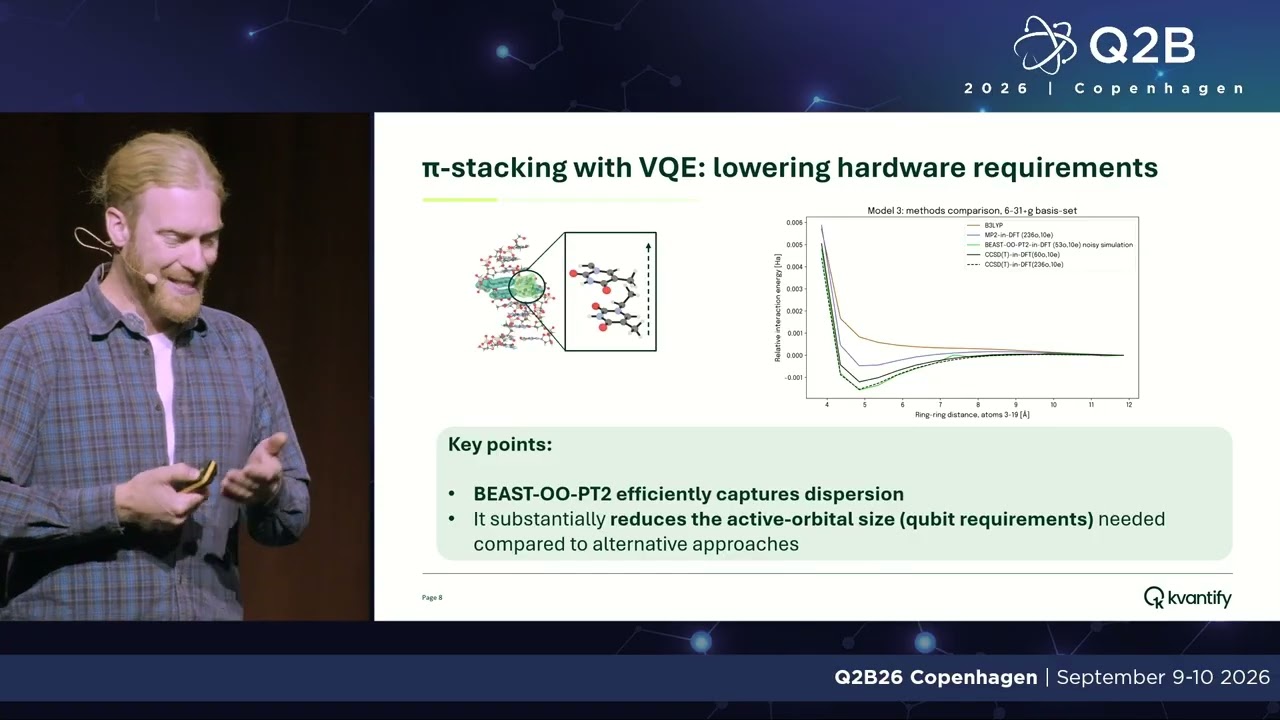
Q2B26 Copenhagen | Pier Paolo Poier, Senior Quantum Applications Scientist, Kvantify
Keywords
Summary
167 words
Critical Evaluation
Value of the Information & Strength of the Argument
The value lies in providing concrete evidence that quantum computers can effectively capture dispersion interactions, which are computationally challenging for classical methods. The argumentation is supported by simulation and hardware results, with acknowledged limitations in quantitative accuracy. The speaker clearly explains the computational advantages of their VQE approach and the necessity of scaling to fault-tolerant machines. However, the argumentation would be strengthened by more detailed comparisons with classical benchmarks and explicit treatment of error mitigation strategies.
Scientific Rigor, Source Quality, Title Accuracy
The title accurately reflects the content: a scientific talk by a quantum applications scientist from Kvantify, consistent with the conference format. The presentation relies primarily on original work, with only a single external link to the Q2B conference site provided in the description. No specific external references are cited within the talk, aside from mentioning an IBM paper on SQDRIFT without details. The methodological rigor is moderate; while the results are presented coherently, the lack of supplementary references and limited specificity on noise models and error mitigation reduce the scientific robustness. Nevertheless, the content is logically structured and transparent about its qualitative scope.
194 words
Title / Content Match
Title accurately reflects content: a scientific talk by a Kvantify quantum applications scientist on quantum chemistry.
Quality & Reliability
8/10
The presentation provides concrete simulation and hardware results for VQE and SQDRIFT, but lacks methodological details and external references beyond a single conference link.
Key Moments
Markers derived by PSI from the transcript: the creator did not define chapters.
Cited Sources
- Q2B26 Conference — Official conference website mentioned in the video description.
Contribution & Novelties
The talk contributes a practical demonstration of using VQE with orbital optimization to capture dispersion interactions with reduced quantum resources, and explores early fault-tolerant algorithms (SQDRIFT) with realistic noise simulations. It highlights the pathway from NISQ to fault-tolerant quantum chemistry, emphasizing the reuse of classical and NISQ-era knowledge. The results are preliminary but promising.
Pour aller plus loin :
- Variational quantum eigensolver — Foundation of the VQE method used in the talk.
- Quantum phase estimation algorithm — Core algorithm for fault-tolerant quantum chemistry.
- Van der Waals force — Physical basis of dispersion interactions discussed.
- SQDRIFT algorithm (no reliable public URL) — An approach for early fault-tolerant machines, referenced in the talk.
111 words
Radar Profile
The radar profile indicates high technical level and moderate levels of information quantity and reliability, consistent with a specialized conference talk that presents original results but lacks extensive external validation.