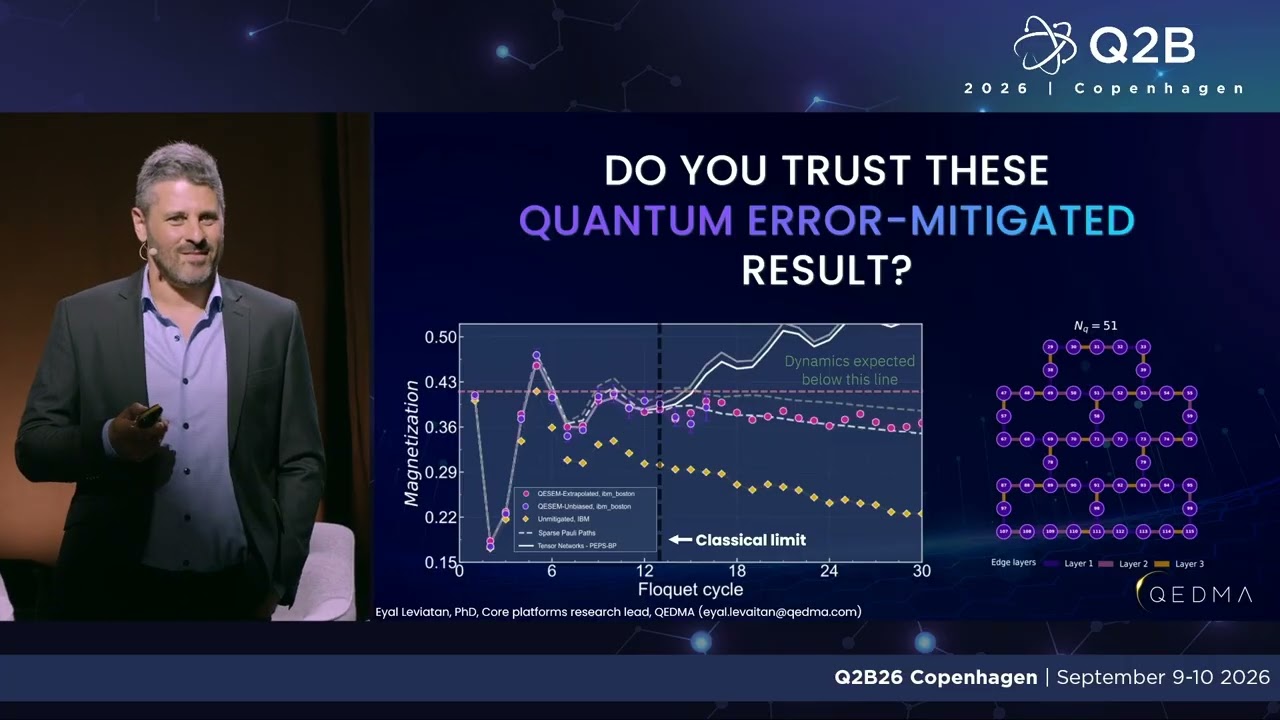
Q2B26 Copenhagen | Quantum Advantage: Modeling Physics Beyond Classical Capabilities
Keywords
Summary
217 words
Critical Evaluation
Value of the Information & Strength of the Argument
The value of the information is high: it provides concrete evidence that error mitigation enables quantum computations to surpass classical capabilities in a specific physics problem, and it showcases a practical software solution. The argumentation is solid, built on multiple checks: agreement with classical methods at early times, cross-platform validation, and finite-size scaling. The speakers are transparent about the assumptions and limitations of the extrapolated method, and they include validation tests. The demonstration of oscillations that classical methods missed is a strong argument for quantum advantage, and the chemistry part shows a path to practical applications.
Scientific Rigor, Source Quality, Title Accuracy
The rigorous approach is notable: they validate results on smaller systems where exact simulation is possible, compare different classical algorithms, and perform cross-platform tests to confirm consistency. The use of multiple validation steps strengthens credibility. The only provided source is the Q2B conference website, but the talk references an arXiv paper for computational fluid dynamics without a direct URL. The title is adequately descriptive and not misleading.
178 words
Title / Content Match
The title accurately reflects the content, which focuses on achieving quantum advantage in physics modeling via error mitigation.
Quality & Reliability
8/10
The talk presents concrete experimental results with multiple validation steps, including cross-platform agreement and consistency with smaller exact simulations. However, it is a company-presented demo, so some bias is possible.
Key Moments
Markers derived by PSI from the transcript: the creator did not define chapters.
- Introduction and the question of what convinces us of quantum advantage.
- Presentation of classical simulation methods (tensor network and sparse Pauli) and their results.
- Bare quantum results show errors; introduction to Kessm error mitigation software.
- Kessm results reproduce classical at early times and reveal oscillations absent in classical simulations.
- Cross-platform validation on Quantinuum and finite-size scaling showing a persistent response.
- Stephan P. A. Sauer discusses quantum chemistry on NISQ machines, focusing on water molecule.
- Results with error mitigation approach chemical accuracy, enabling prediction of correct molecular structure.
Cited Sources
- Q2B Conference Copenhagen — Official conference website where the talk was presented.
Contribution & Novelties
The talk demonstrates a concrete case where quantum error mitigation enables a quantum computer to simulate a 51-qubit spin system and produce results that classical methods cannot achieve, including discovering oscillations that are a genuine property of the system. This contributes to the ongoing quest for quantum advantage. The finite-size scaling with 51 and 74 qubits is a significant step, suggesting behavior persists in the thermodynamic limit. The chemistry application shows that with error mitigation, NISQ devices can achieve chemical accuracy, which is a milestone for practical quantum chemistry.
Pour aller plus loin :
- Quantum error mitigation — Relevant technique discussed in the talk.
- Noisy intermediate-scale quantum era — Context for why error mitigation is needed.
- Quantum chemistry — Application domain explored by Sauer.
- Tensor network — Classical method used for comparison.
132 words
Radar Profile
The radar profile shows high scores in information quantity, quality, and technical level, while reliability is slightly lower due to the commercial context. The overall profile indicates a technically deep and informative presentation with some bias considerations.