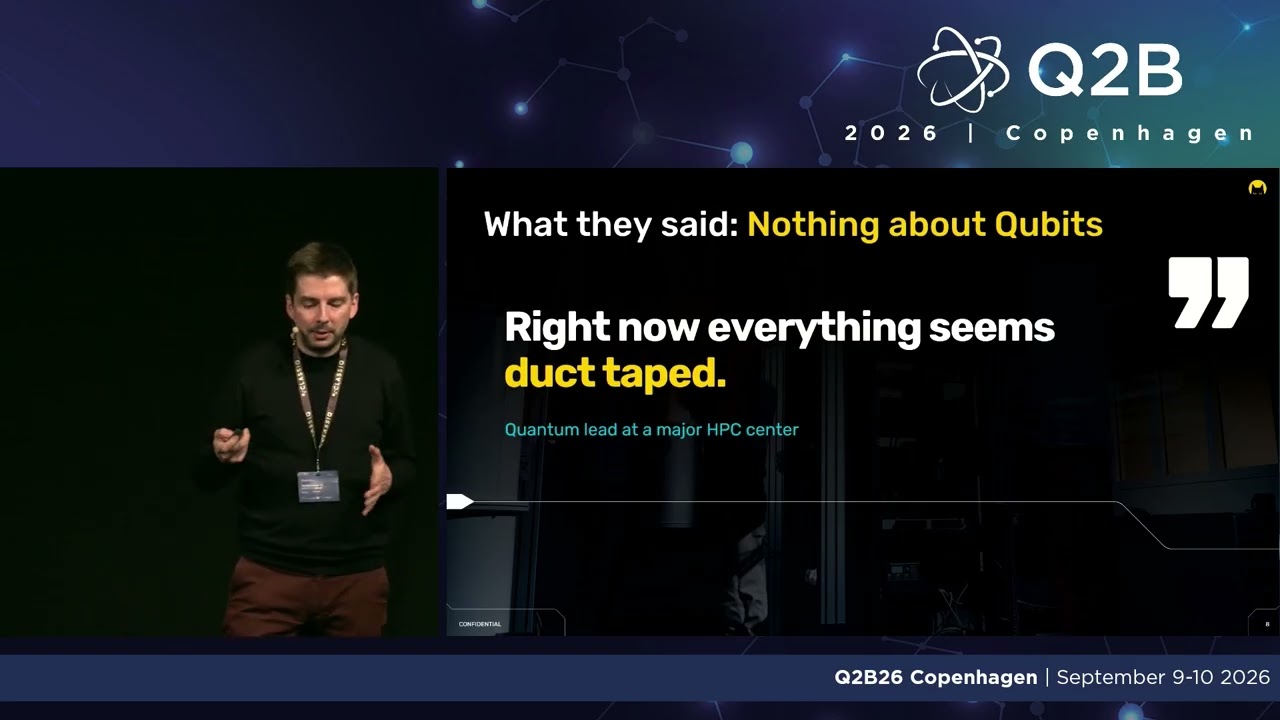
Q2B26 Copenhagen | Rémi de La Vieuville, Head of COO Tech Office, Alice & Bob
Keywords
Summary
200 words
Critical Evaluation
Value of the Information & Strength of the Argument
The value of this presentation lies in its practical, industry-oriented perspective. By combining a historical case study (Itanium) with a survey of HPC leaders, it offers concrete lessons for quantum adoption. The argumentation is structured and persuasive: it identifies specific pain points (distance, fragmentation, application readiness) and proposes actionable responses (experimentation, standardization, co-design). However, the evidence is largely anecdotal, based on a limited number of interviews, and the speaker represents a vendor with a vested interest in the quantum ecosystem. The claimed 10,000-fold speedup from co-design is mentioned without detailed citations or methodology, which weakens the scientific rigor. Overall, the talk provides useful qualitative insights but lacks quantitative backing or peer-reviewed sources.
Scientific Rigor, Source Quality, Title Accuracy
The scientific rigor is moderate. The talk references a report (not openly linked) and mentions a consortium ‘OpenQAS’ but provides no direct references to external academic studies. The title accurately reflects the content, focusing on lessons from HPC leaders. The speaker’s background and the survey of 15 organizations lend some credibility, but the lack of specific data and the promotional context (Alice & Bob) temper reliability. The title-main content alignment is strong, with no misleading claims. No comments were provided for analysis, so public reception cannot be assessed.
215 words
Title / Content Match
The title accurately describes the content: a presentation of lessons learned from HPC leaders on integrating quantum computers into data centers.
Quality & Reliability
7/10
The talk is based on a survey of 15 HPC leaders and presents practical lessons for quantum integration. However, as a vendor at Alice & Bob, there may be a promotional bias. The arguments are coherent and the Itanium analogy is insightful, but the lack of specific data or external references limits its scientific depth.
Key Moments
Markers derived by PSI from the transcript: the creator did not define chapters.
- Introduction: speaker from Alice & Bob, context of HPC and quantum integration.
- Itanium story: a cautionary tale of failed CPU architecture due to compiler difficulties.
- Survey of 15 HPC leaders: their concerns about quantum integration, including distance and fragmented stacks.
- First lesson: opportunities for experimentation now, such as testing latency and GPU configurations.
- Second lesson: lack of standards and fragmentation among vendors, HPC centers, and third parties.
- Third lesson: co-design with multiple experts can yield 10,000x speedups; mentions chemistry, materials, cryptanalysis.
- Conclusion: warning about software readiness and a call for proactive integration; reference to report and QR code.
Cited Sources
- Q2B26 Conference site — Official conference page where the talk was presented; contains links to reports and other info.
Contribution & Novelties
This talk contributes a practical synthesis of HPC leaders’ perspectives on quantum integration, highlighting three actionable lessons: experimentation, standardization, and co-design. It skillfully uses the Itanium failure as a warning to the quantum community. The originality lies in directly addressing the operational concerns of data centers, rather than focusing on qubit technologies.
Pour aller plus loin :
- Itanium architecture — Historical background on the failed processor, relevant to the analogy.
- OpenQASM — A quantum assembly language and potential standardization effort, linked to the fragmentation discussion.
- Cat qubits — The qubit technology developed by Alice & Bob, mentioned implicitly in the talk.
- Quantum error correction — Essential for fault-tolerant quantum computing, relevant to the co-design discussion.
115 words
Radar Profile
The profile shows moderate scores across all dimensions, reflecting a talk that is informative but not deeply technical. The strength lies in qualitative insights rather than quantitative evidence, indicating a balanced but not exceptional presentation.