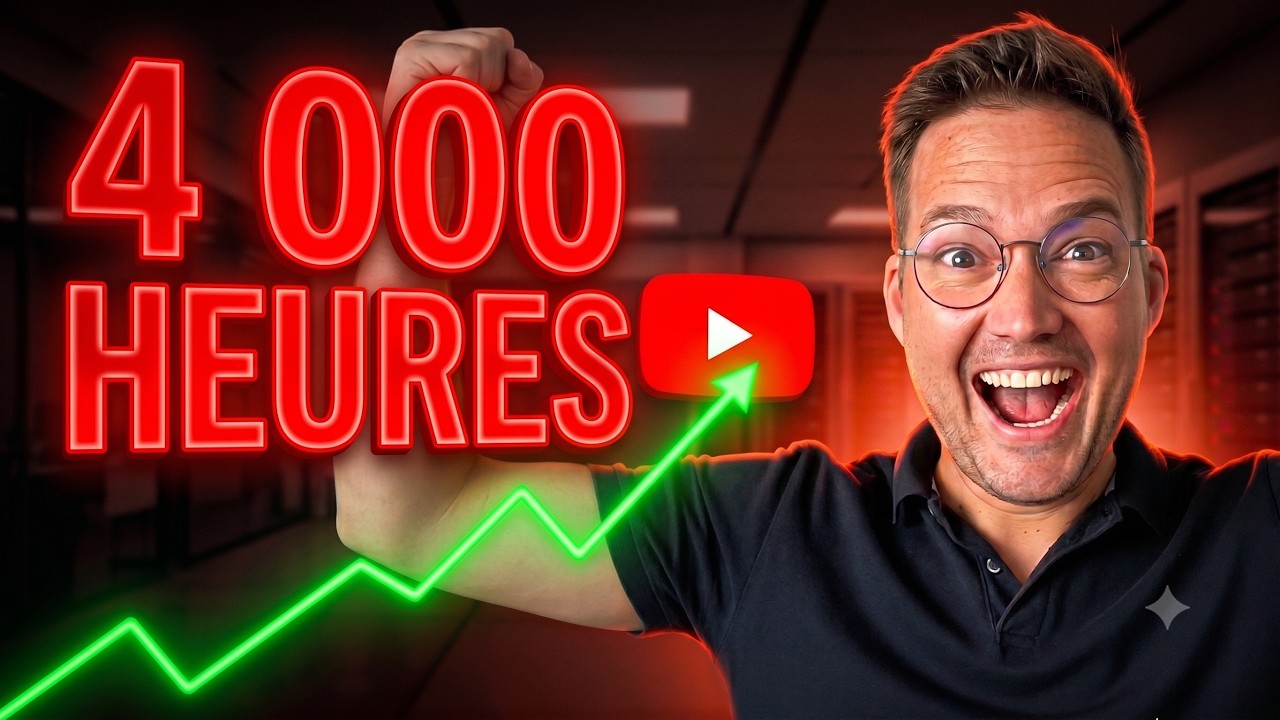
Monétisation YouTube : comment débloquer les 4 000 heures de visionnage en 6 mois
YouTube Monetization: How to Unlock 4,000 Watch Hours in 6 Months
Title history
- Monétisation YouTube : comment débloquer les 4 000 heures de visionnage en 6 mois — observed on 20261111-2335 UTC (YouTube)
Keywords
Summary
169 words
Critical Evaluation
Value of the Information & Strength of the Argument
The video provides concrete, actionable data: monthly watch time figures (40h to 1,600h), retention percentages, and the impact of specific formats. The argumentation is logical: from initial struggles to identifying the right niche and format, with data to back each claim. The creator honestly shares mistakes (wrong niche, cannibalization effect, premature promotion) and explains how he corrected them. The use of real analytics from Studio and vidIQ adds credibility. However, the video is primarily anecdotal and may not generalize; the creator acknowledges this by calling it a ‘build in public’ case.
Scientific Rigor, Source Quality, Title Accuracy
The video is based on first-hand data from the creator’s YouTube Studio and vidIQ, which are credible sources for channel statistics. Affiliate links to tools (vidIQ, CapCut, etc.) are disclosed but may introduce bias. The title is accurate and matches the content. The creator references YouTube’s official monetization criteria (1,000 subscribers and 4,000 watch hours in rolling 365 days) correctly. No external scientific sources are cited, but the video is a practical tutorial rather than a research piece. The description includes links to his newsletter, community, and affiliate tools, which are not academic sources but relevant to the topic.
205 words
Title / Content Match
The title accurately reflects the content: the creator explains how he unlocked monetization in 6 months by reaching 4,000 watch hours. The title is not misleading.
Quality & Reliability
7/10
The video is a personal case study with real data from the creator's YouTube Studio and vidIQ. The methodology is transparent: the creator shares monthly watch time, views, retention rates, and specific video performance. However, it lacks external validation and includes promotional elements (affiliate links, community plugs).
Chapters
- Le pari risqué de reprendre une chaîne abandonnée
- Pourquoi je fais vraiment des vidéos YouTube
- Le vrai démarrage : les chiffres du début
- Le déclic : changer de sujet pour tout réussir
- Le format miracle : 3 minutes pour comprendre
- La vidéo qui a tout changé pour ma chaîne
- Le moteur silencieux : la puissance du SEO
Cited Sources
- vidIQ — YouTube keyword research tool — Mentioned and used for data analysis and keyword research throughout the video.
- Skool — community hosting platform — Used to host the Club SMART community; the creator mentions it as a monetization tool.
- CapCut — AI video editing — Listed as one of the tools used in production.
- Wispr — voice typing tool — Listed as a tool to save time in writing scripts.
- Tella — screen and camera recording — Listed as a tool for recording and editing videos.
- Kit — email platform — Used for the newsletter mentioned in the video.
- Club SMART community — Promoted as a paid community for AI and productivity.
- Related video: YouTube + Skool + IA: my model for financial freedom in 2026 — Suggested as further content by the creator.
- Related video: From views to revenue: 3 systems to monetize correctly — Suggested as further content by the creator.
External References
Contribution & Novelties
The video offers a rare, transparent peek into a small channel’s growth with actual numbers, debunking common myths (e.g., ‘subscribers matter’, ‘10,000 views is success’). The key insight is the role of format (short 3-minute videos) in boosting retention and signaling quality to YouTube’s algorithm, and how a single long-form tutorial can dominate watch time due to high average view duration. The creator identifies the pitfall of promoting a paid community too early, which is a practical lesson. Overall, it provides a replicable playbook for niche-focused, SEO-driven content.
Pour aller plus loin :
- YouTube Partner Program (official criteria) — Official requirements for monetization.
- Evergreen content on Wikipedia — Concept of content that remains relevant over time.
- YouTube Watch Time (article on TubeBuddy) — Explanation of watch time and its importance.
- Retention rate and algorithm — How retention impacts recommendation.
139 words
Radar Profile
The radar profile shows high quantity of information (8) and decent quality (7), reflecting a data-rich personal account. The lower scores on technicality (6) and reliability (6) are due to a lack of external validation and the promotional nature of some content. The video is a practical guide rather than a scientific study, so the profile is appropriate.