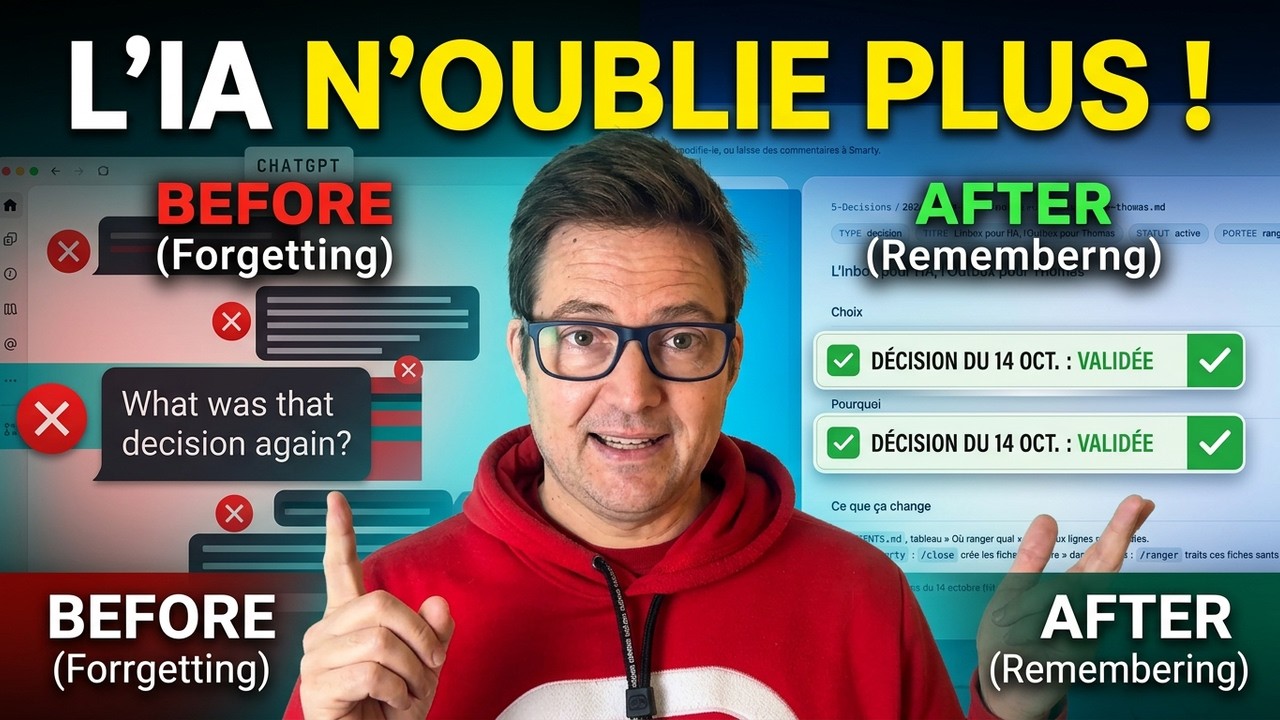
J'ai appris à Claude à ne plus rien oublier : installe ça en 5 minutes
I Taught Claude Never to Forget Anything: Set This Up in 5 Minutes
Title history
- J'ai appris à Claude à ne plus rien oublier : installe ça en 5 minutes — observed on 20261111-2335 UTC (YouTube)
Keywords
Summary
183 words
Critical Evaluation
Value of the Information & Strength of the Argument
The value lies in a simple, reproducible method to reduce wasted time and errors when using AI, illustrated with a realistic scenario. The argument is pragmatic: without a record, AI will re-suggest discarded options, leading to inefficiency and potential mistakes. The demonstration in both Claude and ChatGPT is concrete and easy to follow. However, the argument is based on personal experience and a single simulated case; it does not include quantitative data or comparative analysis, which limits its scientific weight.
Scientific Rigor, Source Quality, Title Accuracy
The video is a tutorial, not a scientific study. It does not reference external research or credible studies; the only sources are the creator’s own resources (a template and prompt) and the tools themselves. The title promises a quick fix, which is somewhat accurate but overstates the scope: it teaches a method to track decisions, not to make the AI ’never forget’ everything. No comments were provided for analysis.
164 words
Title / Content Match
The title accurately describes the goal of implementing a decision journal to prevent AI from ignoring prior decisions, though it oversimplifies the scope.
Quality & Reliability
5/10
The video provides a practical framework for managing AI decision memory, but relies on anecdotal evidence and personal demonstration. It does not cite external scientific sources, and the effectiveness is not empirically validated.
Chapters
Cited Sources
- Model and rules for the decision journal (free resource) — Offered in the video description as the downloadable template and two rules to paste into the AI project.
- Claude.ai — One of the two AI tools used for the demo; the decision journal is installed there.
- ChatGPT — The second AI tool used for the demo; the decision journal is installed there as well.
- Club Smart (Skool community) — The creator's community for learning AI system creation, mentioned as a further resource.
- Glaido (dictation tool) — Listed as one of the tools the creator uses in production, with a one-month free trial.
- Tella (screen and camera recorder) — Listed as another tool used in production, with an affiliate link.
Contribution & Novelties
The video offers a straightforward, hands-on method to enhance AI assistants’ memory consistency by introducing a ‘decision journal’ – essentially a structured file that logs decisions, rationale, and alternatives. Its originality lies in presenting a practical, cross-platform solution (works with Claude, ChatGPT, and others) that directly addresses a common pain point of AI forgetting prior context. The approach is novel in its simplicity: a single markdown file combined with strategic prompts.
Pour aller plus loin :
- Decision-making — Wikipedia article on decision-making processes, providing background on why tracking decisions matters.
- Institutional memory — Concept relevant to storing knowledge and decisions across an organization or system, analogous to the journal.
- AI alignment — The field focused on ensuring AI behaves in line with user intentions, which the decision journal partially addresses for individual decisions.
133 words
Radar Profile
The profile shows moderate scores on information quantity and quality, a low score on technical depth, and a slightly lower reliability score. This reflects a practical tutorial that is useful for beginners but lacks scientific rigor or deep technical analysis.