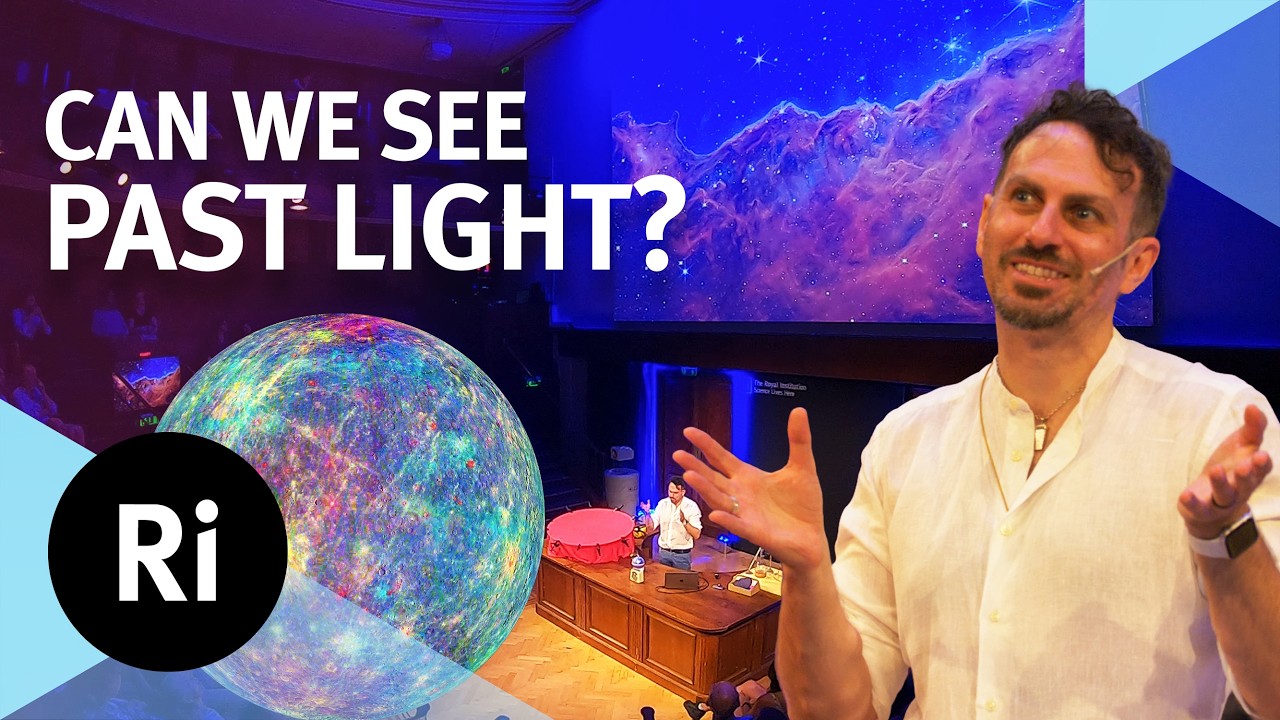
Can astronomers see the universe without light? | with Alfredo Carpineti
Keywords
Summary
193 words
Critical Evaluation
Value of the Information & Strength of the Argument
The talk provides high value by making complex astronomical concepts accessible and engaging through demonstrations and clear explanations. The argumentation is solid, grounded in real observations and missions (e.g., Event Horizon Telescope, James Webb Space Telescope, radar studies). The speaker connects historical discoveries (Jansky) to modern imaging, illustrating the progression of knowledge. While some analogies are simplified for a general audience, the core science is accurate and well-supported.
Scientific Rigor, Source Quality, Title Accuracy
The scientific rigor is high: the speaker cites specific instruments, missions, and discoveries, and the Royal Institution is a reputable venue. Sources include primary research (e.g., CMB measurements, JWST images) and the talk aligns with current astrophysical knowledge. The title accurately reflects the content, focusing on non-visible wavelengths. The description provides links to related content and the Q&A session, which are relevant. No comment analysis is possible as no comments were provided.
155 words
Title / Content Match
The title accurately reflects the content: the talk explores how astronomers study the universe using wavelengths beyond visible light, from gamma rays to radio waves.
Quality & Reliability
8/10
The talk is presented by an astrophysicist and science journalist from a reputable institution, with accurate scientific content supported by real observations and missions. Some simplifications are made for a public audience, but the core facts are reliable.
Key Moments
Markers derived by PSI from the transcript: the creator did not define chapters.
- Demonstration of the electromagnetic spectrum with audience participation
- Discussion of Titan and potential infrared rainbows
- Karl Jansky's discovery of radio waves from the Milky Way
- Imaging supermassive black holes with radio interferometry (Event Horizon Telescope)
- Detection of complex molecules like ethyl formate in Sagittarius B2
- Radar imaging of the Moon and Venus rotation measurement
- Discovery of a galaxy without stars using radio waves
- The cosmic microwave background and its significance
- JWST observations of stellar nurseries and distant galaxies
Cited Sources
- Ri Science Podcast — Mentioned in description for further listening
- Editorial policy for Ri talks — Description link for transparency
- Donate to the Royal Institution — Description link for support
- Q&A session for this talk — Description provides link to the Q&A
Contribution & Novelties
The lecture provides an original synthesis of multi-wavelength astronomy, showcasing how invisible light reveals hidden cosmic phenomena. It uniquely blends scientific history with contemporary discoveries, and includes interactive demonstrations. The speaker’s perspective as an advocate for LGBTQ+ inclusion in STEM adds a social dimension to the narrative.
Pour aller plus loin :
- Cosmic microwave background — Key concept for understanding the universe’s early structure.
- Event Horizon Telescope — The interferometric array that imaged black holes.
- James Webb Space Telescope — Infrared observatory central to current astronomical research.
- Radio astronomy — Field that enabled discoveries like quasars and pulsars.
98 words
Radar Profile
The profile shows high quality and reliability with slightly lower technical depth, indicating content that is accurate and credible but aimed at a general audience rather than specialists. The strong communication and demonstration aspects are reflected in the high information quality score.