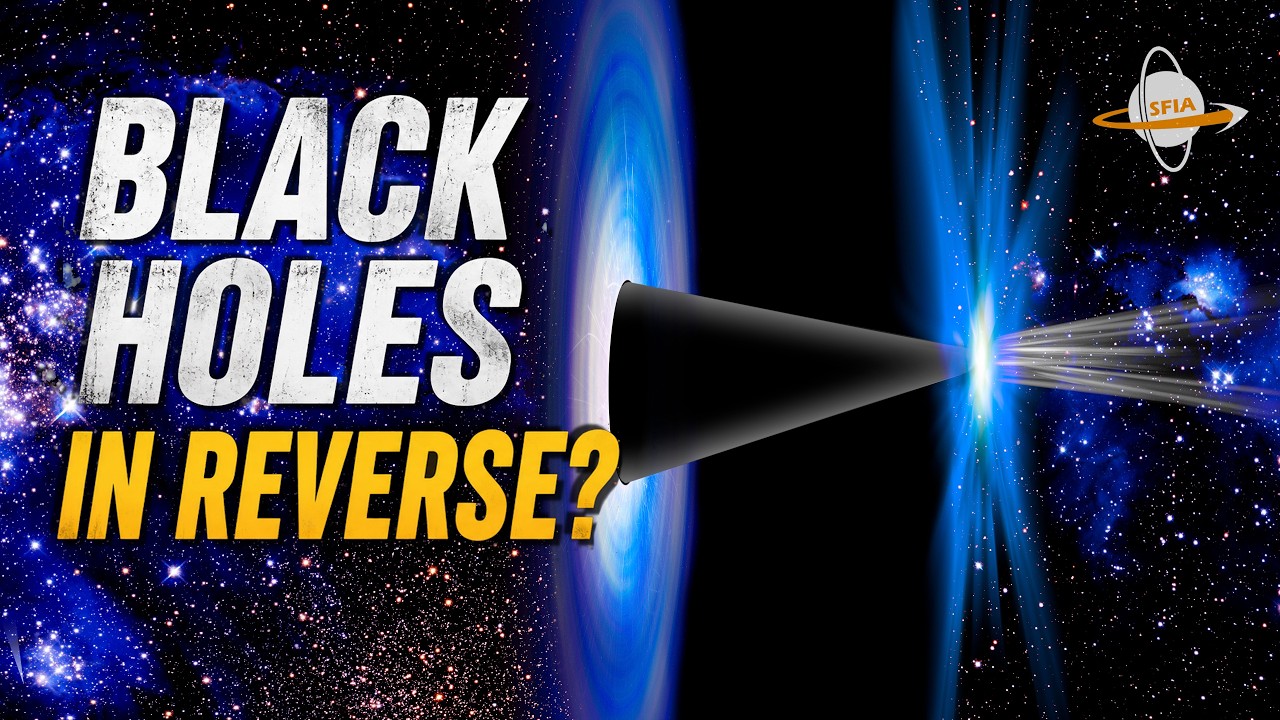
White Holes: Do They Exist?
Title history
- White Holes: Do They Exist? — observed on 20261015-2220 UTC (PSI archive)
Keywords
Summary
172 words
Critical Evaluation
Value of the Information & Strength of the Argument
The video excels in communicating complex physics with clarity and depth. It adds value by systematically breaking down the mathematical and conceptual foundations of white holes, from the causal structure of spacetime to the role of entropy and the arrow of time. The argumentation is solid: it starts with the definition, contrasts with black holes, explains why white holes are difficult to form and keep, and then surveys speculative extensions like quantum gravity and baby universes. The narrator carefully labels which ideas are mainstream and which are speculative, fostering critical thinking. The use of analogies (e.g., shattered glass reassembling) makes the abstract accessible. The inclusion of observational evidence and the lack of detection strengthens the scientific credibility.
Scientific Rigor, Source Quality, Title Accuracy
The video demonstrates strong scientific rigor by grounding the discussion in established theories (general relativity, thermodynamics) and clearly separating consensus from hypotheses. It cites real phenomena like Hawking radiation and the cosmic microwave background, and references specific models (Planck stars, loop quantum gravity). The quality of sources is good, although no direct academic citations are given; instead, the presentation builds on well-known physics concepts. The title is perfectly aligned with the content: it asks a direct question and the video thoroughly addresses it, giving a nuanced answer. Comments analyzed (30 total) reflect a positive and engaged audience, with many appreciating the clarity and offering their own speculative ideas, but no negative or toxic trends were observed.
248 words
Title / Content Match
The title perfectly matches the content, which directly addresses the existence of white holes and their theoretical foundations.
Quality & Reliability
9/10
The video provides a comprehensive, accurate, and well-structured explanation of white holes, clearly distinguishing established physics from speculative concepts. The argumentation is rigorous, using analogies and examples effectively.
Chapters
Cited Sources
- Epidemic Sound — Music provider credited for the episode's soundtrack.
- Isaac Arthur's Website — Channel's official website.
- Nebula (sponsor link) — Sponsor link for Nebula subscription.
- Rifftrax on Nebula — Sponsor segment highlighting RiffTrax content.
- IsaacArthur Reddit Community — Community forum for discussions.
- Subscribestar Support — Support platform for the channel.
Concurring Sources
- White Hole - Wikipedia — General overview matching the video's discussion.
Contribution & Novelties
The video’s original contribution lies in its comprehensive synthesis of white hole physics, drawing connections between classical relativity, quantum gravity, and cosmology. It effectively communicates the speculative nature of concepts like Planck stars and baby universes while grounding them in the mathematical framework of general relativity. The discussion of time reversal and entropy provides a novel perspective on why white holes are theoretically possible yet observationally absent.
Pour aller plus loin :
- White hole (Wikipedia) — Provides a general overview and references.
- Hawking radiation (Wikipedia) — Key concept for black hole evaporation and potential white hole transitions.
- Maximally extended Schwarzschild solution (Wikipedia) — Discusses the spacetime structure including white hole regions.
- Planck star (theory) — Proposed quantum-gravity phenomenon connecting black holes and white holes.
124 words
Radar Profile
The radar profile shows high scores in quantity, quality, and reliability, with a slightly lower technical level, indicating a well-balanced, accessible yet rigorous scientific presentation.
💬 positive, The 30 comments are overwhelmingly positive, praising the clarity of the video and the channel's style, with many viewers engaging in light-hearted scientific banter and speculation.