Li Ye: Energetics of Integrating the Brain and Body (October 7, 2027)
Title history
- Li Ye: Energetics of Integrating the Brain and Body (October 7, 2027) — observed on 20261026-2138 UTC (YouTube)
Keywords
Summary
166 words
Critical Evaluation
Value of the Information & Strength of the Argument
The presentation offers significant value by providing direct measurements of glucose dynamics in vivo during behavior, moving beyond theoretical estimates of brain energy use. The argumentation is logically structured: it starts with historical context, describes the molecular screen that identified PDH, then details the biosensor experiments and learning-associated metabolic changes. The use of multiple controls (GFP sensor, astrocyte expression, glucose transporter blockade) strengthens the conclusions. The speaker acknowledges limitations and frames the final hypothesis as provocative, which is appropriate for a scientific lecture. Overall, the evidence is compelling and the reasoning is transparent.
Scientific Rigor, Source Quality, Title Accuracy
The lecture references seminal works such as the CMR measurements from the 1940s and the efficient-coding principles reviewed by Laughlin and Attwell around 2000. Specific tools like the calcium sensor GCaMP and glucose sensors developed by the Janelia Research Campus are cited. The main source listed in the description is the Simons Foundation event page, which provides context for the research program. The title precisely matches the content, and the speaker’s claims are consistent with the described methodology. Although some citations lack explicit URLs, the scientific background is well-established and the presented data are original. There is no obvious discrepancy between the title and the content.
214 words
Title / Content Match
The title accurately reflects the content, focusing on the energetic coupling between brain and body in the context of neural activity.
Quality & Reliability
8/10
The lecture presents original research supported by established techniques and published findings. The methods are clearly explained, and the claims are grounded in experimental data, though some hypotheses remain provocative.
Key Moments
Markers derived by PSI from the transcript: the creator did not define chapters.
- Introduction to brain energy consumption and analogy with data centers.
- Historical measurement of cerebral metabolic rate (CMR) and respiratory quotient.
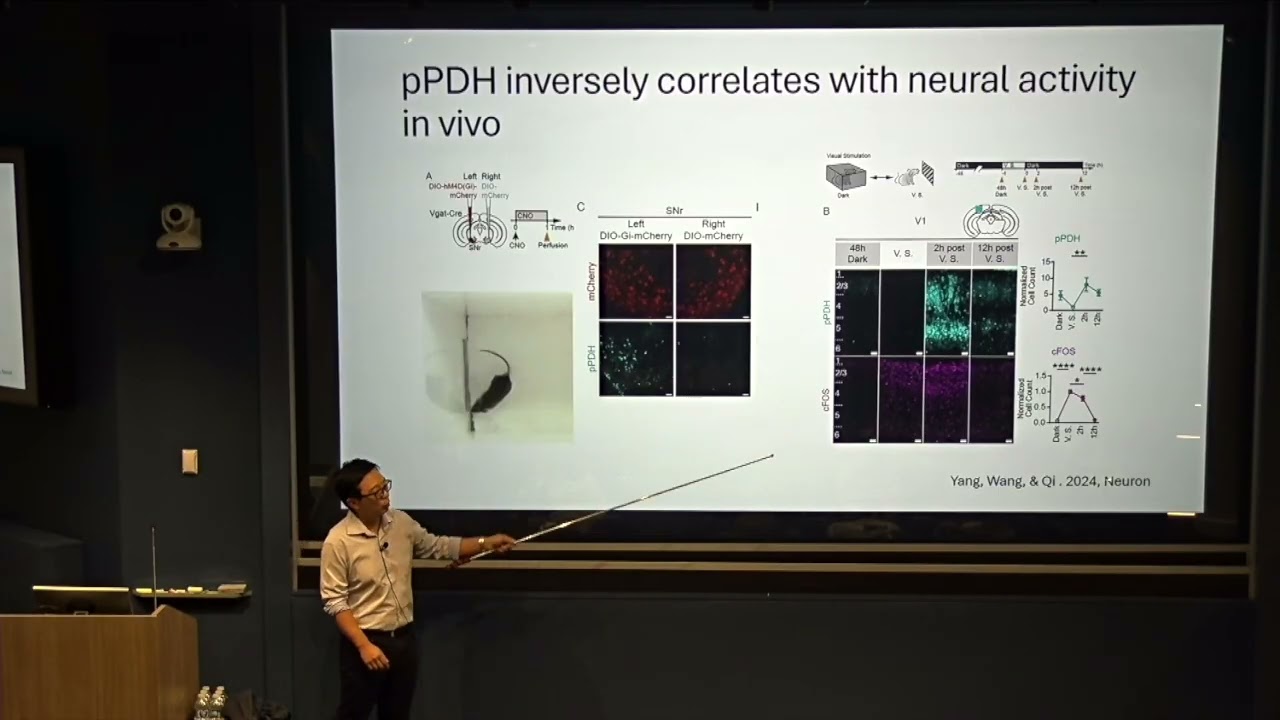
- Screen for activity markers and discovery of pyruvate dehydrogenase (PDH).
- Use of genetically encoded glucose sensors to measure intracellular glucose in neurons.
- Spatial learning task in mice showing decreased glucose consumption with learning.
- Discussion of implications for brain-body energetics and future research directions.
Cited Sources
- Energetics of Integrating the Brain and Body - Simons Foundation Event — Official event page providing details about the lecture and the speaker's research program.
Contribution & Novelties
This lecture provides novel directly measured evidence that intracellular glucose levels in neurons fluctuate dynamically with neural activity and learning, challenging the traditional view of stable intracellular glucose homeostasis. The use of biosensors to track glucose in real time in specific brain regions during behavior offers a new methodological approach to study brain energetics.
Pour aller plus loin :
- Cerebral metabolic rate - Wikipedia — Background on the classical measurement technique.
- Brain energy metabolism - Wikipedia — Overview of how the brain utilizes energy.
- Immediate early gene - Wikipedia — Explains the c-fos system used as activity marker.
98 words
Radar Profile
The radar profile shows high scores in information quantity and quality, with a strong foundation in experimental evidence. The technical level is substantial, making the lecture valuable for a scientifically literate audience. Overall, the work appears robust and impactful, with a slight emphasis on original data rather than broad synthesis.