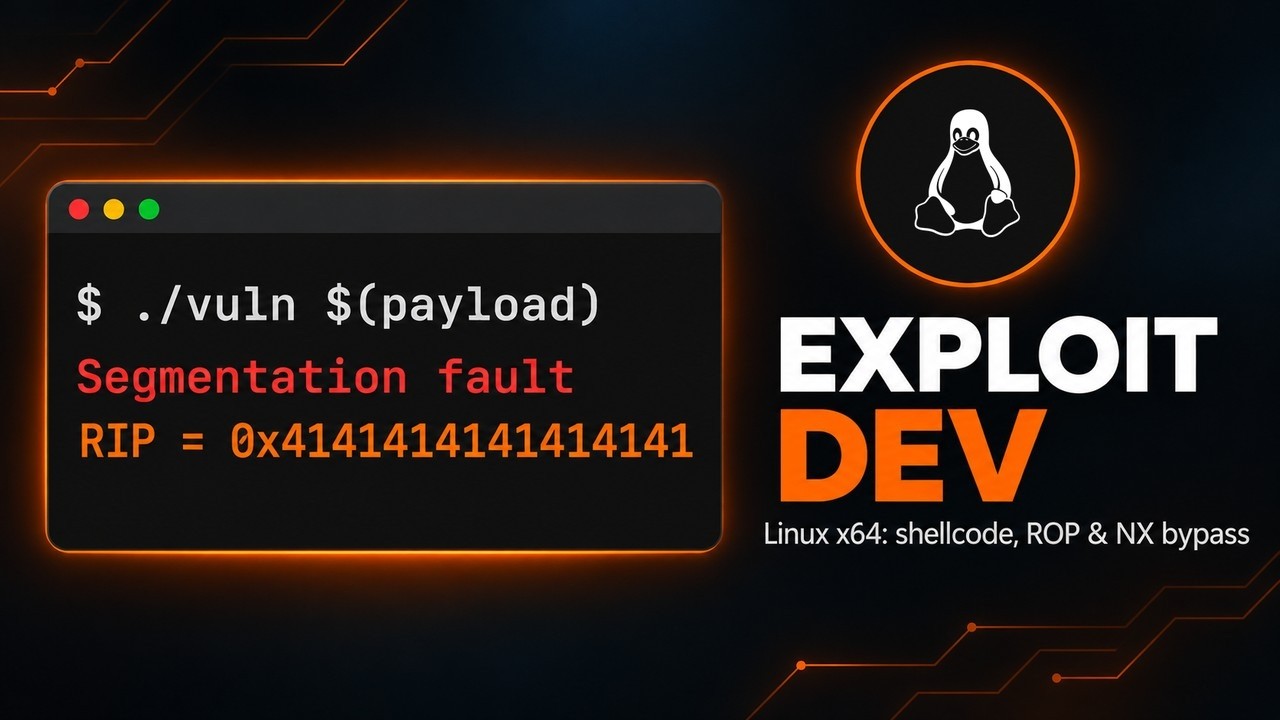
Linux x64 Exploit Development: Full Course for Beginners
Title history
- Linux x64 Exploit Development: Full Course for Beginners — observed on 20261105-2136 UTC (YouTube)
Keywords
Summary
128 words
Critical Evaluation
Value of the Information & Strength of the Argument
The video provides high educational value by breaking down complex exploit development into digestible modules. It builds a logical progression from assembly basics to advanced mitigation bypasses, ensuring learners grasp foundational concepts before moving on. The hands-on approach with real code and GDB debugging reinforces each technique. The argumentation is sound: each technique is demonstrated, and the reasoning behind each step is explained, such as using subregisters to avoid null bytes and the mechanism of exclusive-or to zero registers. The course is well-structured and encourages practical experimentation.
Scientific Rigor, Source Quality, Title Accuracy
Scientific rigor is moderate: the content is technically accurate and aligns with standard exploitation techniques, but the video lacks external references or citations to authoritative sources. The practical experiments serve as internal validation. The title is accurate and fitting: it is a full course for beginners on Linux x64 exploit development. No external inconsistencies were observed. The description provides links to additional resources such as the creator’s website and GitHub, but these are not scientific references.
178 words
Title / Content Match
The title accurately describes a comprehensive beginner-level course on Linux x64 exploit development, covering assembly to advanced bypass techniques.
Quality & Reliability
7/10
Well-structured tutorial with hands-on demonstrations using GDB; concepts are standard and accurately presented, but no external citations or verification by reputable institutions.
Chapters
Cited Sources
- TechBlazes Website — Official course hub, books, and tools mentioned in the description.
- TechBlazes GitHub — Repository for additional resources and code examples.
- TechBlazes Telegram — Community channel for discussions and updates.
- Lifetime Pass — Paid access to all TechBlazes courses and tools.
- TechBlazes WhatsApp — Alternative contact channel for the community.
Contribution & Novelties
The video offers a clear, structured, and practical introduction to Linux x64 exploit development, filling a gap for beginners who need a step-by-step foundation. It effectively demystifies complex topics like ROP and ret2plt with concrete examples. The novelty lies in its all-in-one approach, covering everything from assembly to modern mitigations in a single course.
Pour aller plus loin :
- Return-oriented programming (ROP) — Core technique explained in the video; essential for bypassing NX.
- Executable space protection (NX bit) — The mitigation that ROP and ret2libc aim to defeat.
- Address space layout randomization (ASLR) — The mitigation bypassed via ret2plt and other techniques.
- GNU Debugger (GDB) — Tool used extensively for hands-on debugging in the course.
115 words
Radar Profile
The radar profile shows balanced strengths in quantity of information and technical depth, with slightly lower scores in reliability due to lack of external validation. The video is a solid educational resource, particularly strong in scope and pedagogical structure.