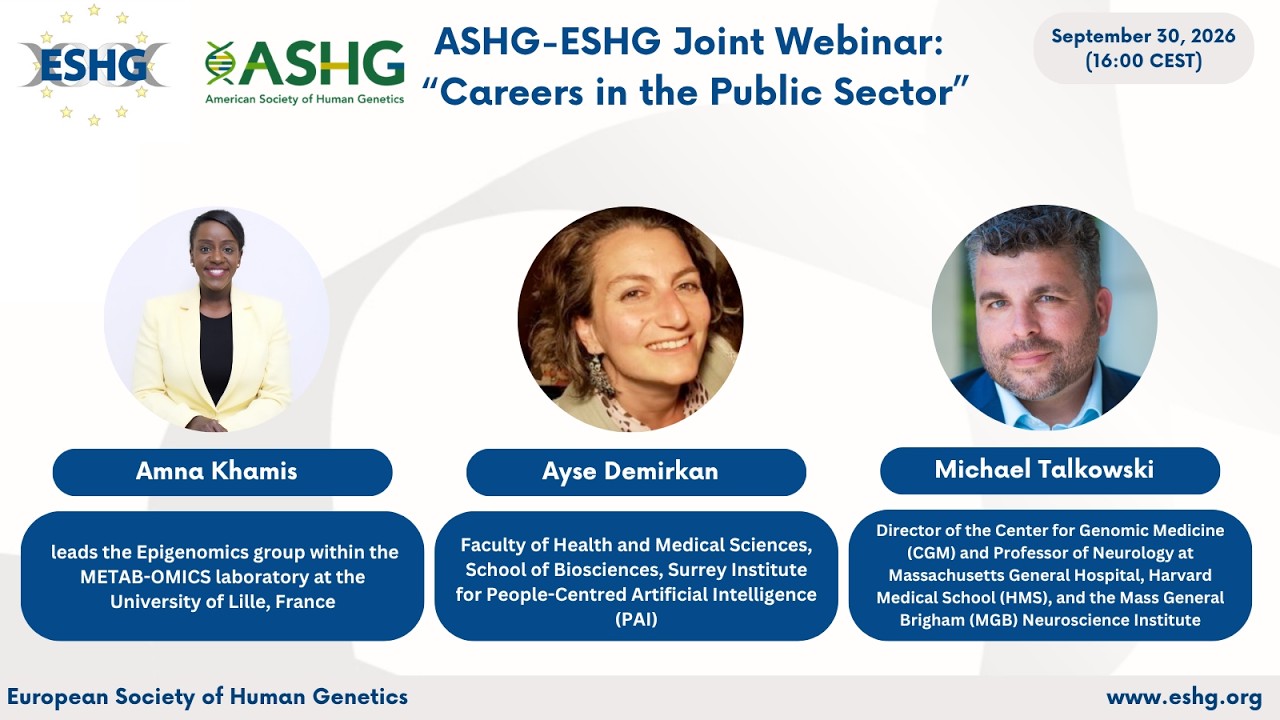
ASHG-ESHG Joint Webinar: Careers in the Public Sector
Keywords
Summary
182 words
Critical Evaluation
Value of the Information & Strength of the Argument
The informational value lies in the authentic, first-hand career narratives of three successful scientists who have navigated academia, public sector roles, and entrepreneurial ventures. Their experiences provide concrete examples of alternative career pathways, practical advice on skill development, and realistic descriptions of daily responsibilities. The argumentation is persuasive through personal testimony and reflection rather than data-driven evidence. Each speaker argues that non-linearity, mentorship, and self-awareness are critical to success, supporting these claims with specific episodes from their careers. However, the lack of systematic guidance or comparison across sectors weakens the generalizability. The panel discussion adds interactive value by directly addressing audience questions, reinforcing the relevance and practical utility of the advice.
Scientific Rigor, Source Quality, Title Accuracy
The scientific rigor is moderate: the content is experiential and not based on systematic review or original research. Speakers cite their institutional affiliations and personal experiences, but no external sources or publications are referenced. The title accurately represents the webinar’s scope, as all presentations and discussions center on careers in the public sector within human genetics. The adequacy between title and content is strong, with no major deviations. The absence of cited sources reduces the verifiability, but the experts’ credentials and the structured format partially compensate. The webinar is not advertised as a scientific lecture but as an educational career development session, which the content appropriately matches.
233 words
Title / Content Match
The title accurately reflects the webinar's focus on careers in the public sector, with presentations and a panel discussion addressing pathways, skills, and advice.
Quality & Reliability
7/10
The webinar features three established researchers sharing personal career narratives, offering authentic insights but limited empirical data. Their academic credentials and institutional affiliations lend credibility, yet the content is largely anecdotal and advisory rather than peer-reviewed.
Key Moments
Markers derived by PSI from the transcript: the creator did not define chapters.
- Welcome and introduction by hosts, overview of webinar format and speakers.
- First speaker Ayse Demirkan shares her career journey from biological oceanography to genetic epidemiology, emphasizing interdisciplinary moves and networking.
- Second speaker Amna Khamis discusses her path from Kuwait to UK and France, focusing on diabetes genetics, mentorship, and embracing non-linear career progression.
- Third speaker Michael Talkowski describes his mission-driven academic career, the entrepreneurial soft-money model, and the shift to team science and administration.
- Panel discussion begins; moderators address audience questions on mentorship, career planning, and transitioning between sectors.
- Q&A continues, covering topics such as balancing personal life and career, and the importance of building a support network.
Contribution & Novelties
The webinar offers a valuable insider perspective on public sector scientific careers, particularly in genomics and genetic epidemiology. It fills a gap by showcasing concrete pathways and practical advice from scientists who have successfully navigated academia, regulatory science, and administration. The emphasis on non-linearity and the importance of mentorship provides a realistic counterpoint to idealized career models. The panel discussion yields candid responses that are often missing from formal career guides.
Pour aller plus loin :
- Mentorship — Provides a general overview of mentoring roles, aligning with the speakers’ emphasis on finding good mentors.
- Science policy — Explains the role of science in policy-making, relevant to public sector careers discussed in the webinar.
- NIH Office of Intramural Training & Education — Official resource for career development and training opportunities in biomedical research, useful for early-career scientists.
136 words
Radar Profile
The radar profile shows moderate scores across all dimensions, with slightly higher reliability and information quality compared to technical level. This reflects the webinar's strength in delivering trustworthy expert perspectives while keeping technical content accessible. The balance suggests a resource primarily valuable for its advisory content rather than advanced scientific detail.