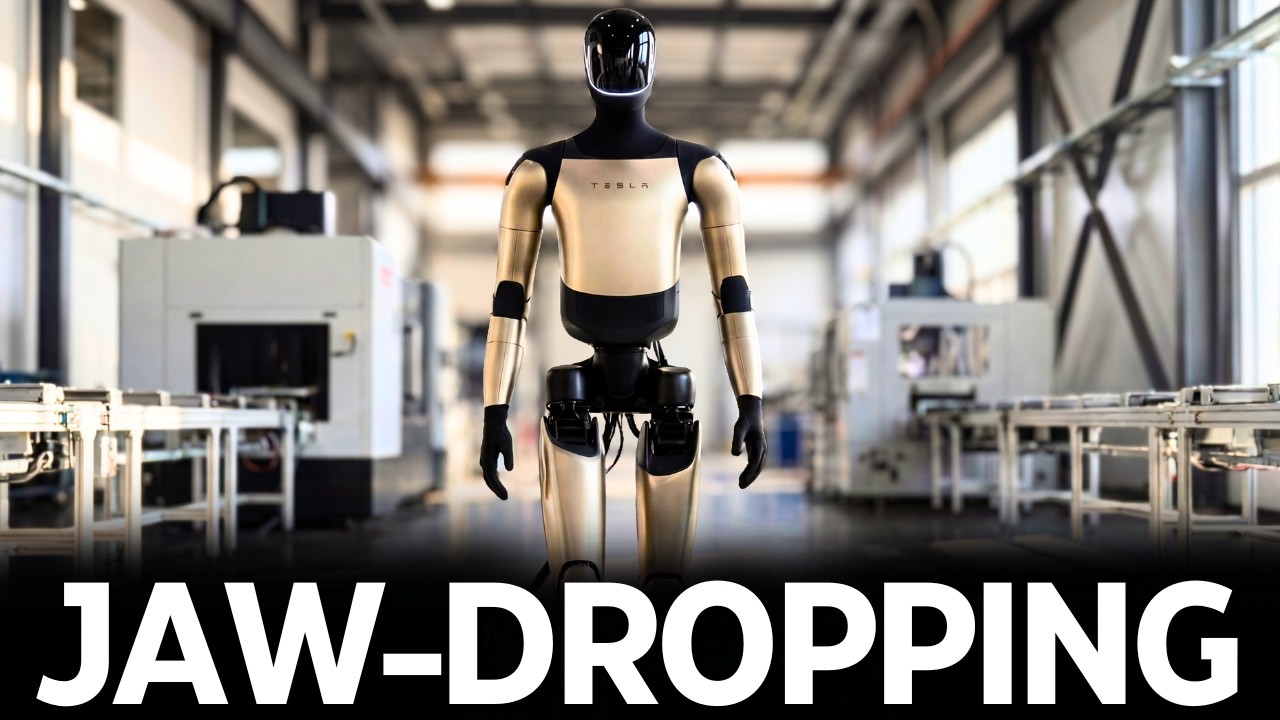
WTF is happening at Tesla
Title history
- WTF is happening at Tesla — observed on 20261110-0326 UTC (YouTube)
Keywords
Summary
164 words
Critical Evaluation
Value of the Information & Strength of the Argument
The video provides valuable insight into Tesla’s robot strategy by reframing the competitive landscape. The central argument—that Tesla is building hardware optimized for future AI rather than current limitations—is well articulated and supported by concrete examples like degrees of freedom and the threading-a-needle metaphor. The analogy with Tesla’s Full Self-Driving evolution is persuasive, as it demonstrates how the same hardware can achieve vastly better performance through software updates. The reasoning is logical and addresses counterarguments, though some claims are speculative (e.g., AI reaching human dexterity) and rely on long-term projections. The presentation is engaging, with clear explanations and effective pacing, making complex concepts accessible without oversimplifying.
Scientific Rigor, Source Quality, Title Accuracy
The video’s credibility is bolstered by Farzad’s background as a former Tesla employee and shareholder, but it lacks rigorous external citations. The primary sources are the author’s own website and articles, along with references to public information about competitor robots. The stance is clearly labeled as opinion, with disclaimers about financial interests. The title is somewhat sensationalist but accurately reflects the content’s core message about Tesla’s unexpected strategy. Overall, the scientific rigor is moderate; the analysis is thoughtful but not peer-reviewed, and the reliance on anecdotal evidence and future predictions limits its empirical strength.
215 words
Title / Content Match
The title is catchy and captures the essence of the video, though it slightly exaggerates the 'WTF' factor as the content is a more measured analysis.
Quality & Reliability
7/10
The video offers a well-structured and plausible argument, supported by specific technical comparisons and the author's background as a former Tesla employee. However, it remains an opinion piece with speculative projections about AI development, and lacks independent citations beyond the author's own materials.
Key Moments
Markers derived by PSI from the transcript: the creator did not define chapters.
- Introduction to the misunderstood Tesla robot strategy and overview of CES 2026 demos.
- Comparison of hand dexterity across Boston Dynamics, Figure, Unitree, and Tesla, highlighting degrees of freedom.
- Explanation of Tesla's long-term hardware strategy versus competitors' short-term practicality, and the parallel with Full Self-Driving.
- Threading a needle example illustrating the future potential of high-degree-of-freedom hands and implications for fields like medicine.
- Counterarguments addressed, including the possibility of AI stagnation, and the data flywheel advantage via Tesla's factory robots.
Cited Sources
- Farzad.fm — Author's official website with community, research, and exclusive content.
- Farzad Consulting — Service offering AI implementation for small businesses.
- Exclusive: WTF Tesla Optimus Software Hands — Supplementary article expanding on the video's key points about Optimus software and hardware.
External References
Contribution & Novelties
The video offers a fresh perspective by framing Tesla’s humanoid robot strategy as a ‘hardware futureproofing’ play, contrasting it with competitors’ short-term optimizations. It systematically compares hand dexterity metrics and connects Tesla’s approach to its successful FSD trajectory, providing a coherent narrative that challenges the prevailing narrative of Tesla being behind. The emphasis on the data flywheel as a decisive moat is particularly insightful.
Pour aller plus loin :
- Human hand — Understanding the 27 degrees of freedom and complexity of the human hand is essential to appreciate the engineering challenge.
- Degrees of freedom (mechanics) — This concept underpins the entire comparison of robot hand capability.
- Neural network — The AI models that control these robotic hands are critical; the video assumes their continued exponential improvement.
- Tesla Full Self-Driving — The analogy with FSD’s evolution from rough to reliable validates the ‘software catches up’ thesis.
145 words
Radar Profile
The radar profile shows a balanced presentation with strong scores in quantity and technical level, but lower reliability due to the speculative nature. The video excels in delivering substantial content and technical depth, yet its credibility is tempered by the lack of independent citations and forward-looking predictions.
💬 Out of 30 comments, the sentiment is overwhelmingly positive, with viewers expressing appreciation for the clear analysis and unique perspective. A few commenters criticize the video's length relative to its core message, but overall enthusiasm and agreement dominate the discussion.