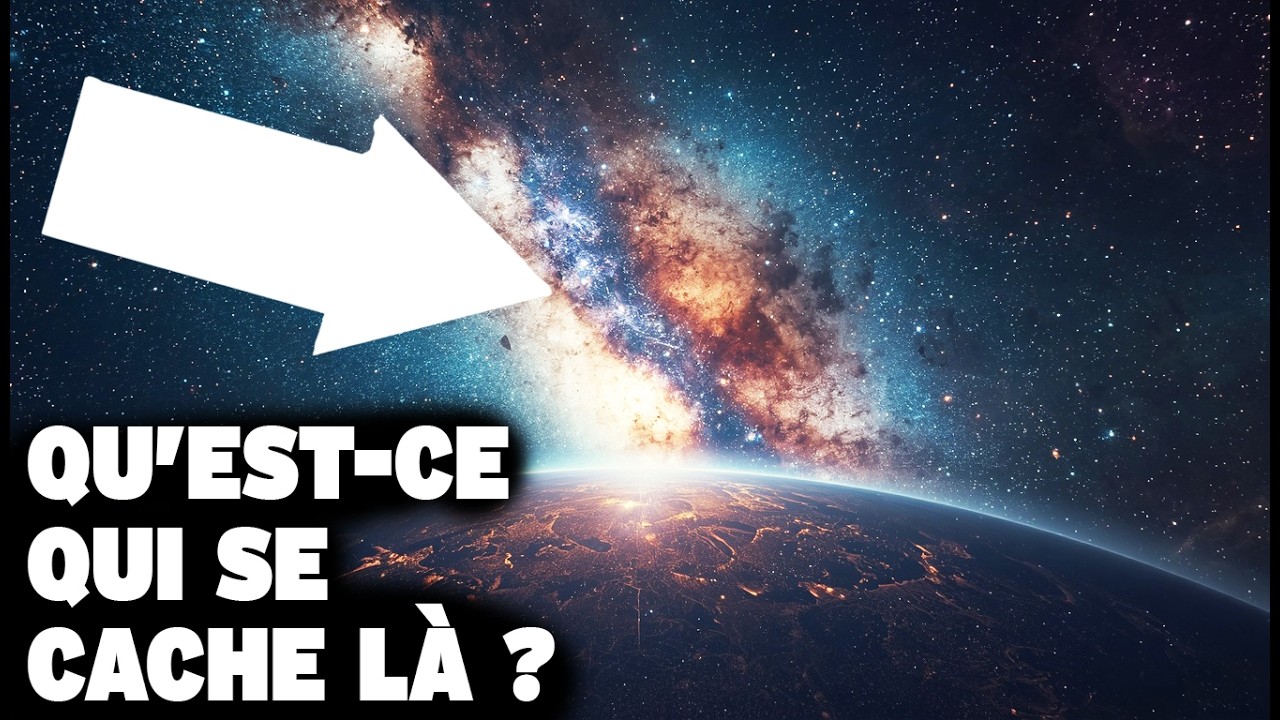
Quelque chose d'immense se cache derrière la Voie Lactée - DOCUMENTAIRE ESPACE
Something immense is hiding behind the Milky Way - SPACE DOCUMENTARY
Title history
- Quelque chose d'immense se cache derrière la Voie Lactée - DOCUMENTAIRE ESPACE — observed on 20261020-2048 UTC (YouTube)
Keywords
Summary
206 words
Critical Evaluation
Value of the Information & Strength of the Argument
The value of the information is high as it provides a comprehensive narrative of how astronomers perceive the large-scale structure of the universe, connecting historical discoveries to current theories. The reasoning follows a well-structured logical progression: establishing the observational barrier, explaining how scientists circumvented it, identifying the gravitational anomaly, and then placing it within the broader framework of Laniakea and the cosmic web. The argumentation acknowledges scientific debates, particularly the skeptical handling of the Dark Flow claim, and correctly notes that structures like the Great Attractor are gravitational concentrations rather than bound objects. This maintains scientific integrity while offering an exciting narrative.
Scientific Rigor, Source Quality, Title Accuracy
The video demonstrates strong scientific rigor. It accurately references key publications and researchers, such as the 2014 Nature paper on Laniakea and the 2008 astrophysical journal study on Dark Flow, though it does not provide direct URLs in the description. It clearly distinguishes between confirmed facts (existence of the Great Attractor, Laniakea) and unconfirmed hypotheses (Dark Flow). The title aligns precisely with the content, avoiding exaggeration. The absence of source links in the description slightly reduces source traceability, but the verbal citations and conceptual accuracy are commendable.
204 words
Title / Content Match
The title precisely matches the content, which reveals hidden cosmic structures behind the Milky Way, focusing on the Great Attractor and Laniakea. It accurately sets the documentary's scope.
Quality & Reliability
9/10
The information is scientifically accurate and largely up-to-date, covering recognized structures (Great Attractor, Laniakea, Shapley supercluster) and known astronomical controversies (Dark Flow, Hubble tension). The tone is appropriately cautionary regarding unconfirmed phenomena, and the explainers of technical concepts (redshift, surface brightness, gravitational attraction) are sound. Minor dramatic colouring in the narration does not undermine factual integrity.
Key Moments
Markers derived by PSI from the transcript: the creator did not define chapters.
- Introduction to the Zone of Avoidance, explaining the opacity of the galactic plane and the 20% blind spot in the sky.
- Detection of the Norma cluster in the 1990s using radio and infrared surveys penetrating the dust.
- Formulation of the Great Attractor hypothesis by the Seven Samurai group, based on galaxy peculiar velocities.
- In 2014, Brent Tully and collaborators publish the Laniakea supercluster reconstruction, redefining our local universe.
- Discussion of the Shapley supercluster and the cosmic web, with reference to the South Pole Wall structure.
- Introduction of the Hubble tension and how local structures like the Great Attractor might bias measurements, before future instruments such as SKA and Euclid.
Contribution & Novelties
The documentary offers a valuable synthesis of recent advances in large-scale cosmology, integrating topics often treated separately in public discussions: the observational constraints of the Zone of Avoidance, the gravitational dynamics of the local universe, and the hierarchy of structures from local groups to the Laniakea and Shapley superclusters. Its particular originality lies in connecting the historical discovery of the Great Attractor with modern computational mapping techniques and discussing the ongoing relevance of this blind spot for new facilities. It also correctly criticizes the popular misconception that we can see the entire universe, highlighting that a significant fraction remains unmapped.
Pour aller plus loin :
- Great Attractor — Detailed entry on the gravitational anomaly, its discovery, and its relation to the cosmic microwave background dipole.
- Laniakea Supercluster — Scope and context of the supercluster defined by velocity flows, including its 2014 description.
- Zone of Avoidance — Scientific explanation of the dust absorption hindering extragalactic observations.
- Shapley Supercluster — Overview of the massive concentration of galaxies influencing local dynamics.
- Hubble tension — Discussion of the discrepancy in measured expansion rates, directly related to the environmental biases mentioned in the video.
189 words
Radar Profile
The radar profile shows a high score in quantity of information (perfectly judging the footage's density) alongside elevated quality and technical level, reflecting a content rich in well-explained concepts. The overall reliability closely follows, indicating a very credible documentary, with global assessment being slightly lower than the raw scores due to stylistic elements and generic narrative framing.