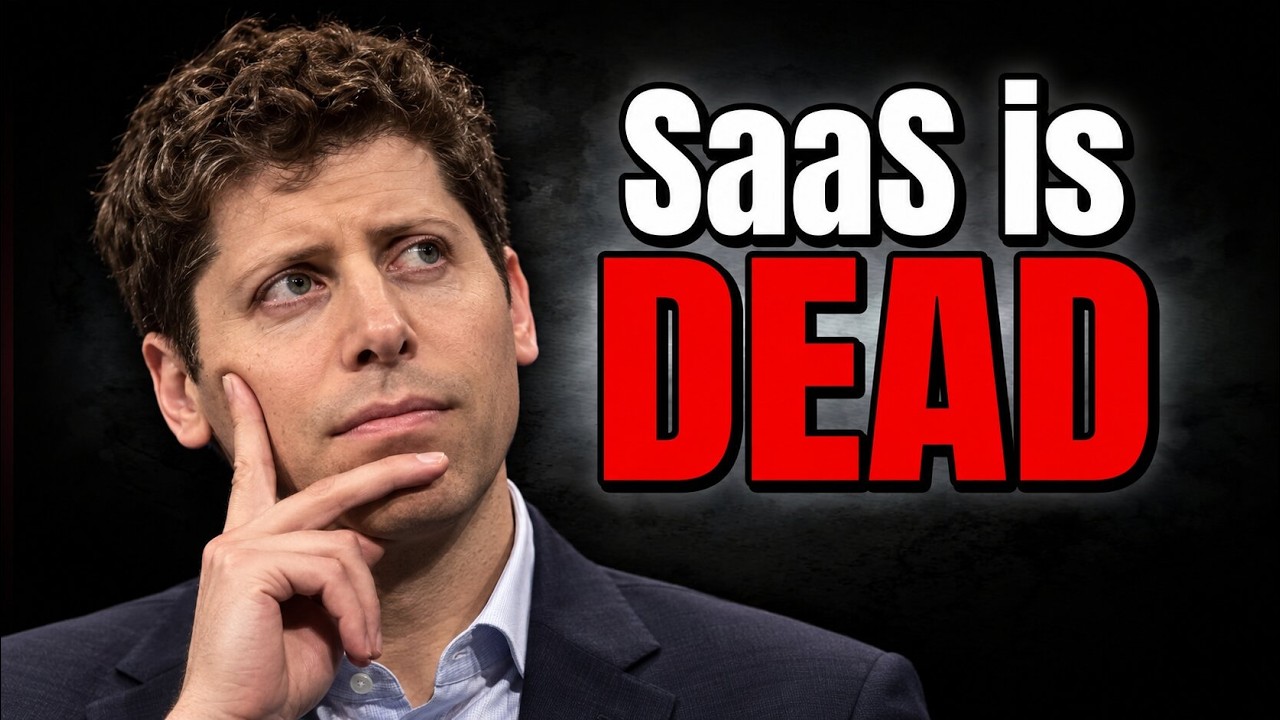
OpenAI CEO’s Shocking Prediction: “Agents Will Replace ALL Software"
Title history
- OpenAI CEO’s Shocking Prediction: “Agents Will Replace ALL Software" — observed on 20261103-1937 UTC (YouTube)
Keywords
Summary
187 words
Critical Evaluation
Value of the Information & Strength of the Argument
The video’s value lies in its comprehensive synthesis of a complex, multi-stakeholder event. It weaves together market data, executive statements, and analytical perspectives into a coherent narrative that avoids oversimplification. The argumentation is sound: it presents both the bear case (agents eliminate jobs and subscriptions) and the bull case (agents become tools that enhance software value), and uses specific examples like Klarna’s Salesforce exit to illustrate the nuance. It critically evaluates sources, noting that each industry leader has a stake (Huang sells chips, Altman sells agents), and it does not take the ‘replace all software’ claim at face value. The strength of the argument lies in its balanced treatment, showing that the market overreacted while also acknowledging real disruption. However, the video relies heavily on narrative storytelling, which may occasionally gloss over technical specifics for dramatic effect.
Scientific Rigor, Source Quality, Title Accuracy
The video demonstrates high rigor in source usage. It frequently cites reputable outlets such as Bloomberg, Reuters, and Gartner, and attributes statements to specific individuals (Nadella, Huang, Altman, etc.) with context. It does not fabricate quotes and clearly distinguishes between direct quotes and paraphrase. The sources are diverse, including market analysts (Bank of America, LPL Financial) and industry executives. Potential bias is acknowledged (e.g., Huang’s conflict of interest). The title, while clickbait-style, accurately reflects the central question addressed; the video explicitly states that Altman did not literally mean all software would die, so it corrects the sensationalism. The video’s own conclusions are well-supported by the evidence presented.
259 words
Title / Content Match
The title is somewhat sensationalized but aligns with the content: the video explores the claim that agents will replace all software, and concludes that Altman's actual statement was more nuanced. It accurately captures the core debate.
Quality & Reliability
8/10
The video provides a thorough analysis of the SaaSpocalypse event, citing multiple sources (Bloomberg, Reuters, Gartner) and including differing views from industry leaders. It distinguishes between hype and reality, and presents a nuanced view of the impact of AI agents on software industry.
Key Moments
Markers derived by PSI from the transcript: the creator did not define chapters.
- Introduction of the SaaSpocalypse market crash on February 3, 2026
- Satya Nadella's prediction that business applications will collapse in the agent era
- Anthropic releases Claude Cooper, intensifying fears
- Jensen Huang calls the idea 'illogical' and defends software as tools
- Altman's 'thin layer vs. core systems' distinction is introduced
- Gartner forecasts cancellation of over 40% of agentic AI projects
- Launch of OpenAI's Dots agent at Dev Day
- Bank of America names exposed software stocks; recovery begins
- Software stocks reach fresh highs; cybersecurity surge
- Conclusion: software fades into background, humans bear the cost
Cited Sources
- Bloomberg — Cited for reporting on the market crash and Klarna's Salesforce exit
- Reuters — Cited for reporting on software stock recovery in October 2026
- Gartner — Cited for forecasts on agentic AI cancellations and adoption
- Jensen Huang at Cisco conference — Cited for his defense of software tools
- Sam Altman interviews and speeches — Cited for his statements on agents and software
Concurring Sources
- Gartner forecasts on agentic AI — Aligns with the video's skepticism about immediate disruption, emphasizing hype and practical challenges.
- Satya Nadella's podcast remarks — Supports the idea that business applications will be fundamentally changed, a key thesis.
Dissenting Sources
- Jensen Huang's statement — Huang argues software will be used by agents as tools, contradicting the notion that agents will replace them entirely.
Contribution & Novelties
The video provides a unique, longitudinal analysis of a market cycle driven by AI agent hype, connecting dots between executive statements, product launches, and market movements. It clarifies the actual meaning of Altman’s prediction, which was widely misrepresented, and illustrates the ’thin layer vs. core system’ framework with concrete examples. Its contribution is in synthesizing scattered information into a coherent narrative that highlights the nuanced reality behind a sensational headline.
Pour aller plus loin :
- Software as a Service — Explains the business model at the center of the SaaSpocalypse.
- AI agent — Conceptual background on agents that autonomously perform tasks.
- Gartner Hype Cycle — Provides context for the overinflated expectations and subsequent disillusionment seen in 2026.
117 words
Radar Profile
The radar profile shows high scores in information quantity and quality, with moderate technical depth and good reliability. This reflects a well-researched, data-rich piece that remains accessible to a general audience while providing substantial depth on the software industry's dynamics.