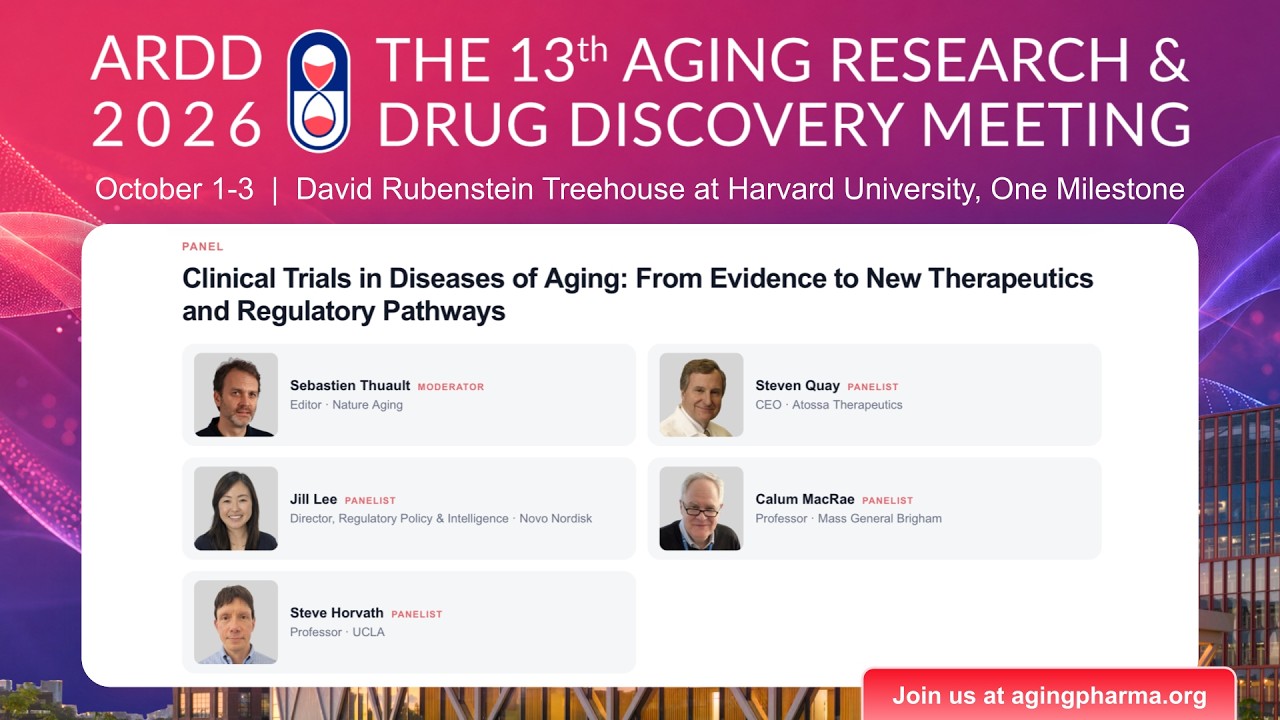
Panel at ARDD2026: Clinical Trials in Diseases of Aging
Title history
- Panel at ARDD2026: Clinical Trials in Diseases of Aging — observed on 20261101-0209 UTC (YouTube)
Keywords
Summary
218 words
Critical Evaluation
Value of the Information & Strength of the Argument
The video offers valuable insights from leading experts on the practical challenges of developing gerotherapeutics. The panelists provide well-reasoned arguments, drawing on historical analogies (LDL, blood pressure) and personal experience. They articulate the tension between regulatory pathways (accelerated approval vs. full outcome-based approval) and the need for patient-relevant measures. The discussion is balanced, with differing perspectives on the role of biomarkers versus functional endpoints, but always grounded in scientific reasoning. The argumentation is solid, though at times it reads more as opinion than evidence-based consensus, which is typical for a panel debate. The value lies in the candid exchange about the obstacles to drug development in aging, including data collection incentives and patient adherence.
Scientific Rigor, Source Quality, Title Accuracy
The panelists are credible, with institutional affiliations (UCLA, Harvard, Novo Nordisk, Atossa) and disclosed conflicts of interest. The video is from the ARDD2026 conference, a well-known event in longevity biotech, and the description includes links to the official website and LinkedIn. The content aligns with the field’s current scientific literature, referencing recent publications in Nature Medicine and the work on epigenetic clocks, though specific citations are not provided in the video. The title accurately describes the panel’s focus, and the content adheres to the topic of clinical trials in aging. The absence of external sources within the video is typical for a discussion, but the speaker expertise compensates. The title-to-content match is strong.
242 words
Title / Content Match
The title accurately reflects the panel's focus on clinical trials in diseases of aging, covering evidence, therapeutics, and regulatory pathways.
Quality & Reliability
8/10
The panel comprises recognized experts from academia and industry (including the inventor of epigenetic clocks and a Harvard Medical School professor) who present evidence-based arguments and openly discuss regulatory pathways. However, the content is largely opinion and forward-looking, with potential conflicts of interest disclosed.
Key Moments
Markers derived by PSI from the transcript: the creator did not define chapters.
- Moderator introduces the geroscience hypothesis and the challenge of measuring prevention in trials.
- Panelists introduce themselves, with Steve Horvath noting his conflicts of interest.
- Steven Quay discusses using mammographic breast density as a surrogate marker for accelerated approval.
- Calum MacRae argues for measuring wellness and function, citing poor statin adherence as a cautionary tale.
- Discussion on the history of LDL and blood pressure as biomarkers, and the lessons for aging trials.
- Steve Horvath calls for incentivizing companies to collect biomarker data and highlights recent progress in biomarker research.
- Calum MacRae describes the Apple Health Study and the importance of multimodal, individualized phenotyping.
Cited Sources
- Aging Pharma (ARDD official website) — Official website for the ARDD conference and the organization hosting the video.
- Aging Pharma LinkedIn — LinkedIn page for ARDD, providing updates and context about the conference.
Contribution & Novelties
The panel provides a unique, multi-stakeholder perspective on the regulatory and scientific hurdles in developing gerotherapeutics, emphasizing the need for a combination of surrogate biomarkers, patient-reported outcomes, and functional measures. It highlights the evolving regulatory landscape (e.g., FDA’s potential designation of aging as a disease in FY2027) and the importance of collecting comprehensive data in trials to qualify surrogate endpoints. The discussion also advocates for a shift from a disease-centric to a wellness-centric framework, drawing on lessons from cardiovascular medicine.
Pour aller plus loin :
- Epigenetic clock — Relevant to Steve Horvath’s work; explains the concept of DNA methylation-based biomarkers of aging.
- Geroscience hypothesis — The hypothesis that targeting basic aging mechanisms can delay multiple age-related diseases; central to the panel’s rationale.
- Surrogate endpoint — Definition and regulatory considerations for surrogate endpoints in clinical trials, directly discussed by the panel.
140 words
Radar Profile
The scores indicate a high quantity and quality of information, with a solid technical level. The reliability is strong given the expert panel, though slightly lower due to the opinion-based nature of the discussion. The radar profile is balanced, with no extreme weaknesses.