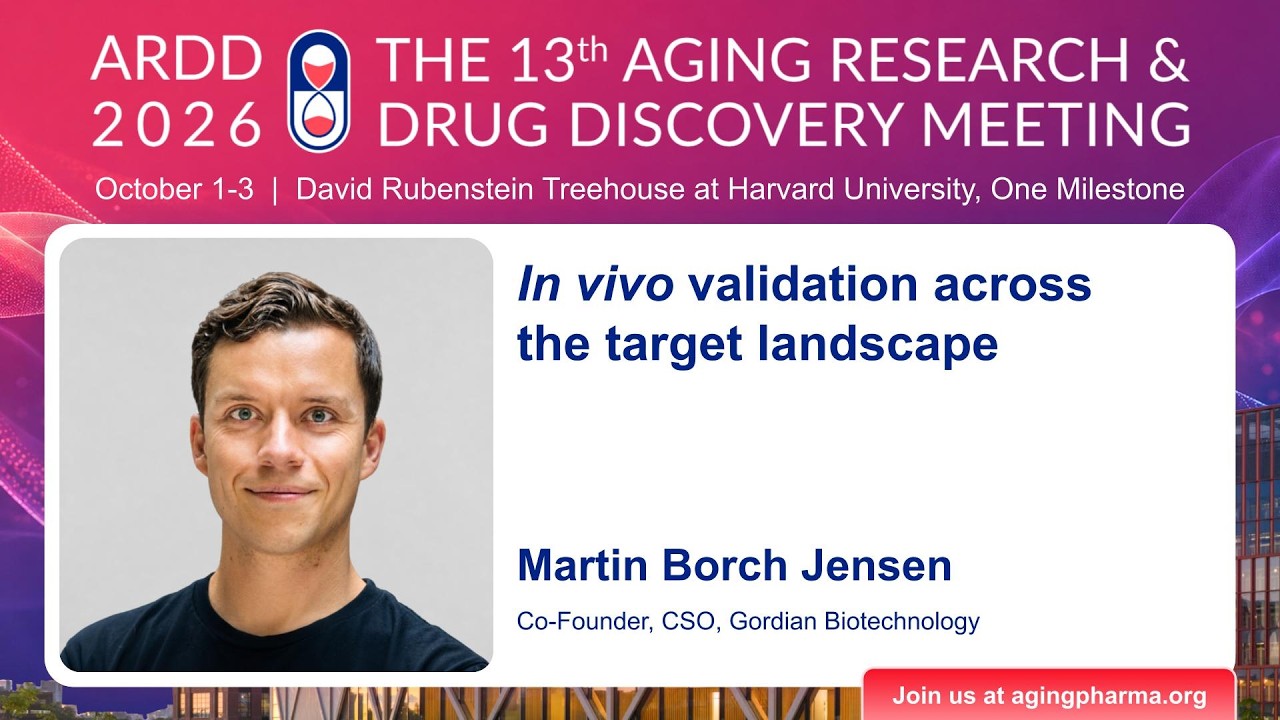
Martin Borch Jensen at ARDD2026: In vivo validation across the target landscape
Keywords
Summary
201 words
Critical Evaluation
Value of the Information & Strength of the Argument
The value of the presentation lies in its clear articulation of a scalable and translational platform for target validation. The argumentation is methodical: starting from the fundamental limitations of AI-driven drug discovery, the speaker builds a logical case for in vivo mosaic screening as a way to generate actionable ground truth. The claim of 100x greater scale than traditional methods is supported by the described approach of multiplexing hundreds of perturbations per animal, with strong illustrative data from osteoarthritis and obesity programs. The argument is further strengthened by the integration of physiological readouts and the ability to co-treat with existing drugs, which directly addresses the practical needs of drug developers. However, the evidence is presented with limited quantitative detail, and the audience is often shown examples without deep statistical backing, which would be necessary for full scientific validation. The argumentation is solid in concept but relies on the credibility of the presenter and the company’s proprietary data, which is not independently verifiable from this talk alone.
Scientific Rigor, Source Quality, Title Accuracy
The scientific rigor is moderate: the methods are described in reasonable depth, but key experimental details are omitted for brevity, and the presentation does not cite specific publications or external sources. The only references are the company website and LinkedIn page, which do not provide technical documentation. The title accurately reflects the content, as the talk indeed covers in vivo validation across a landscape of targets. The speaker acknowledges that this builds on prior work (last year’s talk) and suggests that further details are available elsewhere, but does not provide direct source links. The reliance on proprietary data without detailed peer review limits the ability to assess reproducibility. Nevertheless, the approach aligns with current trends in high-content phenotypic screening, and the internal validation logic appears sound.
307 words
Title / Content Match
The title accurately reflects the content: the talk focuses on scaling in vivo validation across many targets.
Quality & Reliability
8/10
The presentation details a transparent methodology for in vivo target validation using mosaic screens and single-cell readouts. The approach is plausible and backed by experimental data, but the talk is a conference presentation, not a peer-reviewed publication, and some commercial aspects are not fully disclosed.
Key Moments
Markers derived by PSI from the transcript: the creator did not define chapters.
- Introduction: challenges in drug discovery and limitations of AI
- Gordian's approach: mosaic in vivo screens with AAV perturbations and single-cell transcriptomics
- Two-step concept: mapping target effects and disease signatures
- Osteoarthritis results using horses with spontaneous disease and human tissue validation
- New work in cardiometabolic renal disease, focus on adipose tissue and obesity
- Data matrix example: perturbations vs. physiological features, multiple hits
- Co-treatment with incretins (semaglutide) and target 'augury 1' results
- Mechanistic interpretation from screen: lipolysis increase confirmed
- Multi-organ screening to assess broad benefits and safety
- Integration of AI and robotics for scaling in vivo experiments
Cited Sources
- AgingPharma.org — Official website of ARDD conference and related aging research initiatives.
- AgingPharma LinkedIn — LinkedIn page for the organizing company, providing updates and context for ARDD meetings.
Contribution & Novelties
The primary novelty is the integration of mosaic in vivo perturbation with single-cell transcriptomics to map target effects across multiple organs and diseases in a single animal model, enabling a 100-fold scale-up in target validation. This approach directly addresses the bottleneck of ground-truth data for AI-driven drug discovery. The ability to combine screens with standard-of-care drugs (e.g., GLP-1s) to find additive targets is also notable. The talk also highlights the generation of interpretable mechanistic data, on-target identification, and the potential for multi-organ safety profiling.
Pour aller plus loin :
- Single-cell RNA sequencing — This technology underlies the readout method and is central to the described approach.
- CRISPR gene editing — The AAV-based perturbations are conceptually similar to CRISPR-based screens, and this technique enables precise gene modulation.
- In vivo CRISPR screening — This article provides background on high-throughput genetic screens, though Gordian uses AAV instead of CRISPR for delivery, the principle of perturbing genes in vivo is shared.
- Phenotypic screening — This concept contrasts with target-based screening and contextualizes the screen described by the speaker.
174 words
Radar Profile
The profile shows a balanced set of scores, with quantity and quality of information high (8/8), indicating a substantial and well-structured presentation. The technical level (7/10) is moderately high, suggesting the content is accessible to a domain-intermediate audience. Reliability (7/10) is slightly lower, reflecting the lack of peer-reviewed sources and commercial context. Overall, the radar suggests a strong informational talk with minor limitations in external validation.