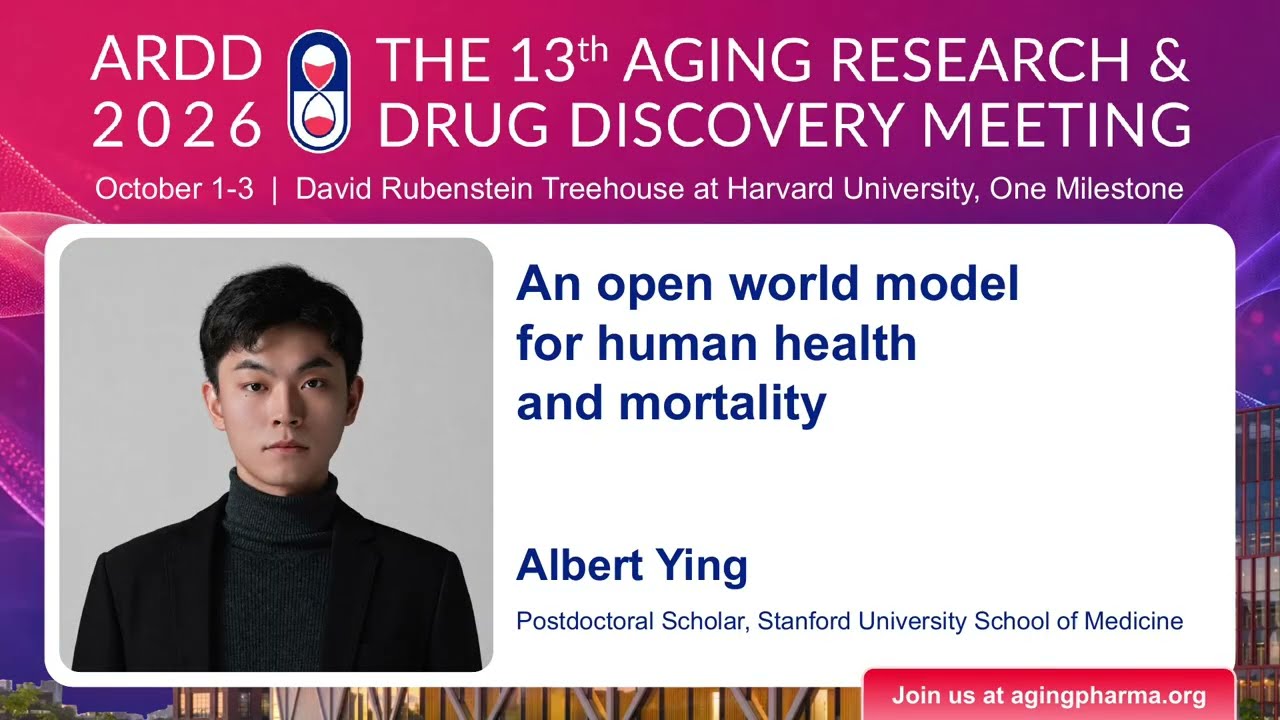
Kejun (Albert) Ying at ARDD2026: An open world model for human health and mortality
Title history
- Kejun (Albert) Ying at ARDD2026: An open world model for human health and mortality — observed on 20261030-1054 UTC (YouTube)
Keywords
Summary
157 words
Critical Evaluation
Value of the Information & Strength of the Argument
The value of the information is high: it presents two novel frameworks that bridge AI, health data, and evolutionary biology. The world model for health is innovative in its pan-modal and open-set approach, showing tangible improvements in prediction longevity and the ability to generalise to unseen diseases. The argumentation is solid, supported by comparisons with existing models (Delphi 2M, Rescue), rigorous cross-validation across clades, and correlation with known biological pathways. The discussion of protein structural features as an orthogonal axis to expression is compelling and evidenced by enrichment analyses. The speaker also openly addresses limitations (e.g., not adjusting for body weight, validation challenges in drug combinations). Overall, the claims are well-supported and the logical flow from data to model to application is clear.
Scientific Rigor, Source Quality, Title Accuracy
The presentation is a conference talk referencing several published works: Delphi 2M (Nature 2025), Horvath’s methylation clock, and the speaker’s own MedRxiv preprint. The speaker also cites the UK Biobank as data source. The rigour is high: methodological details are transparent, comparisons are systematic, and questions clarify limitations. The title is accurate and not overstated. The content is well-aligned with the described research. No comments are provided, so no public feedback analysis is included.
212 words
Title / Content Match
The title accurately reflects the content: an open-world model for human health and mortality, covering both a world model for health and a protein-language-model study linking structure to lifespan.
Quality & Reliability
8/10
The presentation is by a Stanford researcher, describing two research projects with published/preprint results. The methods are rigorous, comparisons with state-of-the-art are provided, and the talk is technical. However, the work is not fully peer-reviewed for the health model, being on MedRxiv, and the ESM Life results are preliminary. Still, the content is grounded and coherent.
Key Moments
Markers derived by PSI from the transcript: the creator did not define chapters.
- Introduction: two axes of AI in biology, and focus on macroscopic modeling
- Health Block: concept of world model for health, integration of 11 data modalities
- Health state vector and visualization of individual trajectories from UK Biobank
- Performance benchmarks against Delphi 2M and rescue, including 20-year horizon predictions
- Open-world generalisation: predicting unseen diseases using semantic embeddings
- Simulating clinical trials with statins and validation against 286 real trials
- ESM Life: using protein language models to fold orthologs and extract structural features
- Predicting maximal lifespan and discovering the golden mole as a long-lived species
- Orthogonality of structural and expression changes; design of improved proteins
Cited Sources
- AgingPharma.org — Official website of ARDD, the conference organizer, where this presentation was given.
- Aging Pharma on LinkedIn — LinkedIn page for ARDD updates and conference information.
Concurring Sources
- AgingPharma.org — Supports the context of the conference and related aging research.
Contribution & Novelties
The talk introduces two novel contributions: (1) Health Block, a pan-modal world model that maintains a continuous health state and enables open-set disease prediction and clinical trial simulation; (2) ESM Life, a protein-structure-based lifespan predictor that reveals structural features associated with longevity, orthogonal to expression-based signals. These advance the field by showing that large-scale AI models can integrate heterogeneous biomedical data and provide insights across biological scales.
Pour aller plus loin :
- UK Biobank — Large-scale biomedical database used to train Health Block; central to the study.
- AlphaFold — Key inspiration for protein structure prediction, closely related to the ESM Life approach.
- Epigenetic clock — Horvath’s methylation clock referenced for comparison; relevant to lifespan prediction.
115 words
Radar Profile
The profile shows high scores in quantitative and technical aspects, with slightly lower but still strong quality and reliability. This indicates a technically dense, data-rich presentation, well-founded but not yet fully peer-reviewed for the health model.