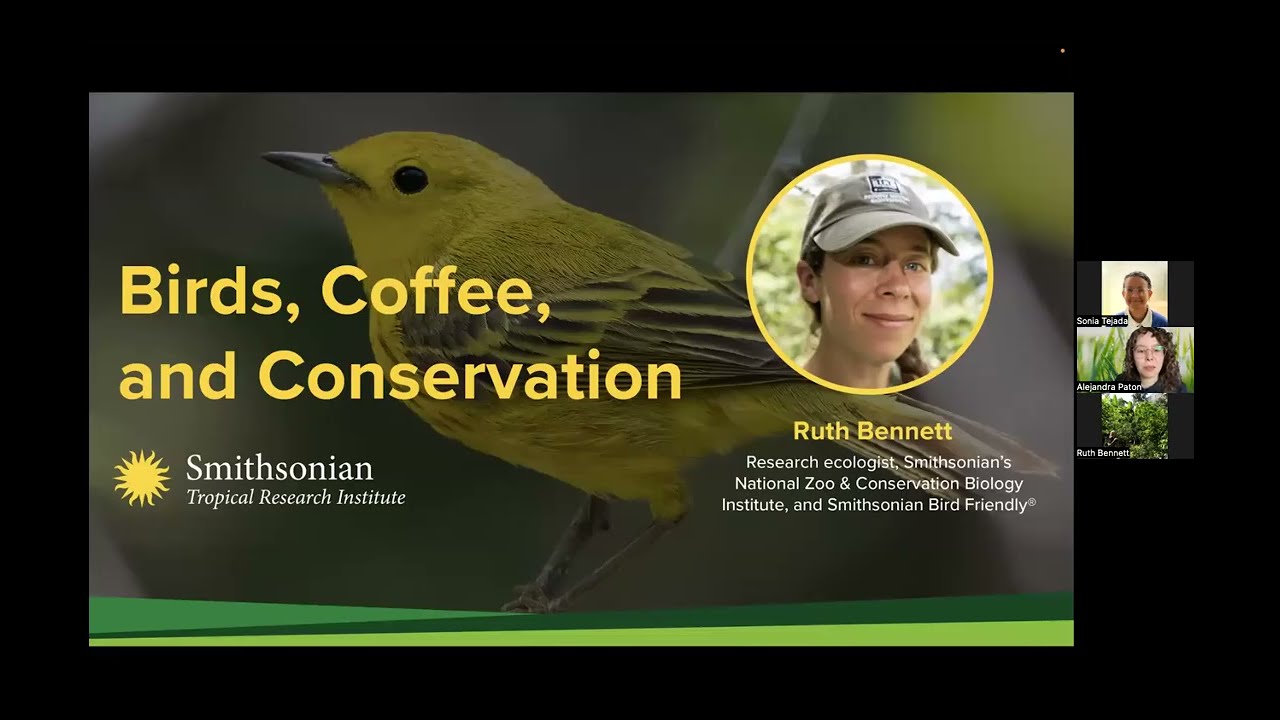
Monthly Talk: Birds, Coffee, and Conservation
Title history
- Monthly Talk: Birds, Coffee, and Conservation — observed on 20261026-2251 UTC (YouTube)
Keywords
Summary
193 words
Critical Evaluation
Value of the Information & Strength of the Argument
The talk provides substantial, scientifically grounded information, drawing on peer-reviewed research, including a meta-analysis on cocoa birds and landscape-level studies. The argumentation is coherent: from documenting bird declines to identifying coffee/cocoa agroecosystems as conservation opportunities, and then building a certification standard that incentivizes biodiversity-positive practices. The speaker clearly explains the logic behind each step, from research to extension and market mechanisms. The use of concrete data (e.g., 2.9 billion birds lost, 75% intensification, numbers of certified farms) strengthens the credibility. The inclusion of farmer perspectives and a video from a Colombian researcher adds practical depth, making the case for conservation both ecologically and economically compelling.
Scientific Rigor, Source Quality, Title Accuracy
The presentation is scientifically rigorous, rooted in the Smithsonian’s long-term research. Key studies are cited implicitly, such as the Rosenberg et al. 2019 paper on bird declines and a meta-analysis on cocoa birds. The certification criteria are transparent, and the speaker acknowledges limitations, such as the difference in bird communities between agroforestry and intact forest. The title accurately reflects the content, covering both the ecological importance of birds and the role of coffee in conservation. Sources are not formally referenced in the description, but the institutional affiliation and the detailed presentation of research methods (e.g., DNA analysis of bird droppings) support reliability. No conflicting sources are mentioned, and the talk aligns with established ecological knowledge.
235 words
Title / Content Match
Titre exactement reflète le contenu : oiseaux, café et conservation.
Quality & Reliability
8/10
Presentation by a Smithsonian research ecologist based on extensive peer-reviewed research and institutional program data; high credibility but limited independent verifiability of specific claims.
Key Moments
Markers derived by PSI from the transcript: the creator did not define chapters.
- Introduction to birds and their ecosystem services (pollination, pest control, seed dispersal).
- Explanation of coffee farming systems: agroforestry vs. sun monoculture, and the impact on bird biodiversity.
- Details of the Bird Friendly certification standard: organic, shade cover, deforestation-free, and traceability.
- Meta-analysis showing that shade cocoa farms maintain bird diversity similar to forests, leading to expansion into cocoa.
- Current status of Bird Friendly: 15 certifiers, 5,000 farms, 14 countries, and market presence.
- Landscape research: how forest cover around farms shapes bird communities, emphasizing the importance of landscape context.
- Introduction of the forest conservation pathway in 2022, allowing farms with one-third forest set aside to be certified.
- Shade tree catalogs and research on bird-friendly tree species, including a video from Colombia on fig trees attracting birds.
Contribution & Novelties
This talk presents original research and program developments from the Smithsonian Bird-Friendly Program, including a meta-analysis on cocoa birds and landscape-scale analyses. The integration of science into a market certification is a notable contribution, bridging conservation research with practical farming and industry actions.
Pour aller plus loin :
- Shade-grown coffee — Relevant background on agroforestry systems and bird habitat.
- Coffee berry borer — Key pest discussed; link to biological control by birds.
- Agroforestry — Broader concept of integrating trees into agriculture, central to the talk.
- Rosenberg et al. 2019, Science — Original study on 2.9 billion bird loss, cited as foundational evidence.
102 words
Radar Profile
Le profil radar montre des scores élevés en quantité et qualité d'information, reflétant une présentation dense et bien étayée. La fiabilité est très bonne en raison de l'institution, et le niveau technique est modéré, adapté à un public scientifique mais accessible.