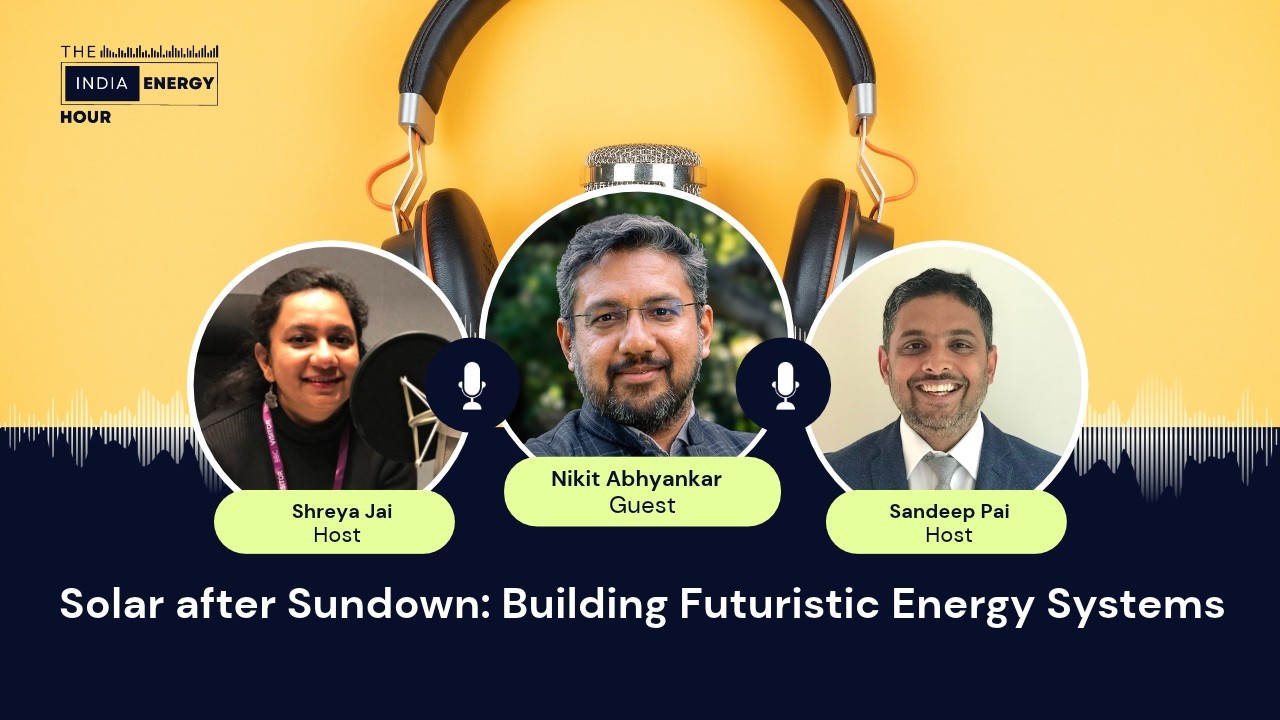
Solar after Sundown: Building Futuristic Energy Systems| ft. Nikit Abhyankar
Title history
- Solar after Sundown: Building Futuristic Energy Systems| ft. Nikit Abhyankar — observed on 20261105-1151 UTC (YouTube)
Keywords
Summary
179 words
Critical Evaluation
Value of the Information & Strength of the Argument
The value of the information is high, as it offers a nuanced explanation of India’s grid challenges and potential solutions from a leading expert. The argumentation is well-structured, systematically addressing barriers (transmission, storage, demand flexibility) and providing concrete examples like industrial heat electrification and price signals. The discussion is grounded in real-world observations and research, giving it practical relevance. However, the claims are not backed by specific numbers or studies within the podcast, making it more of an informed opinion than a rigorous analysis. Nevertheless, the depth and coherence of the arguments demonstrate strong intellectual rigor.
Scientific Rigor, Source Quality, Title Accuracy
The scientific rigor is moderate; while the guest is highly credible, the conversation is conversational and lacks explicit citations or data references. The title accurately reflects the focus on solar energy and evening demand, though the phrase ‘futuristic energy systems’ is slightly grandiloquent for the actual content. The podcast does not include a formal bibliography, but the guest’s affiliations and prior work lend credibility. The discussion also mentions specific organizations like Prayas Energy Group, which adds real-world grounding. Overall, the title is adequate, and the content is trustworthy within the bounds of expert opinion.
205 words
Title / Content Match
The title aptly highlights the core paradox of afternoon solar surplus and evening shortages, and the need for innovative systems, though it slightly overstates the 'futuristic' aspect.
Quality & Reliability
8/10
The guest, Dr. Nikit Abhyankar, is a faculty member at UC Berkeley's Goldman School of Public Policy and a scientist at Lawrence Berkeley National Laboratory, bringing substantial expertise. The discussion is based on his extensive research and practical experience, though it is qualitative and lacks explicit data citations. Overall, the reliability is high for an expert opinion podcast.
Key Moments
Markers derived by PSI from the transcript: the creator did not define chapters.
- Introduction of the guest, Dr. Nikit Abhyankar, and his professional background.
- Discussion on the formation and mission of the India Energy and Climate Center at UC Berkeley.
- Explanation of the main challenges: transmission bottlenecks and insufficient storage capacity.
- Exploration of demand flexibility, including time-of-day pricing and electrification of industrial heat.
- Detailed analysis of energy storage services: arbitrage, capacity, and ramping, and their role in grid reliability.
Cited Sources
- Prayas Energy Group — Mentioned as the organization where Abhyankar began his energy career.
- University of California, Berkeley — Abhyankar's current academic affiliation and location of the India Energy and Climate Center.
- Lawrence Berkeley National Laboratory — Where Abhyankar also works as a scientist.
Contribution & Novelties
The episode provides a fresh perspective on India’s renewable integration paradox, moving beyond simple capacity additions to emphasize systemic changes in storage, demand response, and market design. It effectively bridges technical and policy aspects, making complex issues accessible. The guest’s dual expertise in engineering and economics enriches the discussion.
Pour aller plus loin :
- Time-of-use pricing — Relevant to the discussion on demand flexibility and price signals.
- Demand response — Pertinent for understanding how industrial consumers can shift loads.
- Thermal energy storage — Directly related to the potential for electrifying industrial heat using cheap solar electricity.
96 words
Radar Profile
The radar profile shows a uniform high score across all four dimensions, indicating a well-balanced episode with strong informational content, high credibility, and appropriate technical depth. This suggests the podcast is both reliable and valuable for understanding India's energy transition.