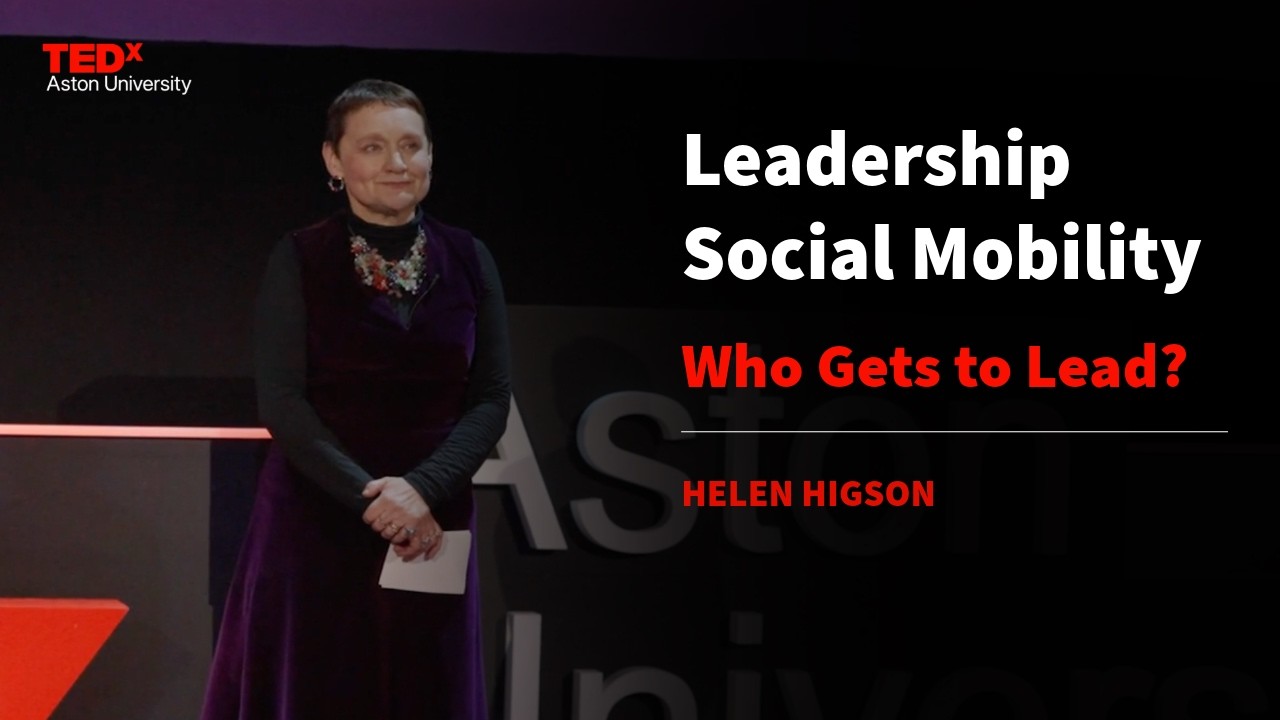
Who gets to lead? | Professor Helen Higson OBE DL | TEDxAston University
Keywords
Summary
163 words
Critical Evaluation
Value of the Information & Strength of the Argument
The talk offers a novel perspective on social mobility by focusing on leadership and the responsibility to give back. It provides inspiring examples and a simple, memorable framework that can motivate individuals and institutions. However, the argumentation relies heavily on selective personal anecdotes, which are persuasive but not systematically evidence-based. The speaker does not engage with potential counterexamples or the structural barriers that might undermine her optimistic view. Nevertheless, the conceptual clarity and inspirational tone make it valuable for raising awareness and stimulating discussion, even if it does not meet rigorous scientific standards.
Scientific Rigor, Source Quality, Title Accuracy
The talk lacks explicit citations to external research or data, with the only link being to the general TEDx website. The speaker’s credibility is established through her academic positions and awards, but the claims are not backed by empirical studies or statistical evidence. The title is well-aligned with the content, posing a question that the talk seeks to answer through personal stories and a proposed framework. The scientific rigor is therefore limited, though the talk is clearly intended as an engaging presentation rather than a peer-reviewed academic piece.
196 words
Title / Content Match
The title 'Who gets to lead?' accurately reflects the talk's exploration of barriers and opportunities for leadership, and the speaker's call to broaden access to leadership positions.
Quality & Reliability
6/10
The talk is based on anecdotal evidence and personal stories, lacking empirical data or citations. However, the speaker is an academic with expertise, and the ideas are presented coherently.
Key Moments
Markers derived by PSI from the transcript: the creator did not define chapters.
- Introduction of Alireza, an immigrant who succeeded in finance despite barriers.
- Introduction of Pam, a female engineer who became a leader, and discussion of common traits.
- Definition of 'leadership social mobility' and introduction of the four pillars: access, progression, influence, paying it forward.
- Stories of Yasmin and Rashnney illustrating progression and influence.
- Paying it forward with Matthew's example, concluding with a call to action.
Cited Sources
- TEDx Talks — Official TEDx website providing context for the TED conference format.
Contribution & Novelties
The original contribution is the introduction of the term ’leadership social mobility’ and the articulation of four pillars that frame how diverse individuals can access leadership and use it to benefit others. The talk also highlights the role of education in enabling such mobility.
Pour aller plus loin :
- Social mobility — Relevant to the broader concept of movement in social status.
- Leadership — General overview of leadership theories and practices.
- Widening participation — UK policy related to increasing access to higher education for underrepresented groups.
86 words
Radar Profile
The radar profile shows high scores in quantity and quality of information, indicating a substantial and coherent presentation, but a low score in technical level, reflecting its accessibility to a general audience. Overall reliability is moderate, supported by the speaker's credibility but limited by a lack of empirical evidence.