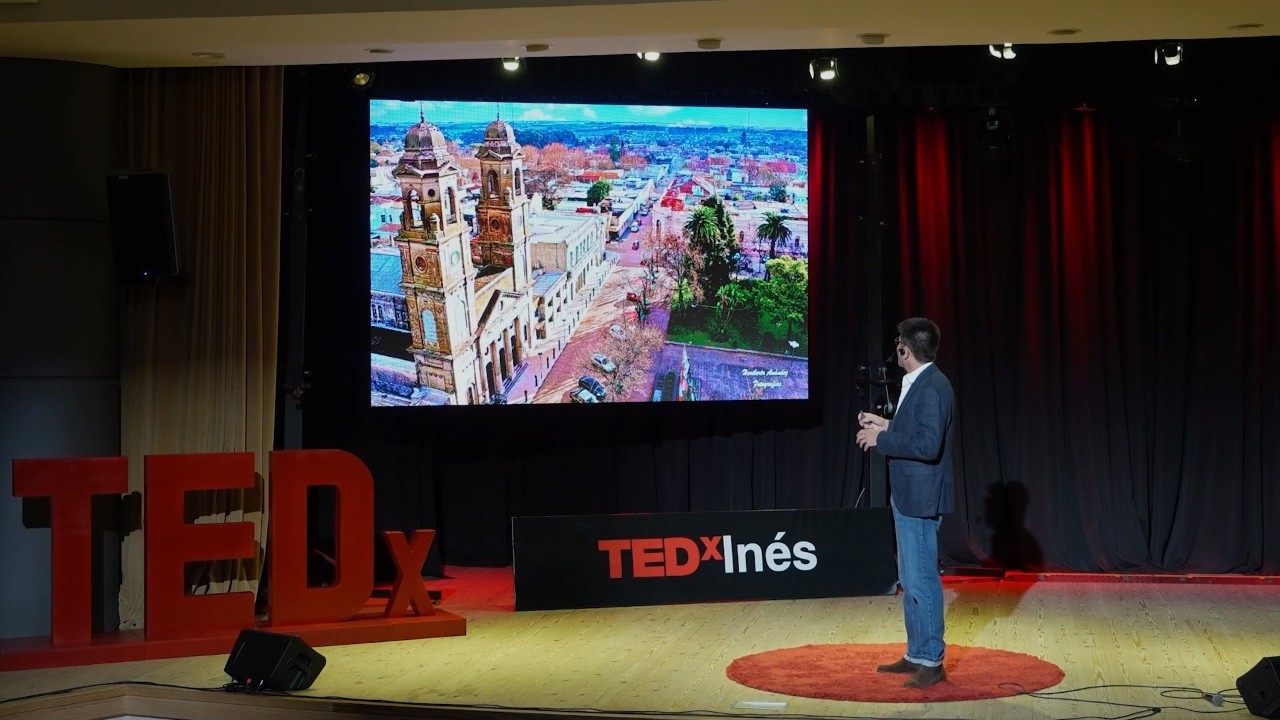
Ciudades para todos: encontrar soluciones desde la movilidad sostenible | Martín Piñeyro | TEDxInés
Cities for all: finding solutions through sustainable mobility | Martín Piñeyro | TEDxInés
Title history
- Ciudades para todos: encontrar soluciones desde la movilidad sostenible | Martín Piñeyro | TEDxInés — observed on 20261029-0033 UTC (YouTube)
Keywords
Summary
204 words
Critical Evaluation
Value of the Information & Strength of the Argument
The value lies in the practical, step-by-step methodology for translating a global innovation into a local solution. Piñeyro’s argument is grounded in his own experience, lending authenticity. He effectively illustrates each phase of the process with concrete details (e.g., the 2-hour failure of the first electric bikes). The argument for sustainable mobility is persuasive, highlighting co-benefits like reduced noise, pollution, and improved access. However, the talk remains largely anecdotal; no quantitative data or rigorous comparisons are provided. The reasoning is straightforward and motivational, but not deeply analytical.
Scientific Rigor, Source Quality, Title Accuracy
Scientific rigor is moderate. Piñeyro makes factual claims (e.g., Uruguay’s renewable energy mix, IKEA’s market share) without citing sources. The examples of cities and companies are plausible but not referenced. The only source link in the description is the generic TEDx page. The title is well-matched to content. No comments were available for analysis, so public reception cannot be assessed.
162 words
Title / Content Match
The title accurately reflects the content: the talk focuses on sustainable mobility as a lens for city problem-solving, with concrete cases and a call to action.
Quality & Reliability
6/10
The talk is an expert opinion based on personal experience and anecdotal evidence. It lacks detailed citations for most claims but presents plausible, well-known examples.
Key Moments
Markers derived by PSI from the transcript: the creator did not define chapters.
- Introduction: Gustavo swapping battery in Ciudad de la Costa; outlining the problem of gas-powered delivery motorbikes in Uruguay.
- First attempt with electric motorbikes fails quickly; people rejected even free use.
- Looking abroad: discovery of Taiwan's battery-swapping revolution with more stations than gas stations.
- Building networks: engaging partners (Quantik, ANI, PedidosYa, Zona América, Newlab) to make Swapy a reality.
- Examples of sustainable mobility: New York cycling-friendly streets, IKEA's inner-city showrooms and e-bike deliveries, Beijing's ban on gas motorcycles, Netherlands' bicycle policies.
- Africa: innovative leasing models for electric motorcycles (Kenya, Uganda, Ghana, Nigeria); Taiwan's battery-swap model as best practice.
- Closing: invitation to identify a local problem, apply the method (problem, quick test, learning, global look, networks, local implementation) and start now.
Cited Sources
- TEDx program — Link provided in the description, mentioning that the talk follows TEDx format.
Contribution & Novelties
The talk offers a generalizable recipe for adapting global innovations to local contexts, emphasizing quick experimentation and network building. While the specific case of battery swapping is not entirely new, the process-oriented approach is a valuable takeaway. It also broadens the discussion by linking sustainable mobility to other urban benefits (health, access to public space).
Pour aller plus loin :
- Battery swapping — The technology and its deployment, notably in Asia.
- Gogoro — A leading Taiwanese company in battery-swapping for urban scooters.
- Sustainable transport — Broader concept and policy interventions.
90 words
Radar Profile
The radar profile shows moderate information quantity and quality, low technical depth, and a reasonable reliability score. The talk is more motivational and inspirational than rigorous scientific content.