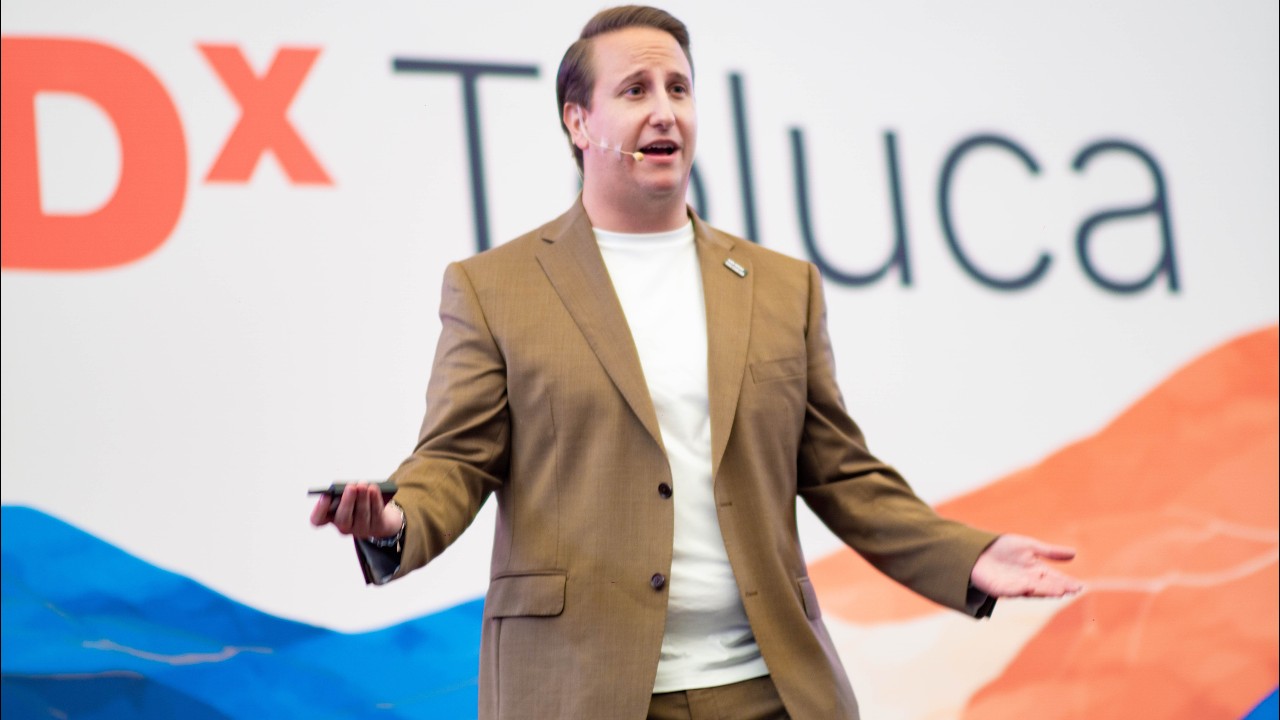
Cómo generar confianza emprendiendo a los 23 años | Albert Zonana | TEDxToluca
How to Build Confidence While Starting a Business at 23 | Albert Zonana | TEDxToluca
Title history
- Cómo generar confianza emprendiendo a los 23 años | Albert Zonana | TEDxToluca — observed on 20261029-0052 UTC (YouTube)
Keywords
Summary
195 words
Critical Evaluation
Value of the Information & Strength of the Argument
VALUE: The primary value of this talk lies in its motivational and practical insights for young entrepreneurs, offering a genuine personal account of overcoming age-related bias. The ‘IVA’ mnemonic, while simplistic, provides a memorable action-oriented sequence. Anecdotes—such as building a stand out of drywall when lacking construction expertise—illustrate resourcefulness and the ‘fake it until you make it’ principle. However, the content lacks depth: business metrics (ROI, ROAS) are mentioned but not explained, and complex frameworks like ‘Six Thinking Hats’ are merely name-dropped without substantive application.
ARGUMENTATION: The argumentation is primarily narrative-driven rather than logical or evidence-based. Zonana builds credibility through his personal success story rather than through measured results or comparative analysis. The social proof of working with brands like DHL or Nestlé serves rhetorical persuasion, but claims such as ‘75% of Mexican companies fail in your first year’ are asserted without citation. The transition from general entrepreneurial advice to promoting his ‘Growth Partner’ model creates a subtle promotional tone, though it remains largely within the TEDx format of sharing a journey and lessons learned.
Scientific Rigor, Source Quality, Title Accuracy
SCIENTIFIC RIGOUR: The talk demonstrates low scientific rigour. It lacks a literature review, verifiable statistics, or experimental evidence. The statistical claim about business failure rates is unsubstantiated. References to established theories (Six Thinking Hats, Six degrees of separation) and figures (Philip Kotler) serve as rhetorical anchors but are not critically examined. The overall structure is epideictic rather than investigative.
QUALITY OF SOURCES: No credible academic sources are cited. The only link provided in the description is the generic TEDx platform link (https://www.ted.com/tedx ). The speaker relies exclusively on personal experience and testimonials from his agency’s clientele, which constitute anecdotal evidence.
TITLE-CONTENT ADEQUACY: The title and content are perfectly aligned. The entire speech addresses the question of generating trust while embarking on entrepreneurship at a young age, directly narrating the speaker’s experiences and strategies for doing so.
326 words
Title / Content Match
Excellent. The title accurately captures the central theme (building trust as a young entrepreneur) and the speaker's personal narrative directly addresses the question posed, offering 28-year-old Albert Zonana's retrospective insights on being a 23-year-old founder.
Quality & Reliability
2/10
The talk is predominantly anecdotal and motivational, relying on personal narratives and business metaphors rather than verifiable data, empirical evidence, or academic research. The single statistic cited (75% failure rate of Mexican enterprises) is presented without any source or methodology. The core 'IVA' heuristic and references to known frameworks (Six Thinking Hats, Six degrees of separation) are applied superficially for rhetorical effect. No external references or studies are provided to substantiate claims.
Key Moments
Markers derived by PSI from the transcript: the creator did not define chapters.
- Introduction and framing entrepreneurship around solving problems and simplifying existing solutions (examples: iPod, Netflix, Tesla).
- Anecdote about encountering practical obstacles as a 23-year-old founder, including being denied a bank account.
- Highlighting the need for courage and the 'IVA' (Idea, Value, Action) formula for entrepreneurial success.
- Audience interaction and claim that 75% of Mexican companies fail in their first year (presented without a source).
- Introducing the 'Six Thinking Hats' theory and the importance of balancing different perspectives as a leader.
- Using youth as an advantage; example of the mobile billboard with a bed and the 'Lo chido de la vida se envía con DHL' campaign.
- Emphasizing networking, referencing the 'six degrees of separation' theory and the role of word-of-mouth referrals.
- Shifting from self-reliance to trusting and delegating to the team; discussing the difficulty of letting go.
- Introducing the motto 'Fake it until you make it' with the anecdote of building a stand from drywall and the origin of the Growth Partner model.
Cited Sources
- TEDx Program — Mentioned in the video description as the platform for this independently organized TEDx event.
Concurring Sources
- Philip Kotler — Mentioned as a key figure in marketing who the speaker has interacted with, supporting the validity of the influencer/networking strategy.
Contribution & Novelties
The talk’s original contribution is not scientific but experiential. It uniquely packages existing business concepts—like the ‘Six Thinking Hats’ and ‘Six degrees of separation’—into a relatable framework for young founders in Latin America, using the personal trajectory of creating a marketing agency. The ‘IVA’ heuristic (Idea, Value, Action) serves as a concise mnemonic that streamlines the entrepreneurial process, distinct from academic models. Its novelty lies in the synthesis of personal resilience narratives with practical business development tactics for emerging markets.
Pour aller plus loin :
- Six Thinking Hats — De Bono’s framework for critical thinking, referenced but not detailed in the talk.
- Six degrees of separation — The networking theory referenced as the basis for the speaker’s relationship-building strategy.
- Return on Investment — Core business metric (ROI/ROAS) that the ‘Growth Partner’ model aims to optimize, contrasting with vanity metrics.
139 words
Radar Profile
The radar profile shows an average amount of information (5/10) with low scores in quality (3/10), technical depth (2/10), and reliability (2/10). This creates a profile heavily skewed towards narrative volume rather than verified knowledge, with the high quantity driven by long personal anecdotes and minimal integration of external, rigorous sources.