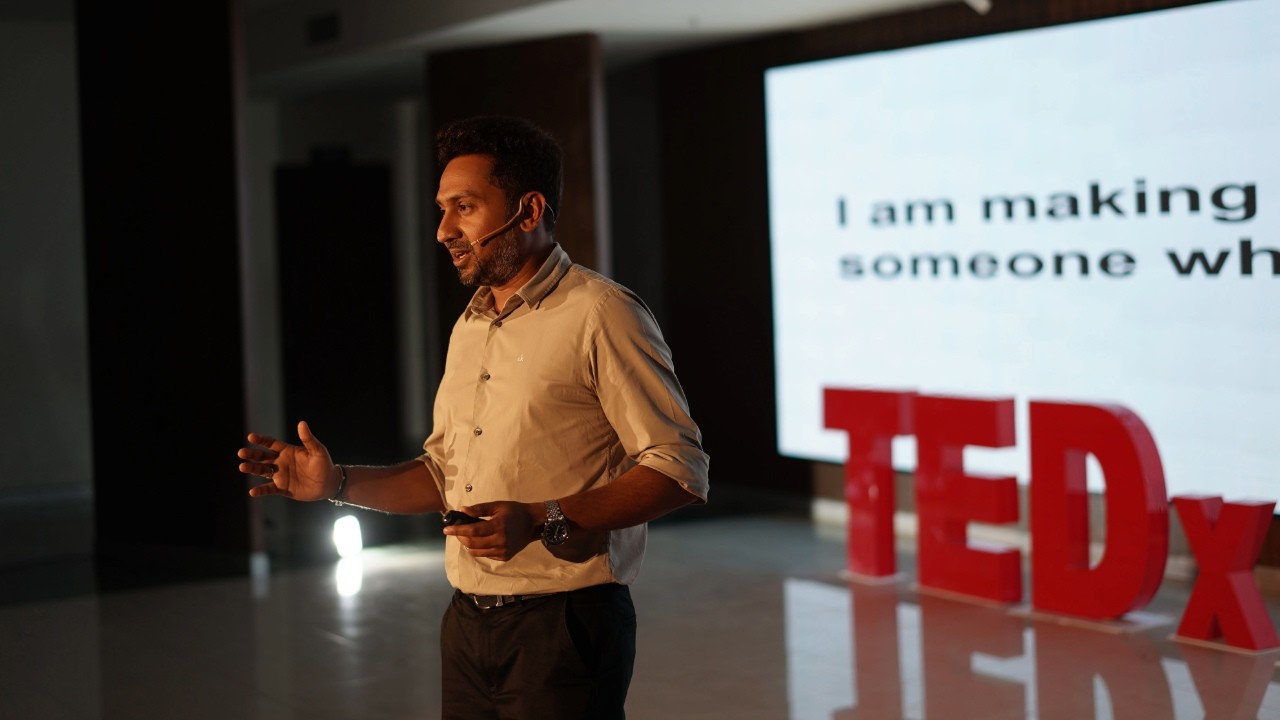
The Creativity Paradox | Suman Balakrishna | TEDxGCEM
Title history
- The Creativity Paradox | Suman Balakrishna | TEDxGCEM — observed on 20261029-1522 UTC (YouTube)
Keywords
Summary
186 words
Critical Evaluation
Value of the Information & Strength of the Argument
The talk offers valuable insights into the intersection of AI and human creativity, particularly in the context of game development. The speaker effectively argues that AI democratizes content creation but places a premium on human discernment, a perspective supported by practical examples such as the need for senior reviewers to validate AI-generated code or for art directors to select appropriate character designs. The argumentation is coherent and engaging, building from a relatable paradox to a structured framework (taste, empathy, courage) for crafting effective creative briefs. However, the claims rely heavily on anecdotal evidence and personal experience rather than empirical data or references to broader studies, which weakens the robustness of the argument. The use of analogies (e.g., the five friends’ trip, the food-brief example) makes the reasoning accessible, but the absence of measurable outcomes or case studies limits its scientific weight.
Scientific Rigor, Source Quality, Title Accuracy
The talk demonstrates moderate scientific rigor. It is based on the speaker’s professional expertise, which adds credibility, but it does not reference peer-reviewed research, industry reports, or specific studies to support its assertions. The only external source in the description is the TEDx organization’s general page, which does not provide further details for verification. The title ‘The Creativity Paradox’ accurately captures the core idea of the talk, and the content aligns well with this framing. However, the talk does not engage with alternative viewpoints or potential criticisms of its claims, and the lack of cited sources limits its scholarly depth. The video’s description provides background on the speaker’s credentials, but no additional references are given, leaving the audience without resources for further exploration.
279 words
Title / Content Match
The title 'The Creativity Paradox' accurately reflects the central theme of the talk, which explores the paradox that as AI accelerates content creation, the human ability to judge and curate becomes more critical.
Quality & Reliability
6/10
The speaker is an industry expert with over 15 years of experience in game development, and the content is grounded in practical examples. However, it relies on personal anecdotes and lacks empirical evidence or citations, reducing its scientific reliability.
Key Moments
Markers derived by PSI from the transcript: the creator did not define chapters.
- Introduction of the paradox: AI makes creation faster and cheaper, but review and selection become more expensive.
- Example from game development: the cost of creating content drops, but the bottleneck shifts to human judgment.
- Explanation of the JI code tool and the brief-AI-validation workflow.
- Discussion of the three fundamentals of a good brief: taste, empathy, and courage.
- Emphasis on courage in showing half-finished products for feedback.
- Conclusion: as AI improves, humans must focus on becoming more human and prioritizing meaningful creativity.
Cited Sources
- TEDx Program — The video is part of the TEDx event series, and this link provides general information about the TEDx program.
Contribution & Novelties
The talk contributes an original perspective by framing AI’s impact on creativity as a paradox where the true challenge shifts from production to curation and judgment. It introduces practical pillars (taste, empathy, courage) for creating effective AI-assisted work, drawn from real-world game development experience, which adds a hands-on, industry-informed angle to the ongoing discourse on AI and creativity.
Pour aller plus loin :
- Creativity (Wikipedia) — Foundational background on the nature and definitions of creativity.
- Artificial intelligence (Wikipedia) — Overview of AI capabilities and limitations, useful for contextualizing the talk’s claims.
- Human-in-the-loop design — A concept directly related to the talk’s emphasis on human validation of AI outputs; no URL provided due to uncertainty.
114 words
Radar Profile
The radar profile shows relatively balanced scores across dimensions, with quality of information (7) slightly higher than quantity (6) and technical level (5), reflecting a talk that is more about insightful industry perspective than technical depth. Reliability (6) aligns with the moderate confidence in the speaker's expert opinion, but the low quantity and technical specificity suggest the talk is more accessible and conceptual than data-driven.