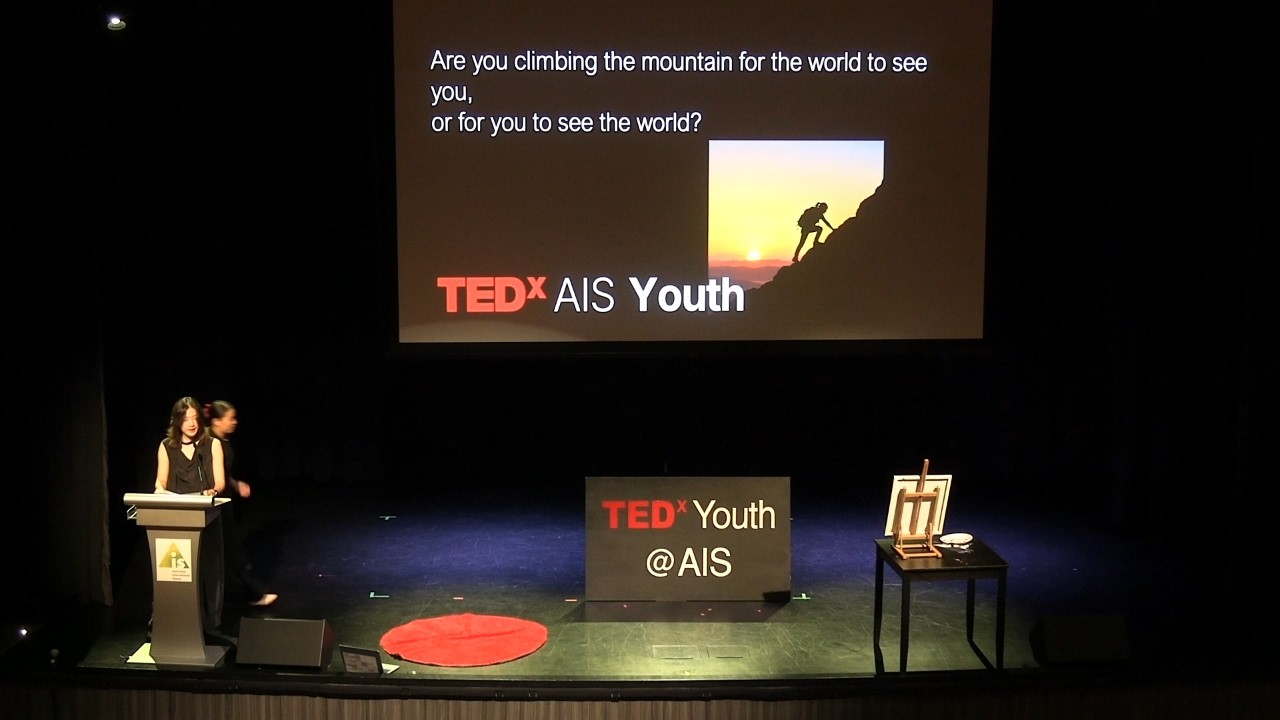
External or Internal Validation | Cian Yu (Belle) Chen | TEDxAIS Youth
Title history
- External or Internal Validation | Cian Yu (Belle) Chen | TEDxAIS Youth — observed on 20261106-0145 UTC (YouTube)
Keywords
Summary
192 words
Critical Evaluation
Value of the Information & Strength of the Argument
The talk’s value lies in its accessible and thought-provoking framing of a common psychological struggle: distinguishing between intrinsic motivation and the desire for external approval. Belle argues from personal anecdote rather than scientific evidence, making the argument emotionally resonant but not empirically grounded. She effectively uses rhetorical questions and vivid examples (social media, student leadership) to challenge the audience to introspect. The reasoning is coherent and logically structured, though it would benefit from references to psychological research on motivation and validation. The inclusion of Zoe’s talk extends the theme by addressing commitment and freedom, offering a complementary perspective on how making choices aligns with personal growth.
Scientific Rigor, Source Quality, Title Accuracy
The talk does not cite any external sources or academic literature; it relies solely on personal experience and anecdote. The only provided link is the general TEDx website, which does not serve as a scientific reference. The content is more of a personal essay than a rigorous scientific analysis. The title accurately captures the main focus on external versus internal validation, though it omits the second talk included in the video. Overall, the scientific rigor is low due to the absence of evidence and reliance on subjective narrative, but the talk is honest and self-aware rather than misleading.
219 words
Title / Content Match
The title accurately reflects the core theme of the talk—distinguishing between external and internal validation—though the video also includes a second talk by Zoe on commitment and freedom, which is not mentioned in the title.
Quality & Reliability
5/10
The talk is a personal reflection without empirical evidence or external citations, but it offers thoughtful and relatable insights on motivation and self-awareness.
Key Moments
Markers derived by PSI from the transcript: the creator did not define chapters.
- Belle asks the audience about social media usage and checking likes.
- She reflects on becoming a student leader and the realization that she wanted to be seen as capable and responsible.
- Discussion on how social media creates curated images that may not reflect true identity.
- She introduces the key question: 'Would I still want this if nobody could see it?'
- Closing metaphor about climbing a mountain to be seen vs. to see the world.
- Zoe's talk begins with the blank canvas metaphor and the meaning of commitment.
Cited Sources
- TEDx Program — The event format and organizational context providing a platform for the talk.
Concurring Sources
- Self-determination theory — Supports the importance of intrinsic motivation over external rewards.
- Social comparison theory — Explains how individuals assess their worth through comparison with others, related to external validation.
Contribution & Novelties
The talk offers a fresh, youth-centered perspective on the perennial issue of external validation, making it relatable for students and young adults. It introduces a simple self-check question that can be applied to any ambition. The second part, by Zoe, adds nuance by reframing commitment as a liberating choice, not a restriction.
For further exploration:
- Self-determination theory — This psychological framework distinguishes intrinsic and extrinsic motivation, providing a scientific basis for Belle’s observations.
- Social comparison theory — Explains how we evaluate ourselves in relation to others, which underpins the need for external validation.
- Intrinsic and extrinsic motivation — A concise overview of motivational types, useful for understanding the talk’s central dichotomy.
- Impostor syndrome — Relevant to the feeling of achieving for recognition rather than genuine ability or desire.
128 words
Radar Profile
The scores show a moderate profile: information quantity and quality are around average, while technical depth is low, making it accessible, and overall reliability is moderate due to the lack of evidence-based content. The talk is more motivational than informational, excelling in qualitative reflection rather than rigorous analysis.